228 search results for “gravitational water” in the Student website
-
 Bob van de Water
water_b@lacdr.leidenuniv.nl | 071 5276223
-
Chasing gravitational waves: damping vibrations in underground Einstein Telescope
Leiden scientists and companies receive 1.37 million euros to develop technology for the Einstein Telescope. This underground telescope will measure gravitational waves and must therefore be extremely sensitive. To that end, the consortium conducts research on the damping of vibrations at temperatures…
-
BlackGEM telescopes begin hunt for gravitational-wave sources
Three Dutch-Belgian telescopes have started operating at the ESO La Silla Observatory in Chile. This so-called BlackGEM array will scan the southern sky to hunt for cosmic events that produce gravitational waves, such as mergers of neutron stars and black holes. Leiden astronomer Rudolf le Poole is…
-
 Laura Scherer
l.a.scherer@cml.leidenuniv.nl | 071 5272727
-
 Misato Okaneya
 -
A cocktail of chemicals in surface water is more toxic than each substance individually
Pesticides can form a toxic cocktail when they occur in combination in surface water. This is the finding of research that Leiden University and the Dutch National Institute for Public Health and the Environment (RIVM) presented on Monday 14 October. The Dutch Ministry of Infrastructure and Water Management…
-
Gaia data maps globular cluster, gravitational lensing and asteroids with great precision
The European Space Agency (ESA) has published an interim data release from Gaia, the space telescope mapping out the Milky Way in 3D. The first scientific papers published today reveal half a million stars in the Omega Centauri globular cluster, nearly 400 candidate gravitational lensers and the positions…
-
 Simon Portegies Zwart
spz@strw.leidenuniv.nl | 071 5278429
-
 Carola Hein
Faculty of Social and Behavioural Sciences
c.m.hein@fsw.leidenuniv.nl | 071 5272727
-
News but nothing new: many pesticides in Dutch swimming and natural waters
There has been a lot of media attention for the report recently completed by the Institute of Environmental Sciences (CML) from Leiden University. However, it has long been known that Dutch surface water contains too many toxic pesticides. ‘We will have to improve our ways of life together with many…
-
 Merlijn van Weerd
vanweerd@cml.leidenuniv.nl | 071 5272727
-
 Ranran Wang
r.wang@cml.leidenuniv.nl | 071 5272727
-
 Jinhui Zhou
 -
 Ksenia Shepetina
 -
What was there first? Water or planets?
Could water be present in planet-forming disks before the formation of rocky planets? The James Webb Space Telescope may have found evidence for that. Webb has for the first time observed water in the inner disc around young star where at greater distance, giant planets have already formed. The research…
-
 Eman Elbadry
e.m.elbadry@cml.leidenuniv.nl | 071 5277486
-
2–6 March: Temporary shutdown of process cooling water
Facility, Organisation
-
 Roberto Arciero
Faculty of Archaeology
r.arciero.1@arch.leidenuniv.nl | 071 5272727
-
 Diana Suhardiman
Faculty of Social and Behavioural Sciences
suhardiman@kitlv.nl | 071 5272458
-
 Valerio Barbarossa
v.barbarossa@cml.leidenuniv.nl | 071 5275656
-
Is our water older than the sun? Astronomers find clue in ice around young star
A team led by Leiden University in the Netherlands and the National Radio Astronomy Observatory have, for the first time, robustly detected semi-heavy water ice around a young sunlike star. In this ice, some of the ordinary hydrogen atoms have been replaced by deuterium, a heavier variant of hydroge…
-
How Euclid will reveal the dark side of the Universe
ESA’s Euclid mission is to reveal the dark side of the Universe. But how? Professor of Observational cosmology Henk Hoekstra explains it in his interview with Space Team Europe and Horizon Magazine. He uses enlightening examples such as… a swimming pool! Listen to Henk Hoekstra to understand how Euclid…
-
 Marja Spierenburg
Faculty of Social and Behavioural Sciences
m.j.spierenburg@fsw.leidenuniv.nl | 071 5276699
-
 Marc Koper
m.koper@lic.leidenuniv.nl | 071 5274250
-
This is how astronomers found out how three stars were ejected from star cluster R136
Astronomers led by Simon Portegies Zwart used simulations to reconstruct how three stars were ejected from the star cluster R136, 60,000 years ago. The analysis reveals that five stars were involved in the event in the Tarantula Nebula.
-
Euclid space telescope reveals the heart of the Milky Way in unprecedented detail
Scientists from the consortium behind the Euclid space telescope, including researchers at Leiden University, have created the largest and most detailed visible-light image ever taken of the centre of the Milky Way. The image shows more than 60 million stars.
-
 Tessa Minter
Faculty of Social and Behavioural Sciences
mintert@fsw.leidenuniv.nl | 071 5273816
-
 Akinyinka Akinyoade
Afrika-Studiecentrum
a.akinyoade@asc.leidenuniv.nl | 071 5276701
-
 Genesis Daquinan
g.l.daquinan@cml.leidenuniv.nl | 071 5272727
-
Supermassive black holes: how do you study something that is invisible?
How are supermassive black holes born? That is the question astronomer Elena Maria Rossi is trying to answer. But how do you investigate something you cannot see?
-
Cosmic magnifying glass reveals exceptionally heavy dormant black hole in the early universe
Astronomers have measured the mass of a dormant, supermassive black hole in the early universe for the first time. Thanks to a combination of the James Webb Space Telescope and a natural cosmic magnifying glass, researchers were able to weigh the black hole directly based on its gravity.
- Well-being moment: Stand-Up Paddleboarding
-
 Mark Driessen
m.j.driessen@arch.leidenuniv.nl | 071 5271756
-
Fundraising Bake Initiative for Gaza
Study support
-
Japanese Brush Techniques (sumi-e)
Arts and leisure, Arts and leisure
-
Finding the origin of giant black holes
‘Space Antenna LISA will open an unprecedented window on the Universe,’ says astronomer Elena Maria Rossi. The mission will be the first one to detect Gravitational Waves from space. These can tell us more about the beginning of our Universe and the formation of black holes. With an NWO grant of twelve…
-
How cells determine the fate of proteins (and can we do it too?)
Cells in our bodies are often threatened by errors in our own proteins. The FLOW consortium, comprising scientists from various institutions including Leiden, is poised to meticulously map out for the first time how cells control proteins, correcting or removing faulty ones. This endeavour holds promise…
-
 Marco Visser
m.d.visser@cml.leidenuniv.nl | 071 5275608
-
 Mingran Cao
Faculty of Humanities
m.cao@hum.leidenuniv.nl | 071 5272727
-
 Thijs Bosker
t.bosker@cml.leidenuniv.nl | 071 5272727
-
 Zifan Meng
 -
Nursing mothers' rooms FSW Building
FSW building, Wassenaarseweg 52, 2333 AK, Leiden
-
The role of bubble formation in sustainable hydrogen production
The sustainable production of hydrogen could potentially be made more efficient by adding a cleverly chosen salt to the process. Researchers at the Leiden Institute of Chemistry (LIC), in collaboration with physicists at the University of Twente, have discovered that the type of salt present in the…
-
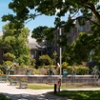 Hortus botanicus
Rapenburg 73, Leiden
-
Your costs as a student
As a student, you will need to take a number of costs into account. Find out here what you need to consider.
-
Special telescope measures neutrino with highest energy ever
Even with state-of-the-art technology, it is almost impossible to see: a cosmic neutrino. Yet scientists have managed to image this particle with a deep-sea telescope. And that could help to better understand our universe. Leiden particle physicists collaborated on this ambitious project, published…
-
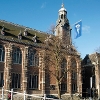 Academy Building
Rapenburg 73, Leiden
-
No general closure of university buildings due to code red weather warning; exceptions may apply
Due to the ongoing heat, a red weather warning (code red) has been issued for Friday in areas including the province of Zuid-Holland.
-
Euclid helps to better understand the universe – first results are exciting
For the first time, we’re seeing what Euclid sees. The telescope’s initial observations have provided a wealth of new information about our universe. But according to cosmologist Alessandra Silvestri, this is just the beginning. The research helps us gain a deeper understanding of the past, present,…
-
A+ for Leiden astronomy student who simulated chaotic interactions of black holes
Leiden astronomy Master's student Arend Moerman has received an A+ for his thesis research on the simulation of chaotic interactions of three black holes. The simulations, which he carried out together with his Leiden and Oxford colleagues, show that lighter black holes tend to slingshot each other…