Organisation
Recognising and acting on inappropriate and unacceptable behaviour
Inappropriate and unacceptable behaviour at work occurs more often than we realise. The university’s recent Employee Experience Survey shows that many employees are affected by it often in subtle ways and without it being immediately apparent. The university is working to tackle this issue but talking about what we see or experience ourselves is a first step. Whether it concerns yourself or a colleague: staying silent is rarely the solution.
Brushed off as a joke
It’s sometimes hard to recognise when a person does not feel secure. There are often small, subtle things that can make a person start to doubt themselves. Examples include bullying that’s brushed off as a joke, or repeatedly ignoring a person’s contributions. Perhaps it involves undermining their work, dismissing their ideas, or deliberately excluding them from discussions. Their feelings of insecurity can be difficult to recognise and were often not intended, yet they can have significant and lasting effects.
Our own role
What many people don’t realise is that we sometimes contribute to this dynamic ourselves, for example by not speaking up when experiencing behaviour that makes you feel uncomfortable or seeing a colleague in such a situation. This denies the person conducting such behaviour the chance to reflect on their actions. As a result, the pattern continues.
Help is available
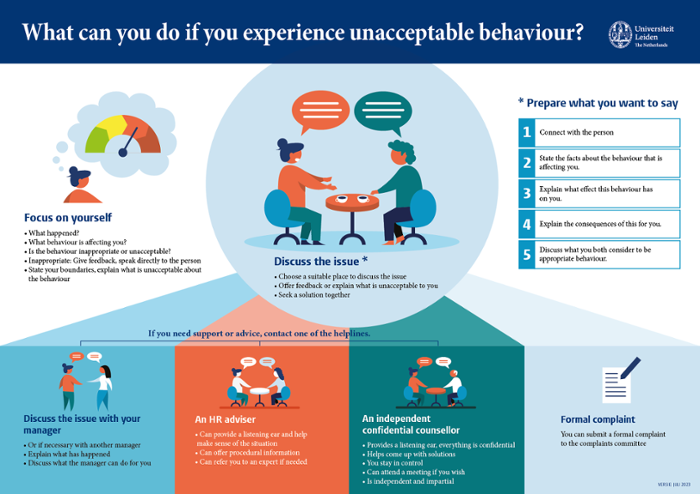
Fortunately, you don’t have to tackle this alone. The university and faculty offer various ways to help you deal with inappropriate and unacceptable behaviour. We have a well-established infrastructure with contact persons and procedures. But sometimes these are difficult to find quickly. A good place to start is the university webpage on Social safety. It provides information about what steps you can take, the available ‘helplines’ and how you can have an impact on your own situation and that of others.
Tools
There are also courses and training sessions available that give staff practical tools for discussing inappropriate and unacceptable behaviour or for holding difficult conversations. Examples include The active bystander (for all staff) or A good conversation (for managers). We are all responsible for nurturing a culture of mutual respect. By staying alert, speaking up, and taking action when needed, we can work together to create a community where everyone feels heard, respected, and safe.