
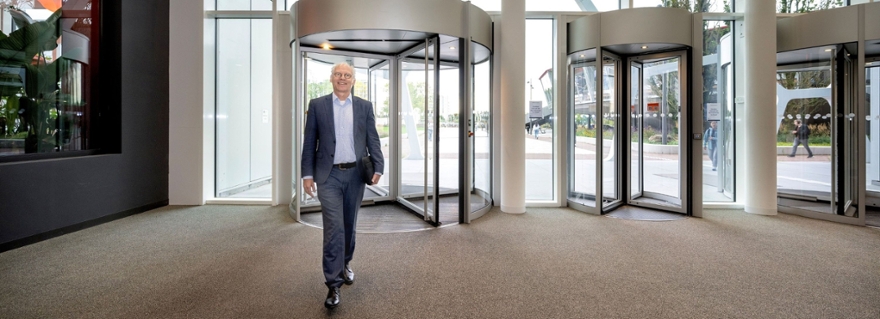
Jasper’s Day – On a knowledge mission in South America
Friday, March 13 – This time, Jasper is in South America, where Friday the thirteenth brings no bad luck, but opportunities. Together with a group of colleagues from our faculty, he meets Brazilian colleagues and discusses the possibility of working together. You can read all about it in this column.
Jasper Knoester is the dean of the Faculty of Science. How is he doing, what exactly does he do and what does his day look like? In each newsletter, Jasper gives an insight into his life.
‘Friday the thirteenth, a warm day in São Paulo. We are on a knowledge mission with a faculty delegation to initiate new collaborations and expand existing ones. The first three days of the week were spent in Chile, with successful visits to the Universidad Diego Portales, the Universidad de Chile, and the Pontificia Universidad Católica de Chile.

Four institutes, the Hortus, and the Graduate School
We have been in Brazil since Wednesday evening. Four of our eight institutes, the Hortus, and the Graduate School are represented on this trip. In my experience, broad representation increases the impact of knowledge missions, and this week confirms that once again. It’s always a matter of teamwork, even for trips like this, in which staff from various institutes, internationalisation experts, and the board work together to achieve a good result. Useful and connecting at the same time!
After breakfast, we depart for the headquarters of FAPESP, the organisation of the State of São Paulo that funds research. Not only within the state itself, but also beyond. FAPESP receives—as stipulated by law—1% of all taxes levied on goods in the state. This ensures a strong financial position.
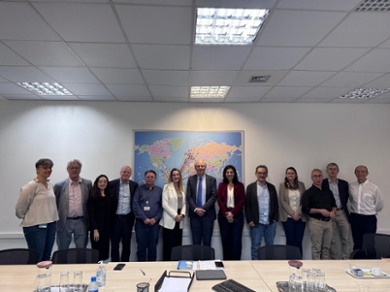
We are received by the President of FAPESP, Marco Zago, as well as by the Head of Institutional Relations, the Administrative Director, and several advisors and staff members. Six of us are present on our side. We start with a presentation by FAPESP, which also explains the projects in which Leiden is a partner. Incidentally, as a faculty, we have not often been a co-beneficiary in recent years, so there is plenty of room to fill a gap.
The latter is certainly evident during my own presentation, in which I briefly discuss the university as a whole and then delve into our faculty: our rich history, strong disciplines and institutes, our facilities, and our working methods. The audience listens attentively and responds enthusiastically, particularly when I explain the faculty profiling themes.
Collaboration in the fields of computer science and AI
Most of these appear to align well with the themes that FAPESP has high on its agenda for the coming years. This offers an excellent opportunity to make our point that we would like to establish a collaboration with the Universidad de São Paulo (USP), based on co-supervision of PhD students (culminating in a degree from both institutions), co-funded by FAPESP. A seed for this lies in the existing collaboration in the field of computer science/artificial intelligence, which could potentially be expanded to include our other themes. President Zago shows himself open to a proposal, a wonderful result of this visit. We make arrangements regarding contact persons to discuss this further. In October, our university is hosting the Dutch FAPESP week (co-organised by NWO); the timing could not have been better!
'This will only succeed if scientists are interested in working together.'
The next stop is the USP main campus, where our delegation first has lunch in the excellent canteen. Subsequently, we have a meeting at the university’s “international office” with representatives from university management and academic staff from various disciplines. After presentations from both sides, we discuss the possibilities for further collaboration, particularly the chance to launch a joint degree PhD programme, partly with support from FAPESP. There is great interest, although everyone also realises that this will only succeed if scientists are interested in working together. At any rate, a foundation for this already exists within computer science and AI. And we expect that this can certainly be expanded. We part ways with clear agreements. Following up on these will require effort, but it is more than worth the effort.
Latin American portion sizes
In the evening, we go out to dinner with the remaining six delegation members. The goal is Japanese-Brazilian fusion cuisine, but the wait turns out to be too long, and we eventually end up at a street restaurant with lots of music, meat, fried fish, and fries. As always in Latin America, the portions here are too large, but little needs to be returned to the kitchen nonetheless. We discuss the day, look back on the entire week, and look ahead to what we soon have to do to turn everything into opportunities for the staff at the institutes. Tomorrow, some of us will travel back or continue on to other destinations. Back at the hotel, I was quickly drawn to conclusion: Friday the thirteenth was a beautiful final day, much more of a lucky day than the name suggests.’