
Mariana Françozo launches collaborative research with Tupinambá and Mapuche people with NWO Vici grant
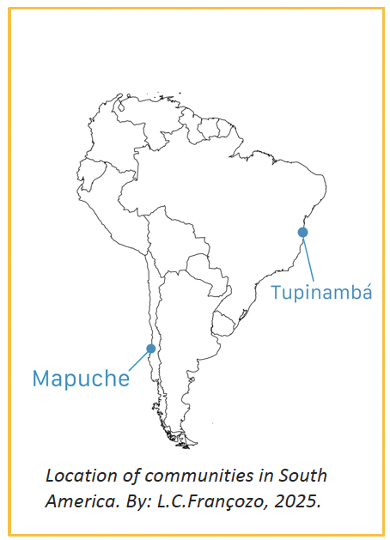
Dr Mariana Françozo has been awarded a prestigious NWO Vici grant for a five year research project that brings together Indigenous communities, museum collections and interdisciplinary scholarship. Her project focuses on the histories and contemporary challenges of two Indigenous peoples in South America: the Tupinambá in Brazil and the Mapuche in Chile.
Shock
Receiving the news came as a shock. ‘When I received the email from NWO, I thought: here comes the rejection,’ says Françozo. ‘It took longer than I had expected to hear the final result, so I assumed they had already contacted the awarded candidates. But then it turned out that the acceptance email was for me. It was a very nice surprise. I felt happy and honored. These calls are extremely competitive, and we see the number and quality of proposals only increasing each round.’
A project long in the making
After finishing her previous ERC BRASILIAE project in June 2023, Françozo allowed herself a few years of normal academic life, but the next idea was already forming. ‘You are always thinking about the next project,’ she explains. ‘About things you couldn’t do before, or would do differently. Writing a proposal that gets funded is a long process. It starts with curiosity, and that is something we all share as humans.’
The new project examines the intertwined yet distinct histories of the Tupinambá and the Mapuche. Françozo has worked with Brazilian Indigenous communities for more than 15 years, and more intensively with the Tupinambá for the past three to four years. Her interest in the Mapuche, however, emerged from a different direction.

Resisting colonisation
‘While researching Brazilian peoples, I kept encountering the Mapuche in records of Dutch expeditions to Chile,’ she says. ‘The Dutch went there looking for gold and silver near Valdivia. But the Mapuche sent them away. The Dutch left and never played a major role in Chile again. I have been fascinated for a long time by how this Indigenous society was able to resist colonisation, albeit temporarily.’
In contrast, the Tupinambá suffered the consequences of colonisation in very different ways. Yet both peoples faced significant state-led land appropriation in the nineteenth century, and both continue to struggle for recognition of their lands and identities today. ‘My colleague Dr Lucas Maciel made it possible to involve the Mapuche in this project,’ Françozo adds. ‘He was worked with the Mapuche for more than 10 years, and he is one of my main partners within the project.’
Collaboration
The project brings together community members, museum professionals, historians, material culture specialists, anthropologists and others. A key component involves working with museum collections that contain objects originating from both communities.
Françozo stresses that this collaboration will not always be straightforward. ‘For some objects, we may not receive authorisation to work on, not even with non-invasive methods. That is entirely possible,’ she notes. ‘The goal is not to force research, but to create questions together. What happens if we put Indigenous experts, historians and museum curators in the same room? What questions does each of us have from our own perspective? And what can we build from that?’
This challenge also speaks to deeper issues of interdisciplinarity. ‘During my ERC project, I often saw botanists, historians and anthropologists puzzling over each other’s questions,’ she says. ‘Interdisciplinarity is often imagined as something harmonious. But it can also be awkward or produce results that are not compatible. How do I, with my very Western academic mindset, accept an explanation rooted in a worldview I do not share? How do I live with that scientifically?’
Ambitions and outcomes
Françozo hopes that the project will result in collaboratively created narratives about specific objects, events or historical situations—stories shaped jointly by researchers and Indigenous partners. ‘We don’t need to retell the entire history,’ she says. ‘If we can produce even a handful of examples narrated from different perspectives—lines of interlegibility—that would already be a success.’
For the Mapuche and Tupinambá communities, access to museum-held materials is a crucial part of the collaboration. Françozo hopes that the project will strengthen their long-term access to these collections, on terms they consider appropriate.
Assembling a team
The project will employ two PhD candidates and one junior researcher, recruited from the Indigenous communities themselves. Collaboration with universities in Brazil and Chile is built into the structure to ensure ongoing ties between researchers and their home communities.
Valuable achievement
Françozo is clear about the project’s broader impact: ‘I also want to write about what researchers without experience in Indigenous worldviews can learn from this kind of collaboration,’ she says. ‘If we can understand each other even a little better, across disciplines, across knowledge systems, that is already a valuable achievement.’