
Working together for ‘broad prosperity’ in the Leiden region
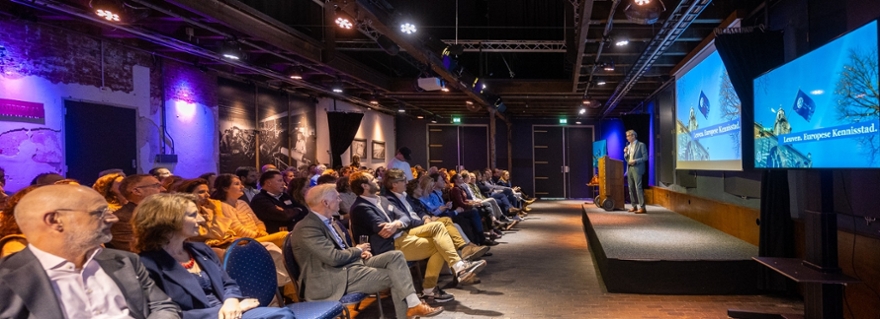
How can universities and research institutions, businesses and government bodies in the Leiden region drive ‘broad prosperity’? During the ‘Working on Broad Prosperity in Key Region Leiden’ symposium, about a hundred stakeholders explored how best practices from Eindhoven and Leuven could help enhance prosperity and well-being in the region.
At the symposium, Robert Strijk (an alderman in Eindhoven) and Luc Sels (President of the Executive Board of Leiden University) drew comparisons with other cities where cooperation between education, entrepreneurship and government has proven effective. Strijk, who served as an alderman in Leiden for eight years, highlighted how ASML has been a driving forces in the Eindhoven region. ‘That flagship committed 90 million euros annually to joint projects’, said Strijk. This investment benefits home building, and language and music education. The company also funds a free music festival.
And this goes both ways: Strijk can see that the local population feels connected to the business community. People from Eindhoven and the surrounding area proudly wear Brainport Eindhoven shirts, particularly when the Eindhoven team PSV became national champion. ‘If I were to return to Leiden, I’d do everything in my power to involve the business community with the city and region in the same way.’
Compared with Eindhoven, Strijk noted the absence of civil society organisations at the symposium. In and around Eindhoven, 21 municipalities (with around 800,000 residents) are working hard to ensure prosperity and well-being are shared. ‘Everyone should be able to participate. That’s why the social agenda must remain a permanent aspect of broad prosperity.’
Leuven
Just one train station down the line from Eindhoven is Leuven, where Luc Sels was based before becoming President of the Executive Board in November. The two university cities are similar in size. ‘Leuven is small enough for direct lines of communication yet large enough to provide critical mass’, said Sels. In an open letter to alderman Wietske Veltman on behalf of the universities and research organisations in the Leiden region, he called for long-term commitment to the topic in the run-up to the municipal elections.
Sels also praised his Belgian weekend home for its relationship with the city council, its links with Europe (Leuven is the European Capital of Culture in 2030) and its ability to attract local and international students. Leuven is also a testing ground for sustainability and biodiversity projects. KU Leuven is also successful in terms of social engagement, with one in seven students doing voluntary work in exchange for credits. ‘Encourage university staff to do voluntary work’, said Sels enthusiastically. ‘The university shouldn’t become a foreign body.’
Partnerships with businesses and government can also deliver social benefits, he said. For instance, KU Leuven provides 6,000 affordable student rooms, made possible in part by favourable municipal licensing conditions, as the buildings were constructed without costly underground parking facilities. According to Sels, this helps keep rents across the city more affordable for students.
Inspired by these best practices from Leuven and Eindhoven, the participants then worked in groups to identify ways to promote greater prosperity and well-being for everyone in Leiden. Collaboration is key. If government, education and the business community in the Leiden region work closely with civil society organisations, all residents stand to benefit.
Key Region Leiden
The Broad Prosperity symposium is a joint initiative of Key Region Leiden, Leiden City of Knowledge and Platform Sociaal Domein.
In Key Region Leiden municipalities, businesses and universities and research organisations work together to tackle societal challenges. With eight of the national government’s ten key technologies, the Leiden, Katwijk, Noordwijk region has the highest knowledge density in the Netherlands.
Together, the knowledge partners Leiden University, University of Applied Sciences Leiden, Naturalis Biodiversity Center, mboRijnland and the municipality form Leiden City of Knowledge. Drawing on their knowledge and expertise, educational institutions contribute to projects in health and well-being, biodiversity and sustainability, and cultural heritage.
Platform Sociaal Domein helps municipalities, the national government and their partners improve social policy and create a safe, healthy society for all residents.