AI agents, missing persons and human smuggling: students advise professionals
How can we become less dependent on the United States in multiple areas? These were the kinds of pressing security questions tackled by third-year Security Studies students. In the lecture hall, they presented their recommendations to professionals from the field, who had come to attend the presentations.
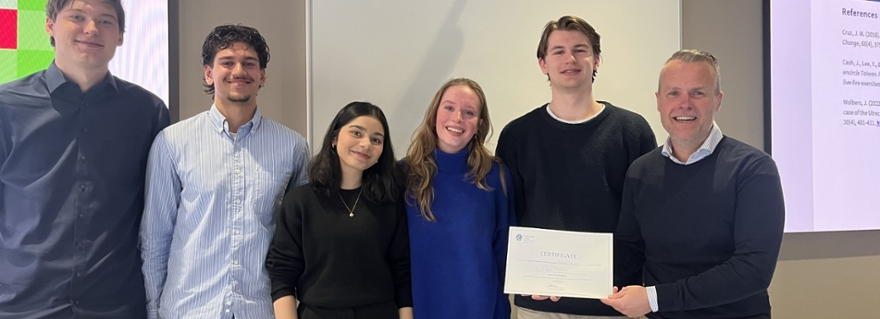
Photo above: the winning group at Wolters Kluwer
How does security work in practice? That question was at the heart of Integrated Project 2, a course in which third-year students spend seven weeks working on a current case set by an external partner. In groups of three to five, they explore a security issue, discuss it with organisations from the professional field, and incorporate interim feedback into their recommendations. In this way, they not only master the subject matter, but also learn what it takes to deliver professional, practical advice.
Microsoft, NCTV, Schiphol, TNO, Deloitte, the Municipality of The Hague
This year, the course involved organisations from both the public and private sectors, including Microsoft, the National Coordinator for Security and Counterterrorism (NCTV), Schiphol, TNO, Deloitte, the Municipality of The Hague and the Netherlands Institute for Public Safety (NIPV). Many students also visited their partner organisation. ‘That way, they see at first hand how broad security is in practice,’ says course coordinator and lecturer Valerie de Koeijer. ‘It can involve technological risks, but also social stability, migration or local security.’

International Commission on Missing Persons
Student Gabriëlla Rabeling: ‘My group and I worked for the ICMP (International Commission on Missing Persons), for which we produced recommendations on the marginalisation of women with missing family members in Latin America. It was an enjoyable course because we were working on an assignment for a real organisation and an existing problem in the security domain.
Through this collaboration with my team and for the ICMP, I learned how valuable it is to approach a complex problem from different angles, such as law, politics and the role of religion, and to bring these perspectives together in recommendations that can hopefully be put to real use. I also realised that you cannot solve all the world’s problems, but that it is already of great value to contribute to addressing part of them.’
What risks does AI entail?
That breadth was also reflected in the topics. Some groups worked on issues relating to hybrid threats or the safety of and around people experiencing homelessness. Others explored people smuggling, international cooperation or the risks of artificial intelligence (AI). The assignments are always developed in consultation with the partners, so that students work on questions that organisations are genuinely dealing with at that moment.
At Microsoft, for example, one of the cases focused on AI and security. What risks does AI entail? Do you want to keep a human in the loop? And is it actually feasible in practice to have everything still checked by people? Valerie says: ‘AI can be very productive, but you also need to think carefully about the security side of it.’ One of the ideas students considered was deploying an external AI agent to monitor another system.
International cooperation
Other groups focused instead on international cooperation on migration. There were, for example, cases on Bosnia and Herzegovina, Ethiopia and Kenya, in which students examined how local leaders, national governments and international organisations could work together more effectively. What does that require from actors in Europe, and how well does policy align with realities elsewhere? Through these varied assignments, students constantly move between the local, national and international levels.
That is precisely what makes the course instructive, but also challenging. Students quickly discover that a good idea alone is not enough. Equally important is the question of what an organisation can actually do. Where does responsibility lie, and where do its powers end? That requires not only subject knowledge, but also a feel for governance and clear language.
Final presentations
The students’ strong progress became clear during the final presentations. In the lecture hall, they presented their recommendations to professionals from the participating organisations, who listened critically and asked questions. Valerie was impressed by what she saw. ‘I was genuinely impressed by the quality of the presentations and really felt that they knew what they were talking about. They had truly gone into depth.’
Wolters Kluwer
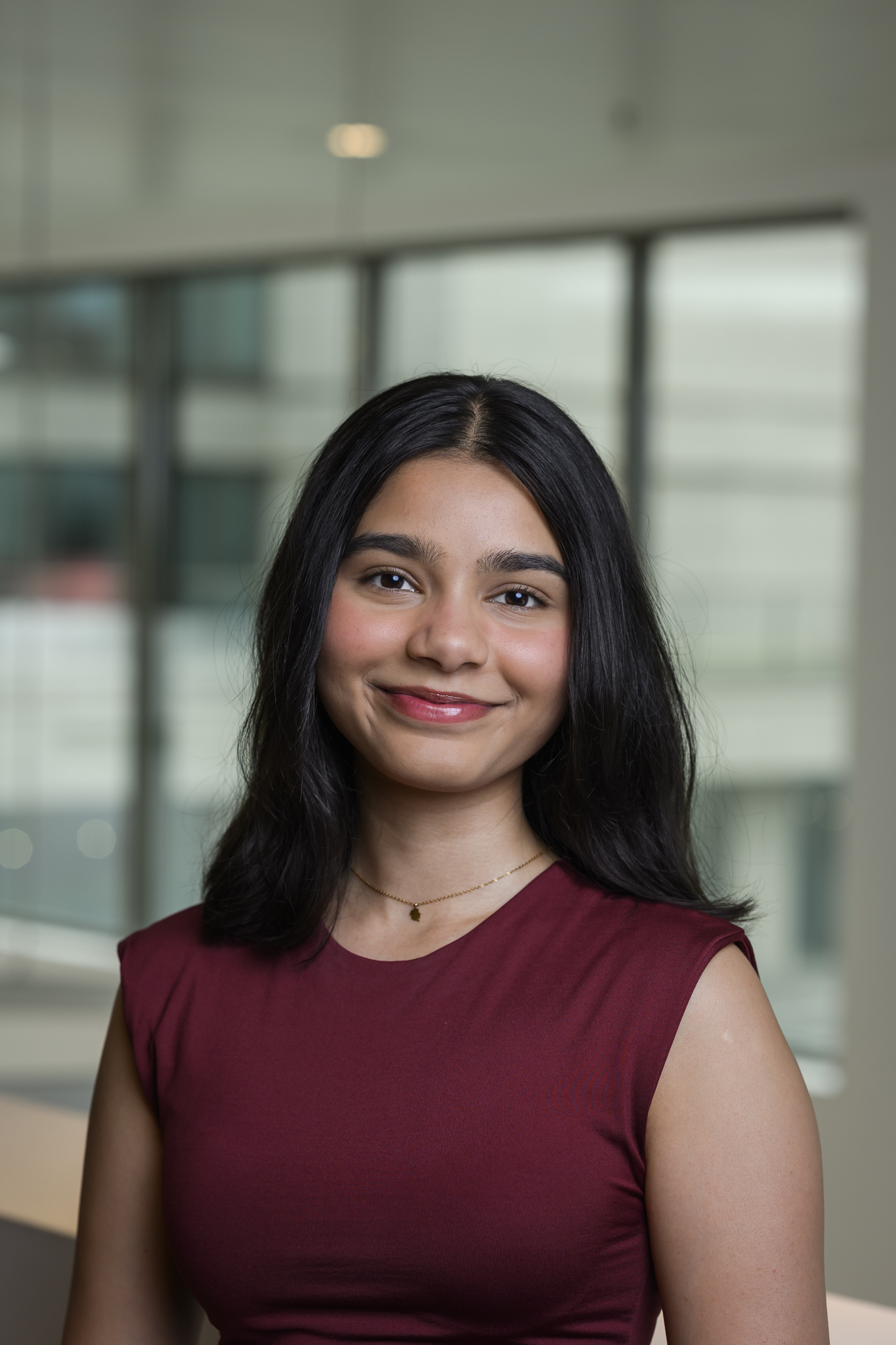
'During IP2, as an academic consultant, I advised Wolters Kluwer, an international IT services company. The experience showed me how organisations must balance business objectives, ethical standards, and security concerns, giving me practical insight into complex private-sector decision-making. It also allowed me to apply what I had learned throughout my bachelor to a real-world issue, highlighting the impact of security concerns in the private domain.'