
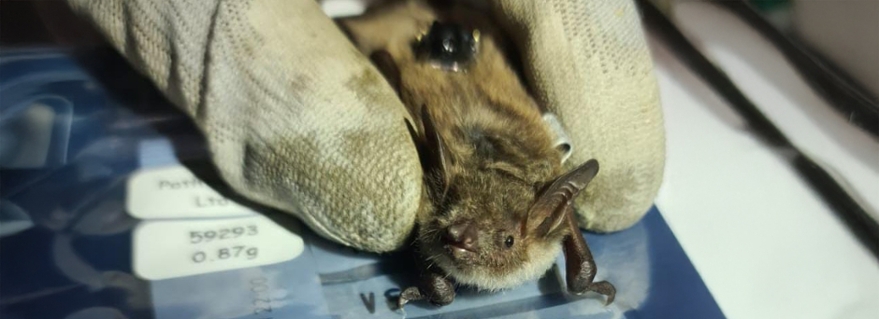
Bats on a break: tracking the secret life of pond bats
What do bats do at night when they’re not hunting? Using tiny GPS trackers, Leiden researchers discovered that pond bats spend a substantial portion of the night resting – often outdoors. This surprising insight could change the way we protect them.
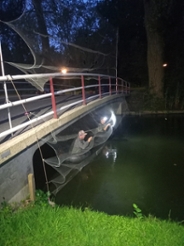
Over a narrow waterway beneath a bridge, a fine mist net hangs in the dark. Volunteers wait quietly through the night. Then, suddenly, a soft flutter. Now, the volunteers have to act quickly.
This is how the fieldwork of a new pilot project on pond bats (Myotis dasycneme) started. Environmental scientist Yali Si calls it a real ‘passion project’, carried out in Leiden and Rotterdam, in collaboration with master students, NGOs, and other conservation partners (see below).
For the first time, researchers fitted pond bats with GPS loggers combined with motion sensors, offering an unprecedented glimpse into their nocturnal lives.
Vulnerable species
According to the IUCN Red List of threatened species in 2023, Pond bats are considered vulnerable across Europe. Their populations are declining due to habitat loss, decreasing insect (prey) numbers, and modern building insulation reducing roosting spaces.
Not only seeing where they are, but also what they’re doing
The devices are tiny, just 1.2 grams, but powerful. ‘We don’t just see where they are, but also what they’re doing’, Si explains. ‘With accelerometer data, we can tell whether a bat is active or resting.’
That combination is key. Previous studies mostly mapped locations, but this new approach links behaviour to specific habitats. ‘We call this functional habitat use: different parts of the landscape serve different purposes, like foraging or resting.’ Till now, that part has been largely overlooked.
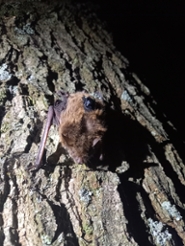
Pond bats rest outdoors at night
For a long time, where pond bats rest during the night remained largely unknown—especially outdoors. Tracking data now show that they spend about a third of their time resting between feeding bouts. During these breaks, they mainly hang in trees along forest edges or in isolated trees near water, and only occasionally in buildings.
This makes sense: pond bats forage over water, catching insects. Si explains: ‘They need places to hunt, but also places to rest in between. Ideally, these are close together.’
A landscape that supports bats
‘These new insights show why it’s important to look beyond day roosts and foraging areas,’ Si explains. ‘You need to think about the whole landscape.’ Beyond Leiden and Rotterdam, the methods from this study can guide future research in other regions, or for other bat species, helping scientists understand how different habitats within the landscape support these key behaviours.
Around Leiden and Rotterdam, pond bats rely on a mix of habitats: High-density, vegetation-rich edges along lakes, ponds, rivers and waterways provide abundant insects for feeding. Straight waterways, like canals, serve as commuting ‘highways’ between their daytime roots and the feeding spots. For resting during the night, pond bats mainly depend on forest edges or isolated trees close to foraging waters, as they are fast flyers that are less manoeuvrable in dense forests.
Protecting this combination of habitats across the landscape is key to supporting both their feeding and resting needs – the foundation for effective conservation. Sometimes, even for bats, a quiet rest is all you need.
Student Thesis Award
A large part of the work was carried out by master’s student Gijs van der Velden who wrote his master’s thesis on the project. His work earned the Stans Award for the Best CML Students Thesis. Si praises Van der Velden’s commitment and quantitative skills, and the way he collaborated with the partners.
Partners & funding
Funded by the CML Biodiversity Programme and Zoogdierwerkgroep Zuid-Holland and Gemeente Rotterdam
Universiteit van Amsterdam, Vrije Universiteit Amsterdam, Batweter, Bionet Natuuronderzoek, van Horssen Ecologie, Ecoresult, Dunea,De Rooij Ecologie, Kocks Ecology, Maasarend, and many volunteers
Scientific paper
Van der Velden, G., Kranstauber, B., Haarsma, A.-J., Janssen, R., van Horssen, M., Halfwerk, W., van Meurs, A., Bom, C., Schrama, M., & Si, Y. (2026). To rest or to roam: Functional habitat use of an insectivorous bat species during active and resting behavior. Biological Conservation, 111823. https://doi.org/10.1016/j.biocon.2026.111823