
Grants for AI in healthcare, computing with light and climate-resilient cities
Researchers at the Faculty of Science work at the frontiers of knowledge every day, tackling today’s major societal challenges. Their work is recognised through grants, prizes and other awards. We highlight some of these achievements below.
Leiden contribution to major national AI4Health programme
How can artificial intelligence become part of the Dutch healthcare system? Gerard van Westen is one of the co-applicants of a large national programme aiming to achieve exactly that. Alongside the Dutch Research Council (NWO), a broad partnership of public and private organisations — including health charities, care providers, research institutes, government and industry — is investing in AI4Health.
This ten-year programme uses AI to speed up innovation in healthcare, tailor care more closely to individual patients, and reduce pressure on the system. Its aims include earlier detection of disease, personalised care and prevention, better decisions about treatment at home or in hospital, smarter deployment of healthcare staff, and the development of safe, reliable, sustainable and affordable AI.
New research on sustainability and climate transitions
Three Leiden researchers have received funding for projects within national calls focused on sustainability and climate transitions. The awarded projects show how interdisciplinary research can contribute to solutions for pressing societal challenges.
Energy-efficient scientific computing — ECO-COMPASS
By developing smarter algorithms, the team aims to reduce the energy use of large-scale simulations and data analysis, without sacrificing speed or accuracy. The ECO-COMPASS project has received funding from the Sustainable Research Practices Fund. Ben van Werkhoven is working with Tristan van Leeuwen and Alexander Skorikov (CWI/NWO) to make scientific computing more energy efficient.
Climate-resilient and healthy cities — Climate Adaptive Futures NL
In the KIN call ‘Transformative practices for climate transitions’, two projects involving Leiden researchers have been selected. One of them, Climate Adaptive Futures NL, is led by Maarten Schrama in collaboration with partners in Rotterdam. The project explores how Dutch cities can become more resilient to climate change while safeguarding public health. Using future scenarios and close cooperation between researchers and practitioners, the team aims to develop practical guidance and an open toolkit.
Repair at the heart of the economy — REPAIR
The second project, REPAIR, focuses on making everyday products easier to repair. By working with citizens and repair communities, the project seeks to improve our understanding of product design and contribute to longer product lifespans and less waste. Franco Donati is collaborating with partners from TU Delft and the Fair Resource Foundation.
New scientific directors at IBL and Leiden Observatory
Dennis Claessen has been appointed Scientific Director of the Institute of Biology Leiden, starting on 1 September. He succeeds Hubertus Irth, who has held the role since September 2024. The appointment is for four years.
Henk Hoekstra will become Scientific Director of Leiden Observatory on 1 January 2027. He succeeds Ignas Snellen, who has held the role since 16 August 2022. Hoekstra has also been appointed for a four-year term.
Violeta Gamez Rosas wins Chesneau Prize 2025
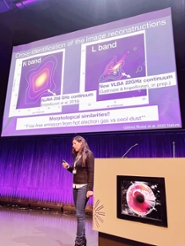
Violeta Gamez Rosas, who completed her PhD at Leiden Observatory, has won the Chesneau Prize 2025 for the best doctoral thesis in high-angular-resolution astrophysics. She received the award for her observations and analyses of the active galactic core NGC 1068.
Using advanced instruments such as VLTI/MATISSE, VLTI/GRAVITY and ALMA, she provided new insights into the structure and physical processes of this complex cosmic environment. Her work is seen as a major step forward in the field.
Collaboration with Ukraine in electrochemistry
Marc Koper is collaborating on an ongoing NWO project with Professor Yurij Kalyuzhnyi of the National Academy of Sciences of Ukraine. As Professor of Fundamental Surface Chemistry, Koper studies electrochemical processes that are important for technologies such as batteries, sensors and corrosion protection.
These processes involve interactions between charged particles and water, particularly at surfaces like electrodes. In this project, Koper and Kalyuzhnyi are developing a new theory that better accounts for how water behaves at the molecular level, including hydrogen bonding. This is expected to improve understanding and support the design of better materials and devices for energy storage and other applications.
Grégory Schneider appointed Professor of Chemical Nanotechnology
Grégory Schneider has been appointed Professor of Chemical Nanotechnology at the Leiden Institute of Chemistry (LIC) as of 1 May. His research focuses on the chemical aspects of nanotechnology, especially the link between molecular and larger-scale systems in devices.
His work includes sensors based on single molecules and selective membranes, bringing together chemistry, physics, nanotechnology and biology. Schneider’s group studies applications of graphene and other ultra-thin materials for detection and energy-related technologies.
Tadé Whenu wins Rachel Carson Graduation Prize 2026
Tadé Whenu has won the Rachel Carson Graduation Prize 2026 for his Master’s thesis in Industrial Ecology. He studied the Grondstoffenstation (GSS) in Rotterdam as a circular initiative that creates a range of values — ecological, social and financial.
Using action research and the Circular Value Flower model, he shows that some forms of value can be measured, while others are better conveyed through stories. He also highlights how bureaucratic barriers make collaboration with government bodies more difficult.
Whenu argues that GSS should be recognised as a public service, which would require more inclusive and long-term policies. The jury praised the clarity of his research design, his engagement with the local community, and the careful validation of his results. They also highlighted the originality and relevance of his work, which — in the spirit of Rachel Carson — draws attention to an urgent but often overlooked issue.
Computing with light and strengthening AI with quantum — funding for Dutch-Japanese research
What if computers could use light instead of electricity? Joost Batenburg and Qinyu Chen, together with Yuya Shoji of the Institute of Science Tokyo, have received funding for a project exploring this idea. The funding comes from the NWO and the Japan Science and Technology Agency (JST) call ‘Unconventional information processing technologies’.
Traditional computer chips, with billions of transistors, are approaching their limits in terms of speed and energy use. The OPERA project explores an alternative: computing with light. In this approach, light beams are guided in such a way that they carry out calculations as they travel — for example in image processing or pattern recognition. This uses far less energy than conventional chips. The project is now developing a first prototype, aimed at applications in medical imaging.
How can existing, small-scale quantum computers enhance AI? Vedran Dunjko (LIACS/LION), together with Jordi Tura, has also been awarded a grant of €1.1 million from this call for a quantum project. Quantum computers perform special data transformations (‘quantum features’) that help classical computers learn more effectively, for example in making predictions or discovering patterns. The project focuses on understanding, developing and testing these techniques, with the aim of identifying applications that are already practically viable.