Rethinking Good Education during Food for Thought Event – Generation of the Future
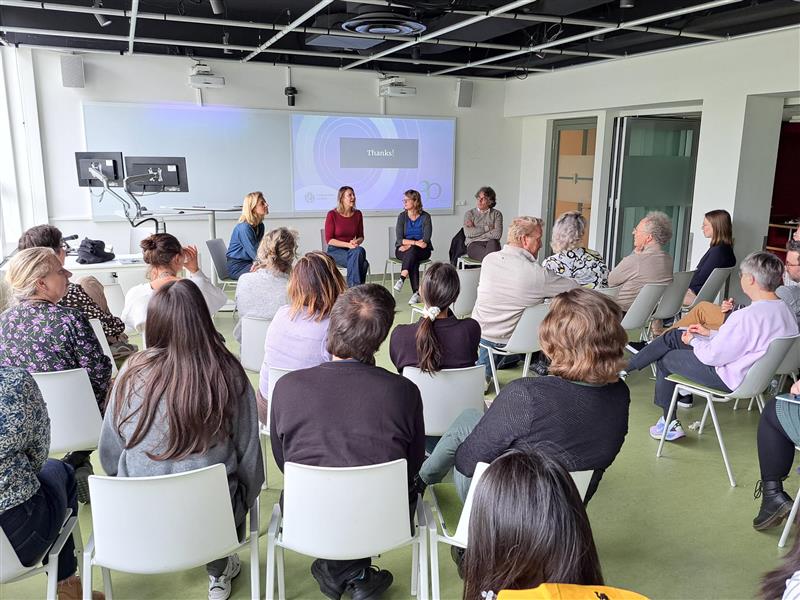
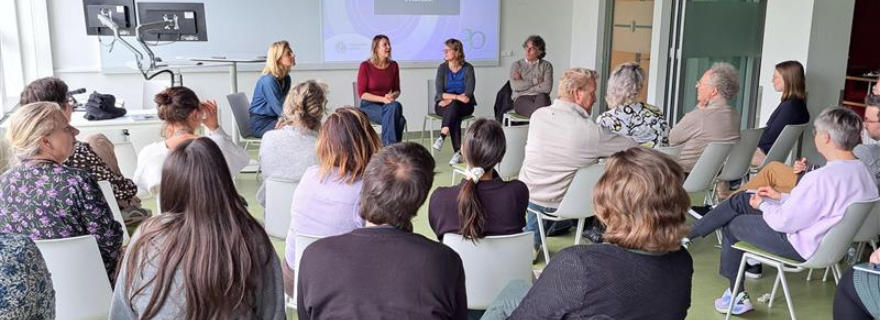
On 19 May, the Food for Thought lunch session on the university wide research theme "Generation of the Future" brought together perspectives from ICLON and across FSW on a central question: what constitutes good education? Moderated by Lenneke Alink, faculty chair for the research theme, the session featured three speakers who approached this question from educational, psychological, and pedagogical angles.
When high expectations miss the mark
Marian Hickendorff critically examined achievement targets in primary school mathematics education. She showed that, contrary to widespread concerns, students’ math performance has remained stable over the past two decades. While public and policy discourse often emphasizes decline, national and international assessments do not support this narrative. See: Reken het rekenonderwijs niet af op percentages leerlingen die 1S behalen.
The core issue lies in how the Dutch reference framework (referentieniveau) is used. The framework distinguishes between a basic level (1F) and a more advanced target level (1S). Although more than enough students reach 1F, the percentage reaching 1S falls short of policy ambitions. Hickendorff argued that this gap is misleading: 1S was never designed as a universal benchmark for all students, nor as a tool to evaluate individual schools. Moreover, the measurement of 1S lacks sufficient validity and reliability, partly due to differences between tests. Using such thresholds for accountability has led to distorted conclusions about educational quality. She concluded that the current practice is “undesirable and unfair” and called for renewed policy courage in redefining educational objectives.
Neurodiversity and academic equity
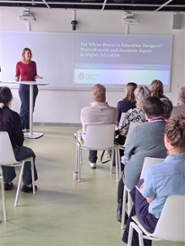
Bianca Boyer focused on inclusivity in higher education, particularly for students with ADHD. She highlighted the prevalence and impact of ADHD, linking it to lower grades, higher stress, and increased dropout rates. At the same time, she challenged the implicit assumptions underlying academic success. Traits such as sustained attention, time management, and independent regulation are often treated as neutral “academic skills,” while they reflect a narrow, neurotypical profile.
Current accommodations, such as extra exam time, do little to challenge this norm. Instead, they extend the same assessment structures without addressing underlying design issues. Boyer posed a fundamental question: are we measuring academic ability, or compatibility with a specific cognitive style? She argued for a shift towards “academic equity,” in which education systems are redesigned to better match diverse cognitive profiles. Ongoing research aims to develop evidence-based strategies that combine targeted support with more inclusive teaching practices.
A common core of good education
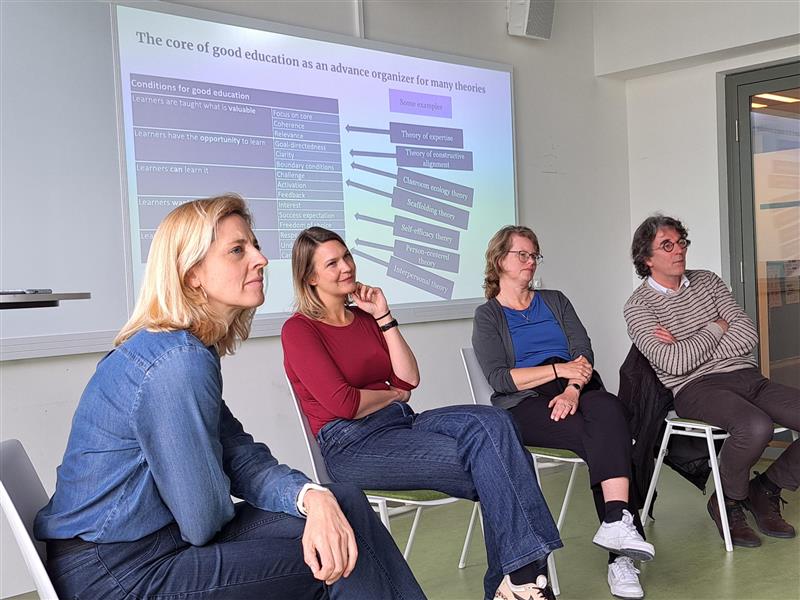
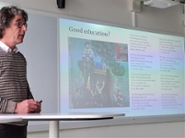
Fred Janssen explored whether a shared foundation underlies diverse views on good education. Drawing on a long tradition of liberal education, he presented a model centered on three elements—teacher, learner, and content—balanced around the overarching goal of emancipation. This involves enabling students to develop responsible self-determination and participation in society.
Janssen emphasized that good education requires attention to conditions such as students’ willingness and ability to engage with meaningful content in a supportive environment. His model functions as an integrative framework that can connect different educational theories, each of which typically emphasizes only one dimension of the educational process.