

Leiden Research Support Network: ‘It takes a team to build a research project’
How can we better align research support tasks across the project life cycle? That was the question explored by more than 100 research support professionals during the sixth Leiden Research Support Network Conference.
Anyone arriving late at a conference will usually try to slip in unnoticed, quickly find an empty seat at the back and quietly shrug off their coat while seated. For the colleague who entered the room during the opening plenary session of the Leiden Research Support Network Conference, things turned out rather differently. Moderator Jasmijn Mioch enthusiastically approached him with the microphone and asked whether he would like to introduce himself to the audience straight away. Fortunately, the latecomer saw the funny side – and was rewarded with a warm round of applause.

Same terms, different meaning
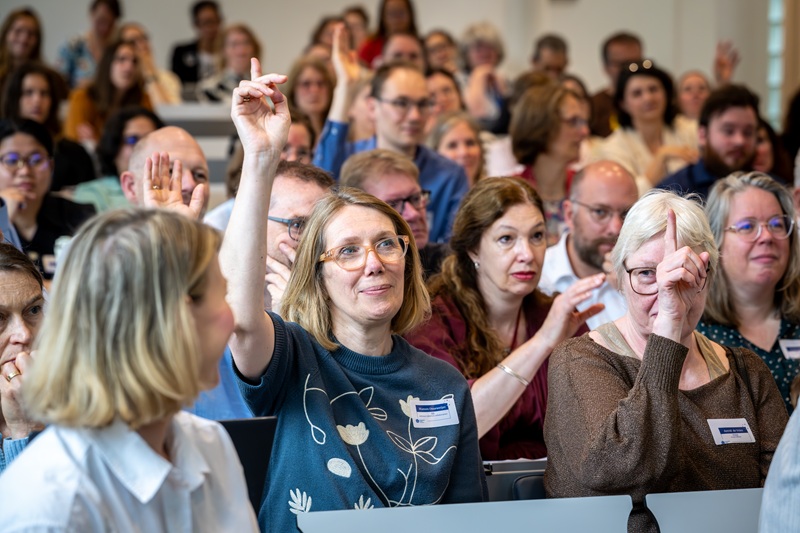
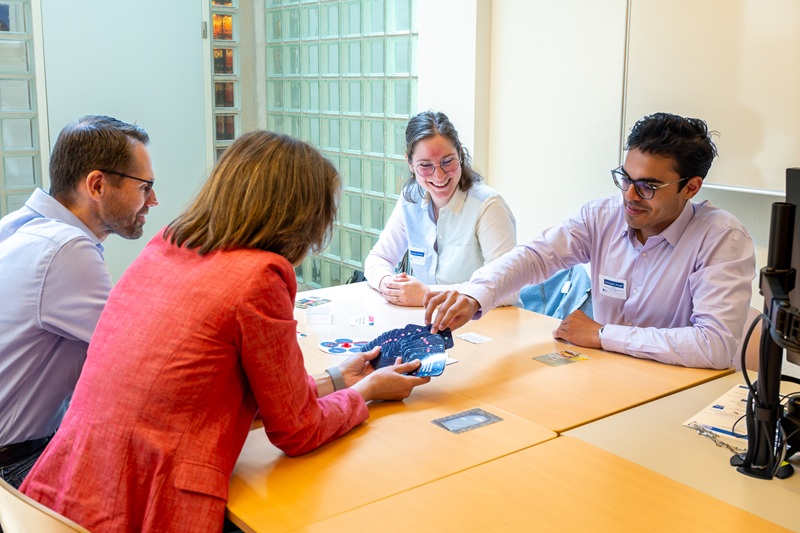
After all, one of the conference’s main aims is to bring people together, strengthen connections, help colleagues get to know one another better and further reinforce the network of Leiden research support professionals, which was established six years ago. The opening session therefore consisted largely of an extended ‘who’s in the room?’ round of introductions, followed by an interactive game in which those present had to guess terms related to the research project cycle.
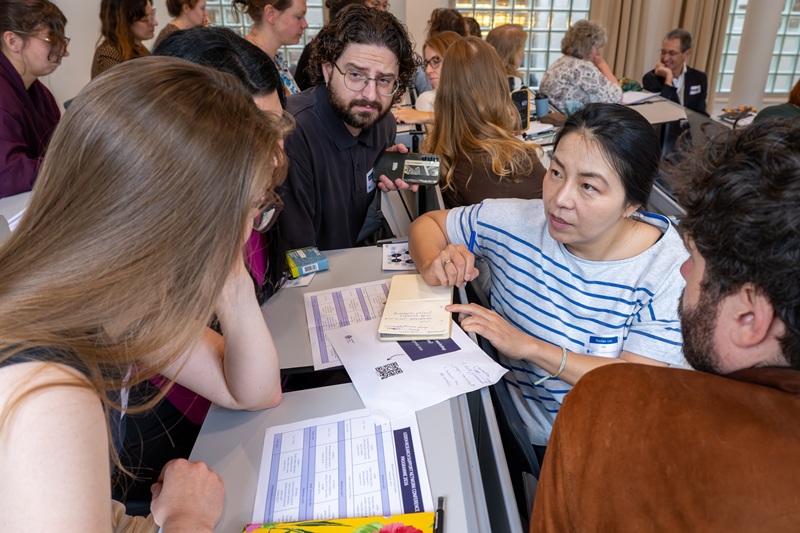
And that proved more difficult than it sounds. Most attendees were able to guess ‘pre-award’ from a simple clue (‘This is the phase in which everyone works their socks off and nothing is certain yet’). But for a term such as ‘valorisation’, Mioch had to provide a few extra hints after the initial description (‘This is why research is also important outside the research context’). ‘For some, it means impact, whereas for others it means money. And funders and researchers often describe it in different ways.’ Participants were then invited to come up with their own terms and clues in small groups. One group associated ‘data protection impact assessment’ with concepts such as questionnaires and compliance, whereas another described it using terms such as confidentiality and privacy officer.
This illustrated the message of the game: words can mean different things to different people. ‘When you work together, you may use the same terms, but they can mean something entirely different to someone else’, said Mioch. ‘That applies to researchers and funders, but also to you as research support professionals. The challenge is to understand one another.’
Look beyond your own role
LURIS director Anouschka Versleijen addressed the conference theme: aligning research support tasks throughout the research project cycle. It takes a team to build a research project, she said. ‘But we don’t often look beyond the boundaries of our own roles, leaving a lot of places in this cycle where stagnation can occur. By making insightful what all tasks are, defining what roles need to be fulfilled, and who is responsible for each aspect, we can create a smoother flow.’
-
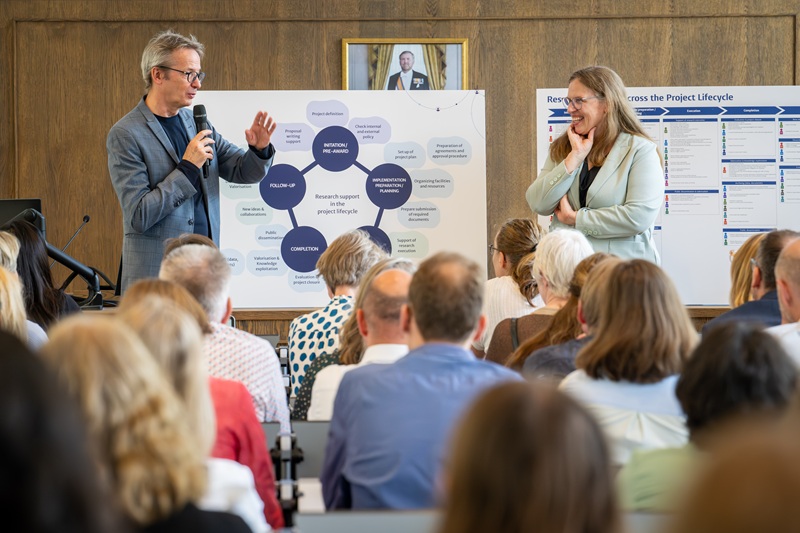
Luc Sels, President of the Executive Board, and LURIS director Anouschka Versleijen -
-
-
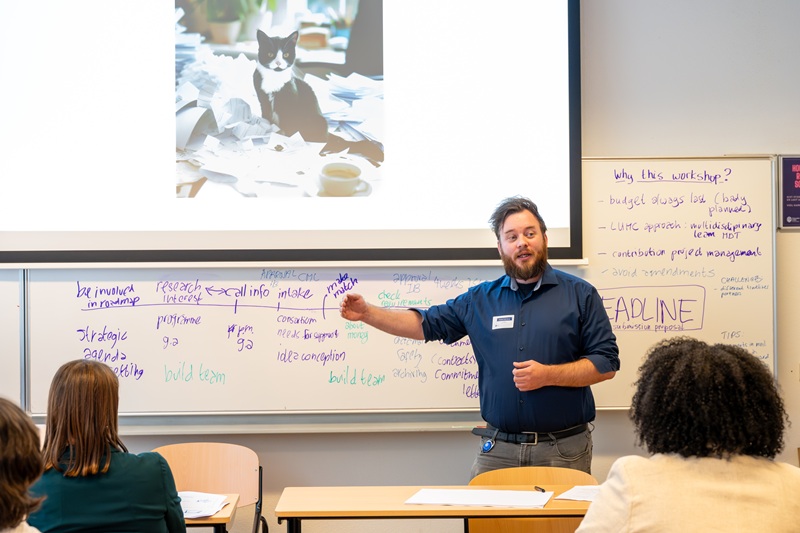
After the plenary opening, the research support professionals took part in workshops -
Fading distinction
The closing remarks were delivered by Luc Sels, President of the Executive Board. As a relatively new colleague, he said he was impressed by the way research support is organised at Leiden University. He mentioned milestones such as the six university-wide communities that collaborate across the boundaries of faculties and institutes, the development of an extensive research funding knowledge base and the creation of a central pool of research project managers who can support researchers in a complex collaborative project. ‘The university-wide approach that we take strongly resonates with our ambition as an organisation to become even better at working together. It’s about connecting people in a network, but also about bringing together resources and expertise.’
According to Sels, the role of research support professional has moved increasingly closer to the heart of research projects in recent years. ‘In discussions, you sometimes forget who is the researcher and who is the support professional.’ It is hardly surprising that the once rigid and hierarchical distinction between these roles is beginning to fade. At a time when both the world of academic research and the research project cycle are only becoming increasingly complex, the expertise of both groups is essential to the success of a research project. Sels therefore encouraged those present to continue to building connections with one another. ‘Your network is a key element in our university’s success today, and what you do will become even more important in the future.’
‘The importance of collaboration’: watch the aftermovie of the Leiden Research Support Network Conference 2026
Due to the selected cookie settings, we cannot show this video here.
Watch the video on the original website orAbout the Leiden Research Support Network
The Leiden Research Support Network is the essential network for research support professionals within Leiden University. This network allows research support professionals from different domains to enhance their synergy in communities: exchanging expertise and experiences, and working as a team to answer researchers’ sometimes complex questions. The network’s strength lies in teamwork that transcends the boundaries of faculties and institutes.
Text: Evelien Flink
Photos: Monique Shaw
Video: Iris Grondstra & Rob Dorresteijn