
‘Practice and academia need each other desperately’
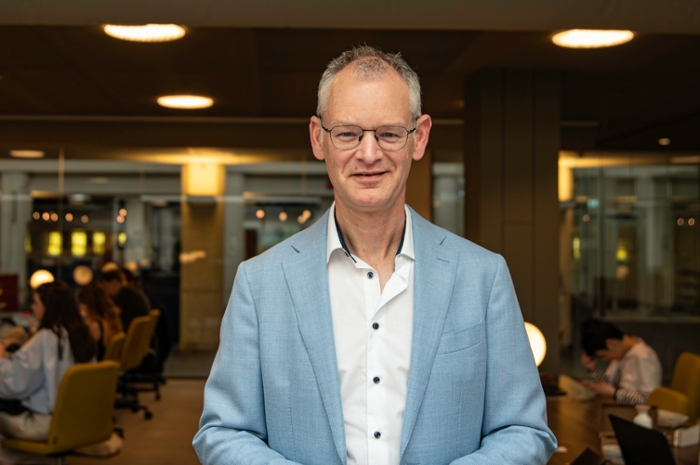
Since May 2026, Roy de Ruiter has been strengthening the Institute of Political Science as professor of Maritime Strategy by special appointment. This chair is a collaboration between the Dutch Royal Association of Naval Officers (KVMO) and Leiden University. A conversation about change versus continuity in the interplay between geopolitics and maritime-military thinking and action.
The sea as a domain for prosperity and security
The Chair of Maritime Strategy was established in 2008 by the Dutch Royal Association of Naval Officers (KVMO) in collaboration with the Institute of Political Science. De Ruiter is appreciative of his new position. ‘What always strikes me when I am in Leiden is the rich academic tradition that the University – and the city too – exudes. I consider it a great honour to be able to be part of that for the next five years. Not least because Leiden is a leader in the field of Political Science.’
As a professor by special appointment, De Ruiter aims to put maritime strategy more firmly on the agenda. ‘The sea has traditionally been a key domain for Dutch and European prosperity and security. Yet, to date, Sea Power has received relatively little attention in Dutch academia. Through my teaching and research, I wish to focus in particular on the link between maritime power, geopolitical influence, and national security and strategy. The aim is to develop knowledge and understanding of the maritime-strategic interests of states and the impact of maritime-military operations on geopolitical decision-making.’
Setting strategic priorities
De Ruiter will also seek to forge links with other chairs in Leiden, as well as with other universities. ‘It is about much more than just synergy. We live in turbulent times. The challenges are diverse, complex and interlinked. Practice and academia desperately need each other to better understand the world around us and to set the right strategic priorities. In the current era, this is more important than it has been for a long time.’
‘80% of all goods and 99% of all data travel over or under the sea’
‘Many conflicts,’ explains De Ruiter, ‘are directly linked to the maritime domain and thus to a country’s strategy. After all, the sea remains the most important lifeline of the global economy and security. 80% of all goods and 99% of all data travel over or under the sea. The blockade of the Strait of Hormuz serves as a daily reminder of this fact.’
The sea has always been a ‘global common’. ‘Partly thanks to Hugo de Groot from Leiden,’ De Ruiter continues, ‘we have had international maritime law in various forms for centuries. The essence is that everyone can make use of the sea, within certain frameworks, such as territorial waters. Ultimately, this benefits everyone. The fact that this is under pressure today symbolises the erosion of the international legal order. For a small country like the Netherlands, this can have major strategic consequences.’
Climate change
Another strategic challenge stems from climate change. ‘Global warming affects us all, but it has particularly significant consequences at sea. A concrete example is the melting of the polar ice caps. This makes new waters accessible, which raises all sorts of strategic questions.
Sailing and writing
De Ruiter knows the navy inside out. In the mid-1990s, he trained as a naval officer at the Royal Netherlands Naval College (Koninklijk Instituut voor de Marine). ‘The training consisted of a practical part – learning to sail and manoeuvre a ship – and an academic part; in my case, that focused on International Security Studies.’
‘After my studies,’ says De Ruiter, ‘I began sailing on various naval vessels and was deployed worldwide. Later, I also started flying navy helicopters from ships. Meanwhile, I remained interested in international relations and, driven by that interest, I contributed to articles whenever I could.’ Around the age of thirty, De Ruiter was given the opportunity by the navy to further his academic development and undertook a PhD programme at the Netherlands Defence Academy in collaboration with the University of Amsterdam.
Watershed
The subject of De Ruiter’s PhD research was the fall of the Berlin Wall and how the political, military and civil leadership of the Ministry of Defence responded to it. ‘This period was nothing less than a watershed in the history of the armed forces. With the disappearance of the threat from the Soviet Union, the very raison d’être of the armed forces was suddenly called into question. Conscription was suspended and a period of sustained cutbacks began, from which the armed forces are still struggling to recover. At the same time, the armed forces have since been deployed almost continuously on operations in distant countries to promote the international legal order. It has taught me a great deal about decision-making in times of crisis, about the influence of cultural differences between organisations such as the Army, Navy and Air Force, and how difficult it is to arrive at sound strategic planning.’
Officer-scholar
At the Netherlands Defence Academy, academics who combine a military and academic career are referred to as ‘officer-scholars’. After obtaining his PhD, De Ruiter continued to alternate between operational, administrative and academic roles. ‘This variety was enriching, both personally and certainly professionally. I am convinced that we can make the world a better place by bringing together knowledge and experience from different fields.’
In recent years, De Ruiter’s career has taken on an increasingly academic focus. He teaches bachelor’s and master’s courses at the Netherlands Defence Academy, delivering tuition (BA/MA) to officers and conducting research. Topics include maritime strategy and operations, international relations, strategy formulation and the impact of war on education.
Change versus continuity
When asked about the questions he is currently pondering, De Ruiter replies: ‘One puzzle that fascinates me is the impact of all these changes. What do the rise of drones, the changing international order and climate change mean for thinking about power at sea? Look, on the one hand, a great deal is changing very quickly at the moment. On the other hand, as a historian, I am aware that there are also many continuities.’
Learning from other perspectives
The coming period for De Ruiter will be all about settling in at Leiden University. ‘I hope to get to know the Institute of Political Science and the university more broadly as soon as possible. I will also be preparing for my inaugural lecture, delivering lectures and supervising PhD students. In the slightly longer term, my ambition is to develop an elective course on Maritime Strategy and to organise a Sea Power conference.’ I look forward to engaging in dialogue and learning from other perspectives. I have always found it very refreshing, educational and enjoyable to build something up again in a ‘foreign’ world. Hopefully, with my ‘officer-scholar’ profile, I will also be an interesting addition to Leiden.’