
Strengthening Mental Health Research during Food for Thought Event – Health & Wellbeing
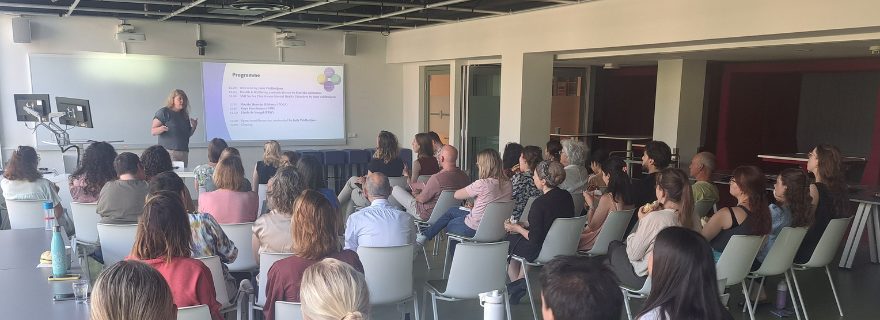
On 26 May, the Food for Thought lunch meeting about Mental Health Disorders brought together researchers from across Leiden University to explore how interdisciplinary collaboration can strengthen research and societal impact. Moderated by Judy Veldhuijzen, the session positioned mental health within both the SSH Sector Plan and the university-wide Health & Wellbeing theme, emphasizing the urgency of addressing rising mental health challenges and their societal burden.
Marieke Adriaanse
Marieke Adriaanse opened with an overview of the Health & Wellbeing theme at Leiden University. She highlighted its central goals: improving health, enhancing wellbeing, and reducing health inequalities. The theme connects multiple faculties and initiatives, such as the Leiden Healthy Society Center and collaborations with LUMC and partners in the Health Campus The Hague, to foster interdisciplinary research and increase societal impact.

Judy Veldhuijzen
Judy Veldhuijzen explained how the SSH Sector Plan on Mental Health further complements this by focusing on strengthening research infrastructure, fostering collaboration, and developing shared research agendas around prevention, mechanisms, and treatment of mental disorders.
Three research presentations illustrated how these ambitions translate into practice.

Understanding violence through networks
Martín Hernán Di Marco presented research on intimate partner violence, focusing on perpetrators and their social environments. Addressing a gap in existing scholarship, his project combines narrative interviews with men convicted of femicide across several Latin American countries. By collecting detailed life histories, the research uncovers how violence develops over time and how social networks—particularly male peer groups—play a role in sustaining or enabling abuse. Findings point to patterns such as social isolation, reliance on peer networks, and strategies to avoid detection. This network perspective opens up new avenues for intervention, for example by targeting social environments rather than individuals alone.

Optimizing expectations for health
Kaya Peerdeman explored how expectations shape health outcomes, drawing on placebo and nocebo research. While positive expectations can reduce pain, her work shows that overly optimistic expectations may also have unintended effects, such as reduced trust when experiences fall short. This highlights the importance of communicating expectations that are both positive and realistic. Her research applies these insights to childbirth, a context where mismatches between expectations and experiences are common and can negatively affect wellbeing. Ongoing work includes clinical tools, e-learning, and co-created interventions to support shared decision-making and improve patient outcomes.
Bridging lab and clinic in mental health research
Linda de Voogd focused on the challenges of translational research in mental health. Despite significant advances in laboratory research, many findings fail to translate into effective clinical interventions. A key issue is the gap between “the lab, the clinic, and the world”: these domains use different models, methods, and assumptions. De Voogd emphasized the need for stronger “cross-talk” between researchers and clinicians, for example through qualitative studies that capture patient experiences and clinical practices. Such approaches can improve theoretical models and help align research more closely with real-world needs.
