
Boost your research process with these science communication tips from colleagues
How do you keep participants enthusiastic about continuing to take part in your research? And how do you share results with them in a way that works for them? Researchers share their advice with colleagues during the first editions of Science Communication Stories.
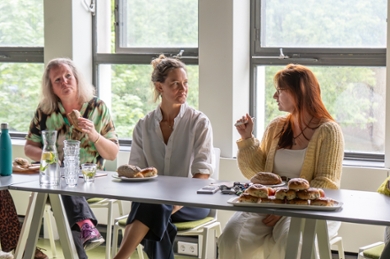
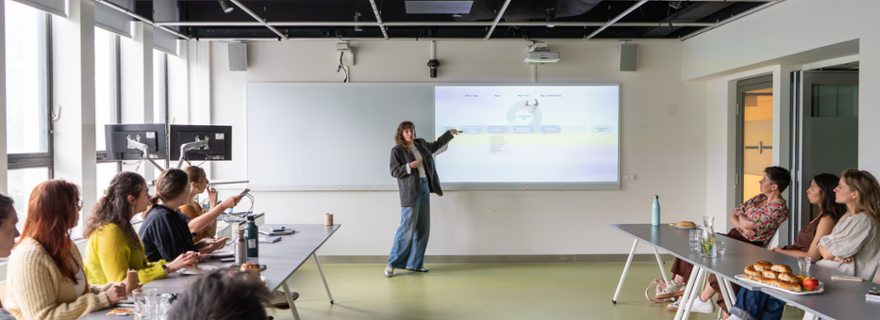
Just before the summer holidays, more than 25 Psychology researchers brave the sweltering heatwave to listen to stories from colleagues, sandwiches in hand and plenty of jugs of ice water with fruit on the table. During the first two Science Communication Stories sessions, Psychology researchers discuss the obstacles they encountered in their research and the communication approaches that worked best for them. The aim of the sessions is to inspire one another to strengthen the connection between research and society through better dialogue with the target group.
Questionnaires with pizza
In the first session, Simone Dobbelaar and Hannah de Boer explain how they keep participants engaged in their research. Dobbelaar, who studies social relationships within a Leiden student association as part of the Growing up Together in Society consortium, explains how setting aside your scientific perspective can help keep participants interested. Her advice is to enter their world. For this study, that meant keeping participants engaged with light-hearted Instagram memes, having pizza delivered while questionnaires were being completed and not taking yourself too seriously as a researcher in your communications. Thanks to a well-considered and tightly implemented communication plan around the measurement points, they experienced hardly any participant drop-out between the two measurement points. And because as many students as possible continue to take part, the researchers gain a complete picture of their social relationships.
Clear language
Hannah de Boer researches financial stress. She emphasises the importance of using clear and straightforward language when communicating with potential participants. She explains, for example, how she adapts consent forms to B1 language level and works with the Ethics Committee to find a balance between informing participants properly and not overwhelming them with complicated texts. The same attention to communication also plays a role in her contact with a welfare organisation in Leiden. There, De Boer has found that investing in personal contact and trust is essential if both parties are to genuinely benefit from the relationship. This sometimes means making a phone call instead of sending an email, avoiding specialist jargon and deliberately choosing a form of communication that suits the other person.
WhatsApping a scientist
A week later, Marina Hanssen and Janna Marie Bas-Hoogendam explain how they report their findings back to participants. As part of her PhD research project How do the Dutch eat?, Hanssen studies the eating behaviour of a large group of people in the Netherlands. Her tips are to develop a clear website on which you and your research group are also visible, and to be accessible through different channels. Not only by email, but also through WhatsApp, for example. She also worked on a feedback tool that automatically gives participants insight into their own eating patterns and how these compare with those of other participants. By regularly reporting this data back to participants, they gain a clear picture of the research process and how their participation contributes to it.
Trial and error
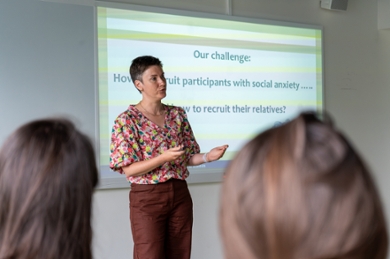
For her advice, Janna Marie Bas-Hoogendam casts her mind back to her PhD project, which began in 2013. Under the supervision of Emeritus Professor Michiel Westenberg, she studied the genetic transmission of social anxiety within families. Her first tip is to pay close attention to the words you use in recruitment materials. Few people recognised themselves in the term ‘social anxiety’, but ‘extreme shyness’? When they used that term in a newspaper appeal, people did feel that it applied to them and registered for the study. She also stresses to colleagues that communicating effectively about and within your research is often simply a matter of trial and error. There is no single golden strategy; it is much more about setting aside time and energy to learn about the subject, giving yourself the freedom to try something new and carefully observing what happens. In fact, it is much like conducting science itself.
About Science Communication Stories
Science communication does not begin only after your research has been completed. It is precisely during the process that you can make a difference: by listening, engaging in conversation and continually adapting the way you communicate to the people involved in your research. This approach increases the likelihood that participants will remain engaged with the research and therefore contributes to robust research practice. With this in mind, the Institute of Psychology’s communications team organises the Science Communication Stories lunchtime sessions, during which researchers spend half an hour over lunch sharing their tips, experiences and ‘failures’ in the field of science communication.