
NIOD Director Martijn Eickhoff is the new Cleveringa Professor
Martijn Eickhoff, a cultural historian and Director of the Institute for War, Holocaust and Genocide Studies (NIOD), has been appointed the Cleveringa Professor. He will deliver his inaugural lecture on 26 November.
Through his work for NIOD, Martijn Eickhoff has proven to be a versatile scholar. For his dissertation, he researched how Dutch archaeologists responded to National Socialist interest in their field during the Second World War, and how they looked back on this later. He then went on to study cultural history in Europe and Asia, among other subjects, focusing in particular on its spatial, material and transnational aspects. Alongside his work at NIOD, he is Endowed Professor of Archaeology and Heritage of War and Mass Violence at the University of Groningen.
‘Exceptionally powerful text’
Eickhoff read Cleveringa’s speech while writing his dissertation and found it an ‘exceptionally powerful text’. ‘At the time, discussion on what makes the Dutch Dutch often focused on national character, something considered hereditary and fundamentally unchangeable. Cleveringa completely ignored this line of thought, instead defining Dutch national identity in terms of constitutional law, which I found incredibly powerful and impressive. That’s why I consider it a great honour to be delivering my own inaugural lecture in the same place on 26 November. It’s an almost historical sensation.’
Protest speech
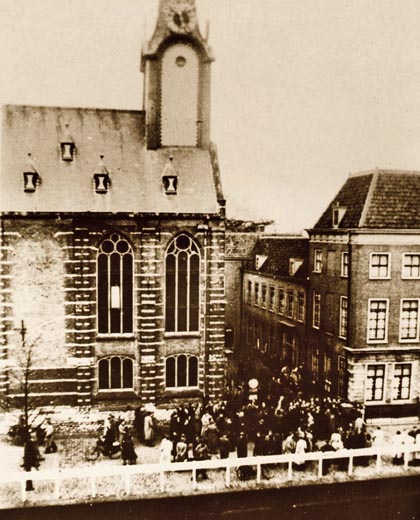
Each year, on or around 26 November, the university commemorates the protest speech delivered in 1940 by Leiden law professor Rudolph Cleveringa. On that day, Cleveringa spoke out in a public lecture against the dismissal of his Jewish colleague Eduard Meijers. After the speech, Cleveringa was arrested by the German occupiers, and Meijers was deported first to Westerbork and then to the Theresienstadt concentration camp. Both men survived the war. At least 663 students, staff and alumni from Leiden University lost their lives during the Second World War.
What defines the Dutch national identity?
In his own lecture, Eickhoff wants to continue exploring the theme he found so compelling in Cleveringa’s lecture. What defines the Dutch national identity? And how did the German occupiers view this? What role did the concept of national character play in their Nazification policy, and how did it relate to Dutch self-image? How did antisemitism become embedded in this? He will focus on Arthur Seyss-Inquart, an Austrian Nazi installed by the Germans as Reichskommissar of the Netherlands on 18 May 1940.
Nominated by Faculties of Humanities and Archaeology
Eickhoff was nominated by the Faculties of Humanities and Archaeology. Deans Henk te Velde and Alex Geurds explain why: ‘We’re delighted to be able to welcome Martijn Eickhoff as Cleveringa Professor. With his clear and engaging vision, informed by an archaeological perspective, he shows how heritage reminds us that the past continues to influence the present. At a time of intense public debate about identity, conflict and memory, his historical and scholarly perspective is especially welcome and very much in keeping with the spirit of Cleveringa.’
Past remains relevant to the present
Through its research, NIOD helps inform current public debates, keeping the past relevant to the present. ‘Especially since the mass violence in Israel and Gaza, and the debates on genocide, there has been growing interest in the experience of the Second World War’, says Eickhoff. ‘What happens when a society mobilises? What effect do depictions of the enemy have on people? How does propaganda work? How and why do people resist? Which histories are given a voice, and which are not? These are complex questions, which makes it all the more important to keep shedding light on the situations people faced two or three generations ago.’
Timeless dilemma
That is why Eickhoff believes it is important to hold the Cleveringa Lecture every year. ‘It marks a significant moment in Dutch history. For someone to speak out publicly when his Jewish colleague was dismissed, and to express his anger and sense of helplessness, was almost unprecedented. The question of how to speak out against injustice is a timeless dilemma. That’s why we must continue to explore, critically and analytically, what motivated Cleveringa and his contemporaries.’