
Worlds on a string: how beads in the sixth century travelled the world
On September 17, Mette Langbroek will defend her dissertation. For her PhD, Mette investigated the contact that people from Northwest Europe had (particularly during the sixth century) with the rest of the world and with each other. This research is part of the ERC Rural Riches project, which took place between 2017 and 2023. These global connections are revealed by the beads that were included as grave gifts for (primarily) women during the early Middle Ages. These beads were found everywhere, came from everywhere, and were worn by both the rich and the poor.
Circular reasoning
There seems to be a tendency to circular reasoning : the presence of beads in a grave causes it to be labeled as that of a woman. Subsequently, it is claimed that those beads are found primarily in women's graves. However, this view is now also confirmed by osteological research. When the skeletons are studied separately from the grave goods, and increasingly often by means of DNA analysis, approximately 99% of those skeletons turn out to be identifiable as a biologically female skeleton.
International connections
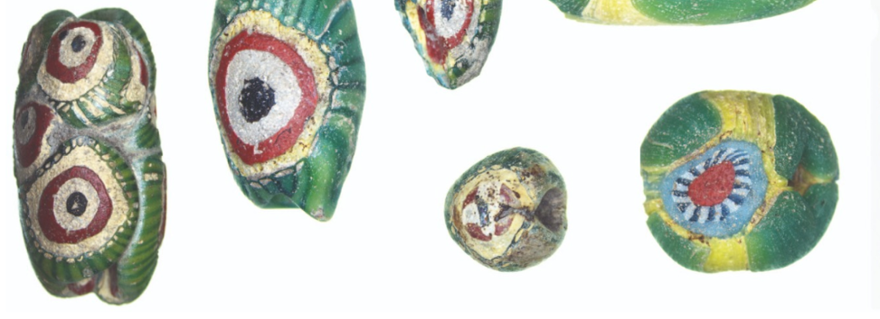
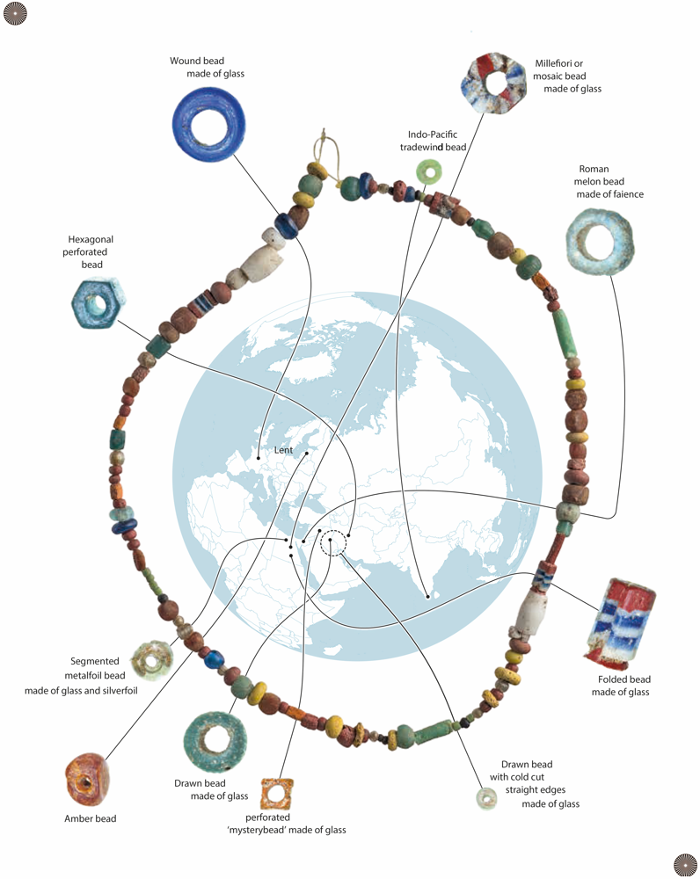
‘The fun thing about these beads from the Merovingian period is that around the sixth century, you often have the whole world around your neck. So you have beads from India, beads from the Mediterranean region, sometimes from Iran and Iraq (what we call Mesopotamia in earlier periods), beads from Egypt, and beads from Europe.’ In addition to the glass beads, Mette also examined many amber beads. ‘That amber is most likely mined in the Baltic Sea and then processed into beads here; we even found some evidence for that. So, in one single string of beads, you can see all those connections reflected.’
Rich grave, rich beads?
The beads are found in about half of the women's graves. ‘That is a lot,’ says Mette, ‘so having them isn't anything special at all.’ Moreover, the beads are found in very ‘rich’ graves (with many grave goods) and very ‘poor’ graves (with few grave goods). The richness of the grave, therefore, does not seem to matter much for the richness of the beads. And that naturally raises debate: what does it mean if you were buried with many items or many beads? Was that something special or not? Through her research, Mette discovered that it didn't really matter. These beads were simply there, and they were everywhere during this period; anyone could have them, and everyone did have them. That is what makes the beads so interesting to her: research into the beads means research into the connections of ordinary people.
The wallpaper map
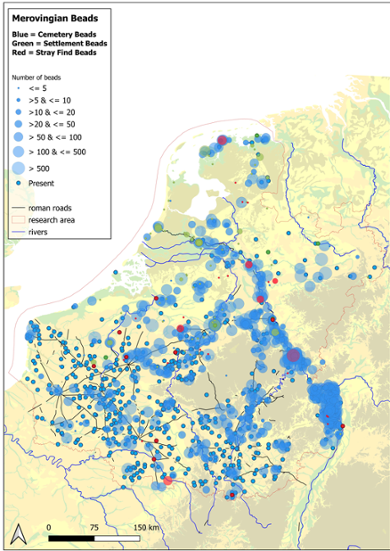
For this research, Mette examined graves in Northern Gaul: the Netherlands, Belgium, Luxembourg, Western Germany, and a small part of Northern France. To investigate the distribution of the beads, the Rural Riches team first created a kind of background map containing all known settlements and burial grounds from the Merovingian period. The ‘wallpaper map’, they call it. The rest of the distribution could then be plotted on this map to determine whether it was a general distribution or not. ‘For example: where exactly do these beads occur? And in how many graves? How many on average per grave? How many of the women's graves, how many of the men's graves?’ Apart from the locations where the beads are found, Mette also researched their origin. Where are they made, and how long is the journey they have taken before ending up in a grave somewhere in Northern Gaul?
Chemical confetti?
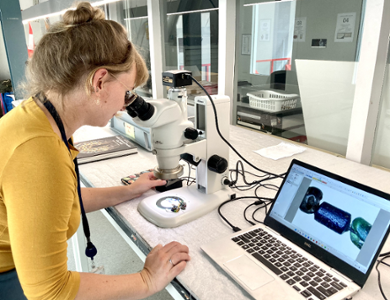
Was a string of beads purchased all at once, or were the beads collected at different times? At first glance, this question seems almost impossible to answer. After all, the beads themselves do not speak, and nothing has been written down about them. But surprisingly, the research has provided answers to this. Based on the chemical signature of the beads, it is possible to see where they were made. And if you group all of those signatures into a program by color and have it analyzed for similarities, you can have two results: chemical groups or chemical confetti. The results of these analyses were incredibly exciting; after all that time collecting data, Mette finally got to see what all that data had to say. And what did it reveal? ‘Especially in the sixth century, I see basically only groups!’ ‘I see groups in the same string of beads that were made in Europe, groups in the beads from India, groups in the beads from Egypt, etcetera.’ ‘That means that those beads from Europe, India, and Egypt were made and traded in such a way that they all stayed together in the same batch, in the same bag, that they were then strung onto a string, and that was worn, and that ended up in a grave. It all stayed together. I find that extraordinary!’
COCO
It appears that a massive industry lies behind these beads, where not only do the beads within the same string share the same origin, but this phenomenon also seems to be visible elsewhere in Europe. Mette has found examples of beads from graves in Italy, Austria, and England that look identical to the beads she examined. Some of the Italian beads were analyzed using the same procedure, and when the results are compared, they prove to be not only visually identical to the beads from our region but also at a chemical level. Meaning: in Italy, the beads were imported from the same sources as here. Over the coming six years, as part of the ERC Synergy project COCO, Mette intends to ‘pull the same trick again’. With a team of international researchers, she will this time examine beads from even more burial grounds in other parts of Europe. In doing so, they hope to map these enormous trade networks even more thoroughly.
On Thursday, September 17 at 14:30, Mette Lanbgroek will defend her dissertation: 'Worlds on a string, on beads and exchange in Merovingian Northern Gaul' at the Academy building in Leiden. More information is available in the university's events calendar.