
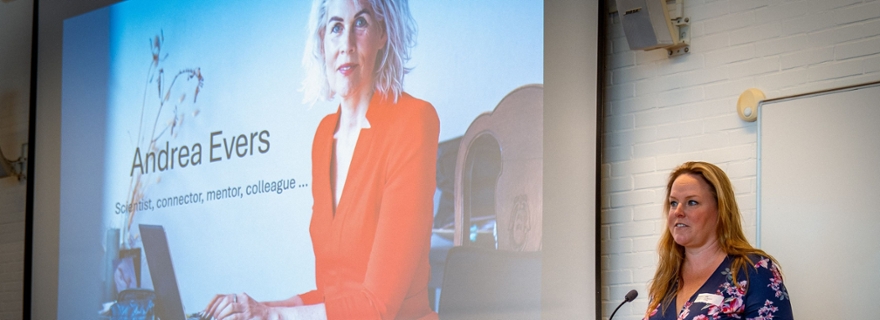
Andrea Evers’ legacy lives on: 'Think bigger, stay connected, and always stay curious'
A gathering filled with memories, but above all focused on the future. That characterized the Working Together for Health symposium, inspired by the work and vision of Professor Andrea Evers. More than a year after her passing, scientists and representatives from the healthcare sector, government, and civil society organizations gathered to ask: How can we carry on Evers’ collaborative approach to address the health and social challenges of today and tomorrow?

'Andrea always strove for the highest possible standards. And with great success.' With those words, session chairs Henriët van Middendorp and Antoinette van Laarhoven opened the gathering at the Kamerlingh Onnes Building in Leiden. Evers, who passed away on August 4, 2025, was a professor of Health Psychology and a pioneer in interdisciplinary research on the interaction between body and mind. But above all, she was a bridge builder between science, healthcare, and policy. Van Middendorp and Van Laarhoven continued: 'Her motivation was clear: to make a social impact. She wanted scientific knowledge not to remain within the walls of the university, but to always make a difference in society. To that end, she brought people, disciplines, and organizations together. She did this all effortlessly.'
A phenomenon
'There’s really only one word that describes Andrea well: a phenomenon,' said Hanneke Hulst, former scientific director of the Institute of Psychology and a close colleague of Evers. She recalls her exceptional work ethic, her mind that never stopped working, and her signature red dresses. 'She was not only an outstanding scientist, mentor, and leader, but also a friend to many of us here today.' According to Hulst, for Evers, societal impact was not the end goal of scientific research, but rather the starting point. With every new project, she first asked herself: Who stands to benefit from this research? Which people should we invite to the discussion table? And how can we tackle this issue collaboratively and in an interdisciplinary manner?


Unapologetically ambitious
The extent of Evers' influence were highlighted during the symposium by eight different speakers, each of whom reflected on their collaboration with her from the perspective of their own field and organization. Each speaker shed light on a different aspect of her work and shared what Evers had taught them about thinking differently, collaborating, and pushing boundaries. Esther Peters, director of the Leiden Bio Science Park, recalled that during her first meeting with Evers, they had already discussed ways to bridge the gap between science and society. 'Andrea made connections that others hadn't yet thought of.'
According to Peters, Evers never limited her ambitions to Leiden, and she always immediately considered potential connections with the rest of the world. Marieke Adriaanse, professor of behavioral interventions and strategic representative of the Healthy Society Program, remembered Evers as someone who constantly encouraged others to think bigger. 'Be unapologetically ambitious, and strive for the highest possible goals,' she emphasized. A lesson from Evers that she still carries with her every day.
Turning words into action
How can we carry on Evers’ ideas and approach to collaboration in the future? That question was central to the closing panel discussion, moderated by Anke Klein, associate professor and director of the Leiden Healthy Society Center (LHSC). Which health and social issues call for interdisciplinary collaboration? How do we ensure that science actually makes an impact? And what would Andrea ask us to do today? The discussion yielded concrete action items: meeting in person more often, collaborating in the same physical space, strengthening existing collaborations, and giving greater weight to social impact when evaluating scientific research.
There was also a call to take societal problems, rather than scientific interests, as the starting point. Everyone wrote down one concrete action or collaboration through which they intend to make a social impact in the coming months. This ensured that the event wasn’t just about memories and good intentions; attendees also left with something to put into practice. Because it is precisely by continuing to connect and collaborate that Evers’ legacy lives on.
The importance of interdisciplinary collaboration is also central to the university’s profile themes. Through these themes, Leiden University aims to bring researchers from different disciplines closer together and foster collaborations. Click here to read more about these themes.