
Lecture | CHiLL series
Qiang 羌, Rong 戎, Yangtong ⽺同, and Tufan 吐蕃 in Ancient Chinese Sources and Their Tibetan Correspondences
- Date
- Monday 2 February 2026
- Time
- Serie
- Chinese Linguistics in Leiden (ChiLL)
- Address
-
Lipsius
Cleveringaplaats 1
2311 BD Leiden - Room
- 1.30
Please note that the times for this event have changed from 15:15-17:00 to 13:15-15:00.
Abstract
This study reexamines the ancient Chinese ethnonyms Qiang 羌, Rong 戎, Tufan 吐蕃, and Yangtong 羊同, found in historical literature referring to ethnic groups in the Tibetan Plateau and northwest region. While previous research has achieved significant results, uncertainties persist. This paper applies Chinese Historical Phonology and Sino-Tibetan sound correspondences to offer new insights, focusing on the mutual historical and cultural relationships between these groups—specifically, the Tufan–Yangtong and Qiang–Rong connections.
The research challenges the traditional link between Tufan and Tibetan bod བོད, proposing instead an etymology from Old Tibetan dbon དབོན ‘Nephew Nation’. Yangtong is interpreted as the zhangzhung ཞང་ཞུང ‘Uncle (Mother’s Brother) Nation’, framing their relationship as a reciprocal “Nephew-Uncle” alliance—a diplomatic term reflecting marriage ties and later adopted by the Tang Dynasty. This alliance was likely the most influential of its time, widely recognized and recorded in Chinese historical literature.
For Qiang 羌 and Rong 戎, the study proposes that Old Chinese Qiang corresponds to Tibetan sgang སྒང ‘highland/ridge’, while Rong aligns with rong རོང or lung ལུང ‘valley/lowland’, distinguishing nomadic upland and agrarian lowland tribes. Modern Minyag Khams Tibetan dialects still use sgang pa སྒང་པ། and rong pa རོང་པ། for these groups, with toponyms preserving sgang ‘uplands’ and rong ‘valley’.
Phonologically, the study traces Yangtong 羊同 and Zhangzhung ཞང་ཞུང to an era with *l-initials, suggesting the Chinese shift from *l- to *d- (e.g., 同) was conditioned by preceding consonants (e.g., *Cl- > *d-). Regarding Qiang 羌 and Rong 戎, Old Chinese Qiang corresponds to Tibetan *sg-, but Middle Chinese Qiang already had a voiceless consonant. Statistical analysis indicates that devoicing of velar stops began in Old Chinese, not Middle Chinese, with velar voiced stops undergoing long-term devoicing evolution. By the Middle Chinese period, the proportion of voiced velar stops was significantly lower than that of labial and alveolar stops.
This research bridges linguistic, historical, and anthropological perspectives, clarifying the ethnolinguistic landscape of ancient Tibet and its interactions with China.
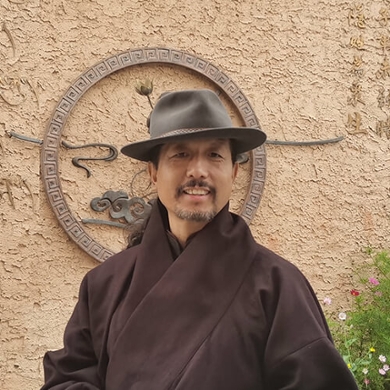
Professor Yeshes Vodgsal Atshogs / ཡེ་ཤེས་འོད་གསལ་ཨ་ཚོགས། / 意西微萨·阿错
Short Bio
Born in 1969 in a remote village of Ganzi Prefecture, he spent eight years as a rural primary school teacher while writing literature, practicing traditional Tibetan Buddhist sculpture, and teaching himself Chinese under extremely difficult conditions. After earning self-study diplomas in Chinese language, he entered graduate school with top national exam scores, receiving an M.A. in Philosophy from Southwest Normal University (2000) and a Ph.D. in Linguistics from Nankai University (2003). After receiving his Ph.D. from Nankai University in 2003, he held visiting scholar positions at the University of Tokyo and the University of Maryland. Since 2003 he works at the School of Literature at Nankai University. His research focuses on Sino-Tibetan comparative linguistics, language contact and mixed languages—most notably his discovery and documentation of Daohua—as well as broader questions in linguistic and philosophical theory. He also mentors graduate students in comparative and minority language studies.
Research Foci
His research spans language contact and mixed languages as well as the historical relationships among Tibetan, Chinese, and neighboring languages, where he proposes an alternative view to the traditional Sino-Tibetan hypothesis and introduces the concept of "Tibeto-Altaic grammatical drift." He also specializes in Tibetan prosodic phonology, identifying reconstructable stress-accent and pitch-accent systems and examining their role in Tibetan and Chinese poetic meter. His work has earned multiple honors, including the MJH Award for Chinese Historical Phonology, China's National Award for Outstanding Doctoral Dissertations, and three Ministry of Education Outstanding Achievement Awards.