FGGA in 2025: This was the year of our faculty
2025 was a year full of impact and milestones for FGGA: From a record number of graduates and new programmes to international collaborations, prestigious awards and research that pushes boundaries and provides insight into current challenges.
January
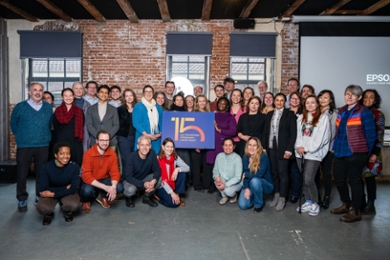
The year begins with the kick-off of LUC's 15th anniversary. The theme 'Global challenges, local impact' shows how the programme connects global issues with concrete contributions to Dutch society.
A good start for ISGA researchers: they receive €1 million for research to enhancing Dutch digital resilience.
Two intelligence specialists, Pepijn Tuinier and Bram Spoor, obtain their doctorates at the beginning of the year. Pepijn Tuinier argues that social relationships play a much more important role in international cooperation than has been assumed to date. Bram Spoor argues that military intelligence needs to be overhauled due to the development of more complex threats.
In January, there were several events. International experts in the field of nuclear deterrence discussed the future of nuclear deterrence in Europe. There was also a lecture on interviews with more than 100 civil servants under Trump, which painted a worrying picture.
February
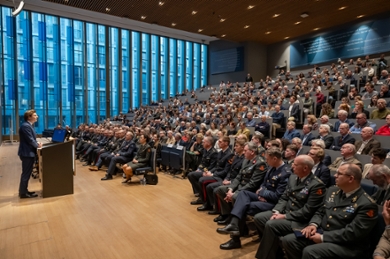
During the Ukraine symposium, exactly three years after the invasion, Minister of Defence Brekelmans spoke to a crowded room and emphasised: ‘We in the Netherlands are now living in a grey zone, between war and peace’ and ‘We in Europe have only one chance to get this right’.
This month, Daan Weggemans defended his PhD thesis on the influence of digital technologies on decision-making and the role of authority in an increasingly algorithm-driven society.
'The way we consume information has changed dramatically,' emphasised Eliot Higgins during his lecture. The founder of Bellingcat was here for the university's 450th anniversary and received an honorary doctorate for his commitment to democracy and justice.
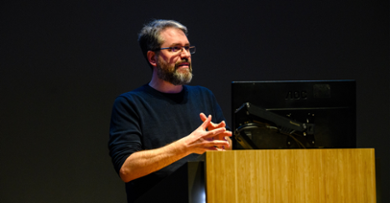
Current MIRD students, alumni and faculty members came together during the MIRD gala 'Reconnect & Gala'. This year's discussions focused on the theme: 'The future of International Relations: Digital innovation, climate change and new ideas'.
To mark Leiden University's 450th anniversary, four FGGA professors taught a class for 7th graders in Leiden and The Hague on questions such as 'why do we need an army?' and 'who governs the internet?'.
In well-read article, Frans Osinga discusses how European security has rapidly become more uncertain now that President Trump is negotiating with Russia first, what this means for the Netherlands, and what we need to do.
March
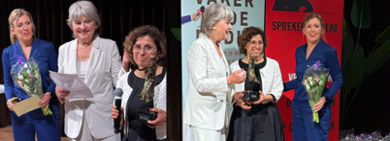
Special Professor Saniye Çelik received the Woman in Media Award this year for her work in the field of diversity, inclusion and policing. She emphasised the importance of female voices in public debate.
Several important appointments were made in March. Martijn Kitzen was appointed professor by special appointment of Military Sciences to the chair established in collaboration with the Royal Netherlands Society for War Studies (KVBK). Don Weenink was appointed professor of Violence and Law Enforcement, with research into why people commit violence.
At the end of March, the symposium ‘Diversity and Inclusion in the Police Force: from wanting to being’ took place, focusing on the question of how organisations can actually be diverse and inclusive. The dual PhD centre also organised a symposium on 'Support for Democracy: Measurement, Explanation, and Effects'. Jan van Zanen, the mayor of The Hague, said that 'if you want to strengthen democracy, start close to home'.
On 10 March, university staff in The Hague and Leiden went on strike against the government's cuts to education.
April
In April, Mischa Dekker received an NWA grant of nearly 3 million euros for the T@CKLE project. Within this consortium, he focuses on cultural change surrounding sexually transgressive behaviour and sexual violence, with the aim of tackling harmful norms about gender and victim blaming.
During the CV of Failures exhibition, students and staff shared their personal stories of rejection, setbacks and unexpected twists and turns.
Various FGGA experts spoke about what freedom means, how our security is affected, and how these themes relate to their field of expertise.
Robin Neumann was nominated for best master's thesis and won second prize in Leiden University's competition for best thesis.
May
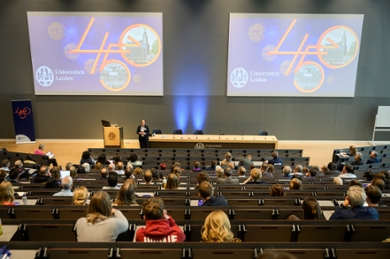
During the first Night of Digital Security on 26 May, more than thirty experts shared their insights on the new threats in the digital age. They emphasised that the greatest risks are often invisible and that cooperation remains crucial.
FGGA students look back on the past academic year and mention new friendships and cultural exchange as highlights. They emphasise how these experiences have broadened their perspectives and advise fellow students to actively participate in international and social activities.
In May, we were busy with the NATO summit, just like the rest of the city and surrounding area. In this article, Nikki Ikani, Martijn Kitzen and Linde Desmaele give their predictions.
Staff took a look at the new Spui University Campus, which will open its doors in early 2026.
Juni
In her PhD thesis, Sophie Vériter argues that the EU must revise its approach to disinformation in order to ensure greater democratic participation and long-term prevention. In his inaugural lecture, Michael Kowalski states that ethics should not be a side issue, but should form the basis for the work of intelligence services in order to protect democracies effectively and responsibly.
The VR documentary 'Shelter' gave visitors in The Hague a poignant insight into the daily lives of Ukrainian citizens under threat of war and encouraged reflection on the protection of citizens and international security issues.
During the Data for Policy 2025 conference, 120 participants from across Europe and beyond came together to explore the connection between digital and green transitions, known as the double transition.
July
In July, the Faculty of Governance and Global Affairs welcomed a new assessor. Mick de Kruijff (22) succeeds Sterre Burmeister (25). After three intensive years, Sterre is stepping down as assessor, while Mick, a fourth-year Public Administration student, is preparing to take on the role with fresh energy. In a short conversation, they share their experiences, challenges and expectations for the coming year.
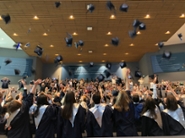
The graduates of the Bachelor's programme in Security Studies, with the message 'See you in the future', and of the Advanced MSc International Relations and Diplomacy, under the motto 'More than a degree', celebrated the completion of their studies in 2025 during festive graduation ceremonies.
August
During HOP week, hundreds of new students in The Hague got to know each other, the faculty and the city, making the introduction week a real game changer for many.
Leiden University celebrated 25 years in The Hague with the photo exhibition Researchers of the City. Eight researchers are shown in this exhibition at the places where their work has an impact on the daily lives of The Hague residents.
September
The new academic year was festively opened on Prinsjesdag with drinks in Wijnhaven. The opening was dominated by the university's anniversary theme: 'Time ahead'.
In his inaugural lecture, Bart Schuurman explains that the threat in Europe is changing. Traditional jihadist attacks are on the decline, but hybrid wars and extremist groups are increasingly posing an internal security challenge.
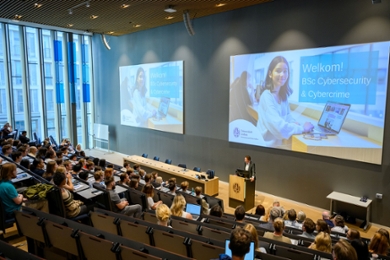
In September, The Hague launched its new bachelor's programme in Cybersecurity & Cybercrime, a course that responds to the growing need for digital security experts. A drone carrying a symbolic 'flying pencil' flew from Leiden into the lecture hall in The Hague, marking the festive opening of this promising new programme.
This month was full of events and special guests. Nobel Prize winner Paul Krugman gave a sharp argument about economic inequality and the question of how to make a society function properly. His lecture offered students, economists and policymakers valuable insights into the current economic context.
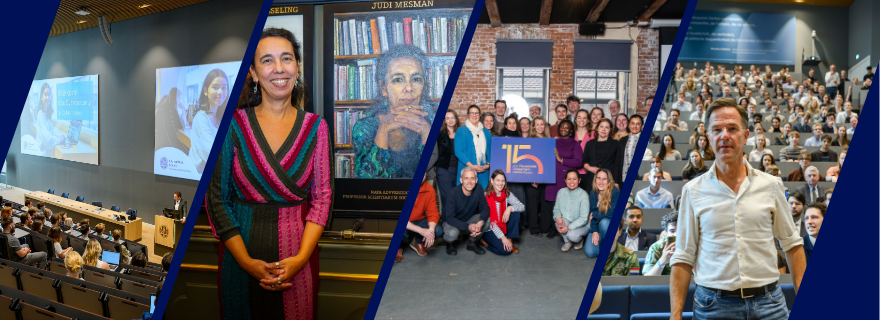
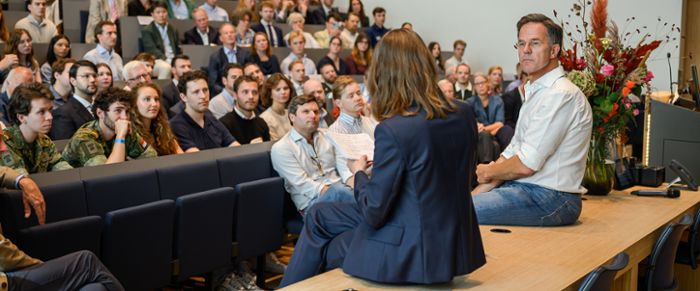
A day later, NATO Secretary General Mark Rutte spoke with students in The Hague at Wijnhaven. He discussed cooperation with the United States and said he appreciated Trump's role in defence, which he believes has stimulated European contributions. He also emphasised that NATO is a defensive alliance rooted in democracy and pointed out the importance of innovation and cooperation within the alliance.
Leiden University has been praised by the French weekly magazine L'Express as a European 'school of power'. The article even refers to the Institute of Security and Global Affairs (ISGA) as the 'diamond of Leiden'. The university is praised for its role in training future leaders in the fields of politics, diplomacy and governance.
October
In his doctoral thesis, William Lippert discussed the world of arms control agreements. The intelligence expert showed that conventional agreements contribute to peace and stability worldwide.
Joris Larik was appointed as the new Director of Education at LUC. He has been working there for exactly ten years and, after many experiences and challenges, is now looking ahead to 'how do we continue to innovate?'.
In a widely read opinion piece, Andrei Poama discussed strategic voting in the Dutch general election. The day before the election, he explained what strategic voting entails, how voters can determine whether their vote is truly strategic, and which choices can make a difference.
Emeritus professor Jaap de Hoop Scheffer spoke with students from Leiden University College about the increasing uncertainty in the world. He called for European determination amid instability and emphasised the importance of cooperation and diplomacy.
In October, nearly 1,000 students from nine FGGA programmes received their degrees, a record number.
Over the past year, the faculty has performed excellently financially and we are closing the year significantly better than both the budget and the forecast. In terms of personnel, we are seeing clear growth, visible in the FTE figures and in daily practice: more internal events, a pleasant bustle at the coffee machine, and yes... more cake from colleagues.
November
This year, LUC received the Special Feature Sustainable Higher Education from the NVAO. This recognition emphasises LUC's commitment to placing sustainability at the heart of education, research and collaborations.
In November, Layla van Wieringen, Pieter Jeroense and Fia van Heteren received their PhDs. Layla van Wieringen investigated how extremist beliefs are passed on within families, with a special focus on jihadist and right-wing extremist families. Pieter Jeroense studied seventy years of internationalisation in Dutch municipalities and observed striking developments. Fia van Heteren investigated how care and welfare professionals can collaborate and reflect more effectively in order to provide more effective support to clients with multiple problems.
Jiska Engelbert also gave her inaugural lecture, in which she warned that municipalities are too eager to digitise and that the digital city does not necessarily serve the well-being of residents. She therefore called for critical civil servants who dare to speak out.
Research Day 2025 brought together researchers from FSW and FGGA to explore interdisciplinary research. Panel discussions, short pitches and networking opportunities stimulated collaboration and the exchange of ideas.
Jantien Hadders presented her personal book, entitled Eindelijk Verdwaald (Finally Lost), about resilience and finding your own way in difficult times.
In November, the Centre for Professional Learning organised the first edition of the Course on State Threats in the Local Context. This course focused on how threats from state actors, such as state interference, espionage and sabotage, manifest themselves in the local context. During the course, academics, practitioners and participants discussed developments and insights from research and practice. The first edition was a success and will be followed up in the spring and autumn of 2026.
In November, Orange the World 2025 kicked off with various FGGA activities that drew attention to violence against women and girls. The HEAR ME NOW exhibition opened in Wijnhaven, featuring poignant portraits about sexually transgressive behaviour. During Consent is Key week, attention was paid to the prevention of unwanted behaviour, including through research by Mischa Dekker. There were also film screenings, including Blauwe Ballen en andere verkrachtingsmythes (Blue Balls and Other Rape Myths) and VIVAS, which highlighted myths surrounding sexual violence and the fight against femicide.
For the documentary Blauwdruk, new figures were presented on children left behind after the killing of a (former) partner. The research, based on the Dutch Femicide Monitor, makes an often invisible group of victims visible and contributes to greater social awareness.
December
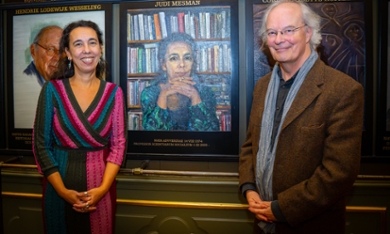
The portrait of Professor Judi Mesman has been unveiled in the Senate Room, a special recognition of her work and impact. She will be given a prominent place as a pioneer in research into diversity and inclusion.
Liberal Arts and Sciences: Global Challenges was once again recognised as a top programme by the Keuzegids Universiteiten 2026. The rating is based on the National Student Survey and underlines the high quality of the programme.
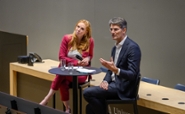
During the Arthur Docters van Leeuwen lecture, AIVD Director General Erik Akerboom spoke about how the changing threat landscape calls for reflective leadership, transparency where possible, and close cooperation to protect the democratic legal order.
In her thesis, Yung Lin showed how citizens in Taiwan actively contribute to diplomacy, thereby strengthening trust, solidarity and democratic resilience.
With the opening of the Spui building, we will be able to spread the growth in student numbers more evenly across our buildings. FGGA currently has around 4,000 students. The first students will move into the new building on 2 February.
Compilation and translation by Loes Velthuis en Niels Heukelom.
This overview is a compilation of the year of FGGA. We certainly do not pretend that it is complete. Are you missing something, or do you know someone who has also done something special? Let us know via communicatie@fgga.leidenuniv.nl with the reference: jaaroverzicht.