
Student conference full of new perspectives on inequality
What role did inequality play in the past? On Friday 5 December, Master's students in history presented their answers at a conference they organised themselves.
The course (In)Equalizers! Social and Economic Histories of Inequality(ies) and Difference(s), 1500-2000 is an initiative of lecturers Catía Antunes and Paul van Trigt. ‘When we discussed what binds us together within the socio-economic history section, (in)equality quickly emerged as a topic,’ says Van Trigt. ‘By building the course around the general debate on socio-economic inequality, Catía and I were able to cover a long period and many topics related to this form of inequality. That also makes it interesting for students. They can follow their own interests for their assignments, as long as their topic relates to that debate.’
Following your own interests
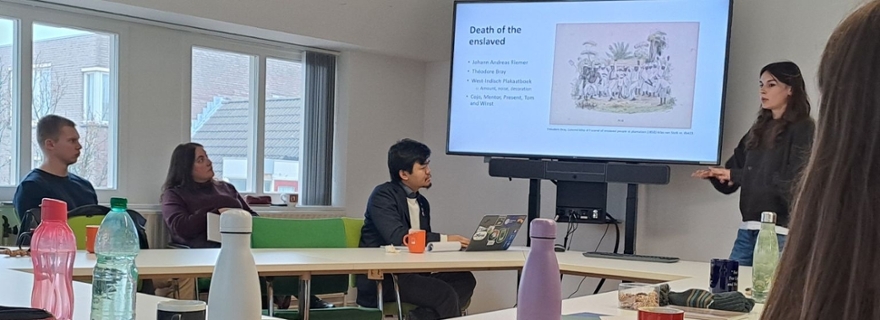
This has resulted in a wide range of choices, as was evident during the closing conference. During a single session, topics range from intellectuals in the seventeenth-century Republic to death cults among diverse population groups in Suriname, concluding with nationalism in newly established newspapers in the Dutch East Indies. ‘Normally, inequality is always about race or money,’ says student Manon Vestjens. ‘I really liked that we were able to choose more unusual topics here. That allowed me to build further on a bachelor's course on death culture. With all the different nationalities in the group, we also had many different perspectives from different cultures, which was very enriching.’
Informative discussions
Student Annabel van der Horst is also building on her bachelor's research with her master's thesis. ‘In my thesis, I used newspaper articles to explore what it means to be Dutch,’ she explains. 'When I came across these Indonesian newspapers, I wanted to explore them further.'
Annabel's research sparked a discussion during the symposium. Why did she consider the group that produced and read these newspapers to be representative of the Indonesian population? 'That lecturer (Catía Antunes, ed.) often asks those kinds of intense questions,' she laughs. 'She also announces them during class: ‘Now I'm going to ask another one of my annoying questions.’ That's great, because I can still incorporate this point into my paper, although I'm secretly a little relieved that the other lecturer will ultimately read and assess my work.'