
A quick call with Nathan Saucier about how the LLInC studio can help you enhance your teaching and research
From practicing ultrasound techniques in augmented reality to chatting with virtual ancient Greeks about what an archaeological site looked like back in the day: video & innovation specialist Nathan Saucier gives an insight into the many possibilities of the interactive media and simulations studio of the Leiden University Learning and Innovation Centre (LLInC). On Thursday 19 February, the studio will host an open day.
Hi Nathan, how did the LLInC studio come about?
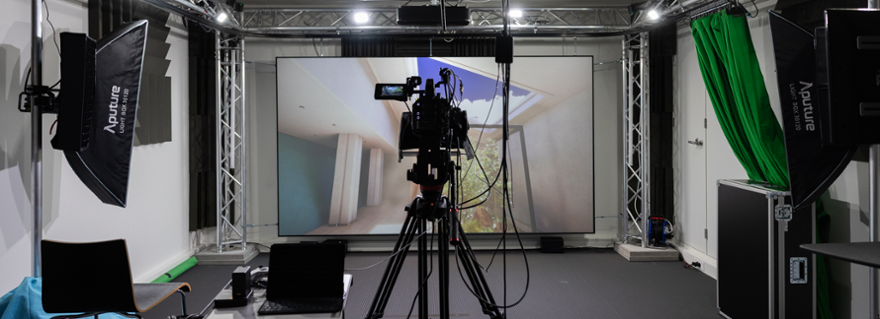
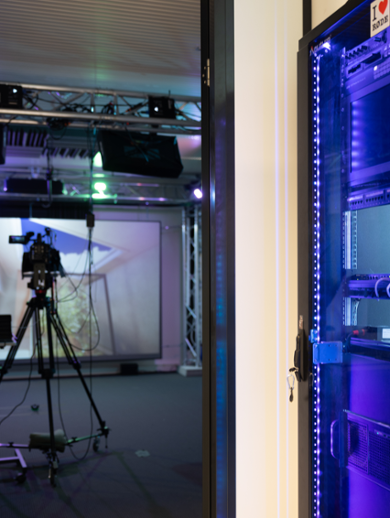
‘I joined LLInC a couple of years ago, and at that time, the studio project was already in the works. We wanted to be able to work with more innovative technology to support new ideas in teaching and research. So we took what was a basic kind of video studio and turned it into a more flexible virtual production space. Think of it as a next generation green screen technology that includes VR production, motion capture and 3D printing.’
What kind of projects do you collaborate on with Leiden researchers and lecturers?
‘One project that I personally led was with assistant professor Jelle Brands from the Institute of Criminal Law and Criminology. He wanted to create a virtual environment where he could test how different urban interventions – like light or darkness, people hanging around, or the absence or presence of trash and graffiti – could make research participants experience feelings of safety or danger. Using a technique called Gaussian Splatting, we created a very realistic 3D version of an existing tunnel near Leiden De Vink train station. Thanks to a very powerful computer in the LLInC studio, we were then able to put research participants into this virtual experience.’
Cool! Any other examples?
‘We collaborated with the Leiden University Medical Center on an augmented reality application to practice ultrasound techniques in an interactive learning environment. We created a multiplayer experience, where a lecturer and multiple medical students wearing AR-headsets were all able to see and experience the same thing at once. Colleagues from archeology are also often interested in working with us, because we can scan historical objects, like vases or tools, and then 3D print scale models on which we place motion trackers. We can then track these models in 3D space and map texture onto them, allowing lecturers to produce clips in which they are handling the object in a virtual environment. This technique provides a lot of applications for training or research purposes in medicine as well, if you 3D print parts of the human body. I enjoy playing with that reality-virtuality continuum, where you can have physical objects that then relate back into a VR experience.’
'I enjoy playing with that reality-virtuality continuum, where physical objects relate back into a VR experience.'
That sounds like the sky is the limit. Is it?
‘Well, our team can help with simple projects, but we really do enjoy a creative challenge. What we strive to do is integrate technologies together. Think of a VR project with an avatar for example, that is connected to a large language model, so that you can talk to it and it can respond to your queries. Referring back to archeology, this means that you could have a virtual professor or even a historical figure give you a tour of an archeological site. Imagine talking to an ancient Greek about a structure that used to stand there: that is an experience we could host in our studio.’
Are there studio innovations that are a little less technologically advanced?
‘For VR production, the lowest bar is 360 videos, which I think can be very useful in a classroom setting, because you can use them to virtually transport students to a location or site that not everyone can go visit. But we’ve also used our 360 camera to virtually train Science Faculty students on wet lab safety procedures. And I advised a PhD student who used 360 videos to create a simulation for a research project in prisons.’
How can colleagues who are interested in a collaboration reach out?
‘We have LLInC contact persons embedded within each faculty, but you are also always free to contact us directly via studio@llinc.leidenuniv.nl. And we definitely encourage everyone who is interested in integrating media within teaching and research to visit the Studio Open Day on 19 February. We look forward to showing you around!’
