
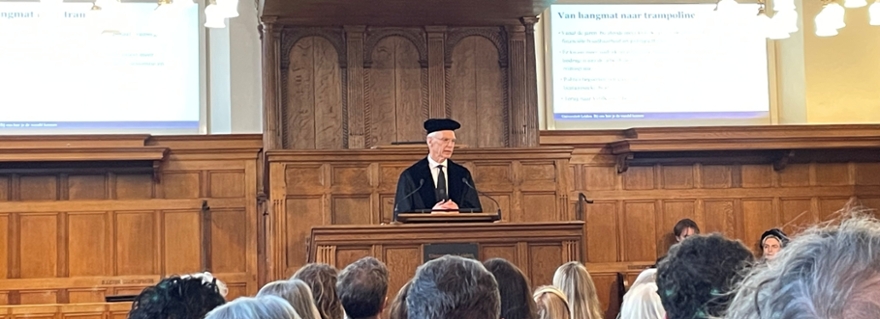
Kees Goudswaard won’t be whiling away his days
After 45 years at Leiden University, it is time for Kees Goudswaard to retire. In his farewell lecture, he reflects on developments in his field: social security.
Social security will affect your life at some point, for example through child benefits, disability insurance, or your pension: 'It’s with us from the cradle to the grave,' says Goudswaard as he starts his lecture. ‘Or, as some might say: from the cradle to the rocking chair, but I won’t be whiling away my days.'
Background to social security in the Netherlands
Goudswaard explains that the Netherlands currently spends a quarter of the national income on social security. To tell us how this came about, he gives a brief history lesson: Gerard Veldkamp (also the first professor of social security in Leiden) was the founder of various social security schemes in the 1960s, including unemployment benefit (WW), invalidity benefit (WAO) and child benefits. The emphasis then was on protecting citizens against loss of income. However, that view has changed over time. In the 1980s, for example, the focus was more on 'labour participation' (the number of people participating in the labour market), and in recent years 'socioeconomic security' (having enough money to live on) has been central. With this latest development, attention has shifted to reducing poverty, which Goudswaard says is one of the 'primary functions of social security'.
Future challenges
'Tackling poverty isn’t actually going so badly,' says Goudswaard, though he does acknowledge there is room for improvement. While the total number of people below the poverty line has dropped in recent years, more people are living in extreme poverty. 'So, there’s not only good news and there’s still a lot to do.'
Goudswaard proceeds in his lecture to set out his vision for the future of social security. He identifies important challenges for policymakers:
1: Steering income protection in the right direction
In the Netherlands, the social security system ensures a relatively effective redistribution between rich and poor, as well as combating poverty. Yet problems still exist such as the poverty trap, where people on low incomes often do not benefit from working more hours, and complex systems that can deter people.
2: Using social security to help people move forward
Social security can positively contribute to encouraging lifelong learning of the working population, especially in a changing society. But how we are going to finance the (re)training of employees remains a challenging puzzle. Part of the problem is training people for jobs that don't yet exist.
3: Closing the gap between employees and the self-employed
Self-employed persons (known in the Netherlands as ZZP’ers) are not covered by employee insurance schemes or compulsory supplementary pension schemes. That difference can cause inequality in the labour market. In addition, the number of ZZP’ers who have less than 70% of their income to spend during retirement is high. For that reason, Goudswaard sees the basic disability insurance system for the self-employed which is currently being set up, as a step in the right direction towards a fair system for all workers. The pensions of ZZP’ers also need to be improved.
4: A future-proof state pension
Raising the retirement age from 61 to 67 since the year 2000 has made the state pension more robust in these times of an ageing population. With a greater number of older people in society, the number of employed people must remain high enough to continue to pay for the state pension (AOW). Goudswaard does not rule out the possibility that the retirement age in the Netherlands will be raised again: 'I’ve often said to our students: “bear in mind that you’ll have to keep working till you’re over 70”. That doesn’t shock them at all, by the way.' Goudswaard mentions alternatives that would allow older generations to participate in the labour market in a healthy way for longer, including part-time work.
5: Supplementary pensions
From 1 January 2028 at the latest, all pension providers in the Netherlands must switch to a new pension system. Goudswaard is in favour of this new system: 'It won’t surprise insiders that I’m positive about this reform, as it makes the pension system more future-proof. Pensions will become more transparent, there’s a better chance of maintaining purchasing power, and investment policies will offer more tailored approaches (higher risk for younger people, lower risk for older people). Nevertheless, certain points do require attention. For example, the new system is complicated, we need to think about how the system can adapt to times of inflation and about better communication with pension scheme members.
Farewell
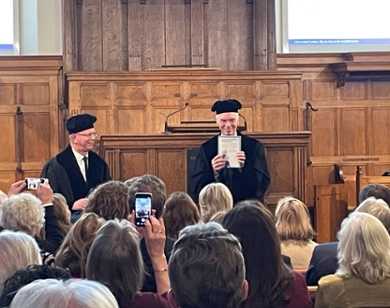
After Kees Goudswaard had delivered his farewell lecture, the audience heard from Suzan Stoter, Olaf van Vliet and Koen Caminada who addressed their retiring colleague. Several speakers had anecdotes about his passion for teaching, and how he always put his lectures first. Van Vliet and Caminada also spoke about how much they enjoyed working with Goudswaard, and how his work has been of great academic importance. The 45 years that Goudswaard spent at the university show that he, too, greatly enjoyed working here.
To mark the occasion of his retirement, a liber amicorum has been compiled as a tribute to Goudswaard's research on social security, pensions, and income distribution. The book contains 28 contributions: 15 essays and 13 personal reflections written by former students, PhD candidates and colleagues. Together, they paint a picture of an inspiring lecturer, supervisor, and administrator who has left his mark on the university.