
The right to demonstrate: an integral part of our democracy, but where are the limits?
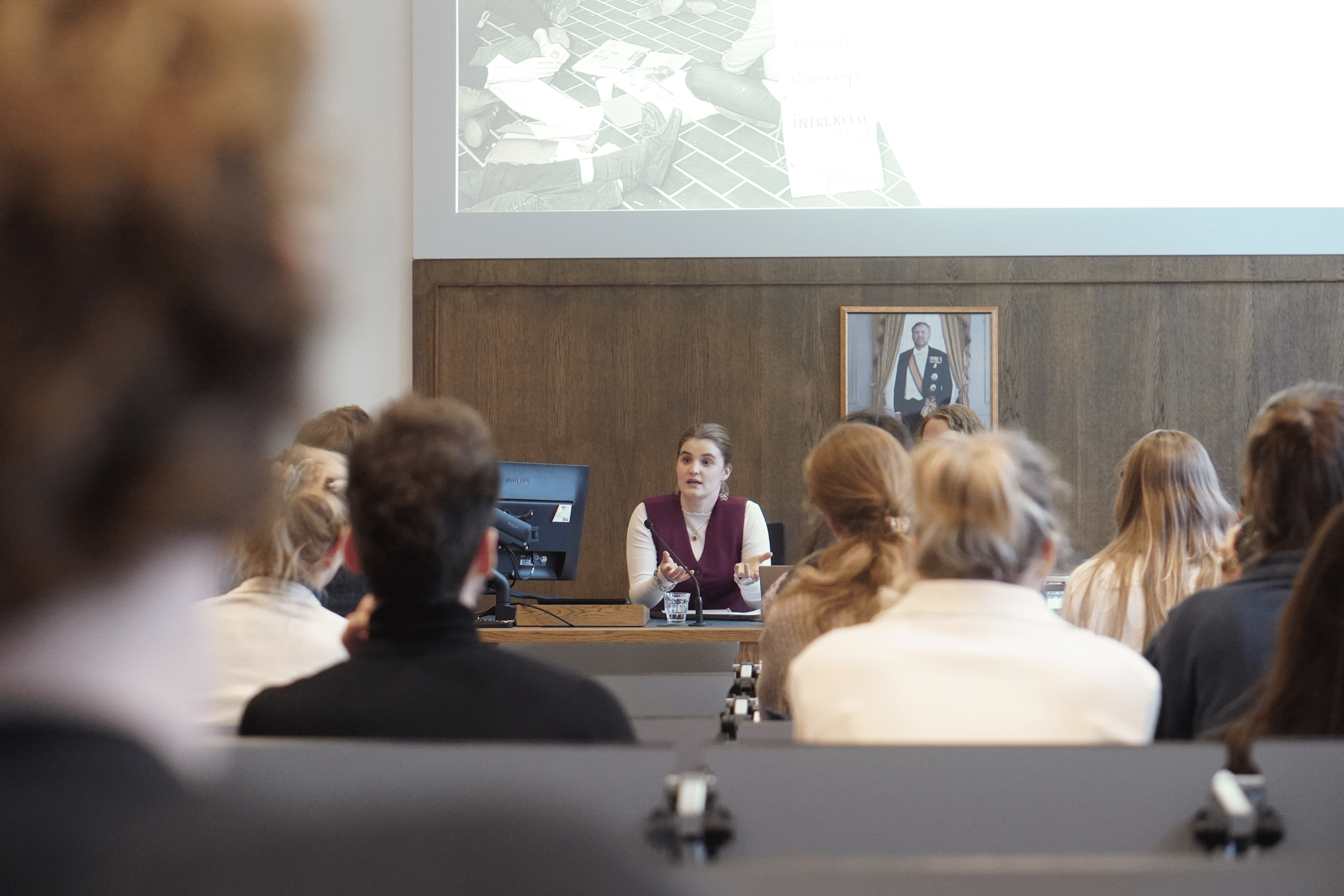
On 26 January, Rowie Stolk, Laura Hanrath and Marloes Noorloos spoke at the lecture ‘The Right to Demonstrate under Scrutiny’. This discussion session, part of the university lecture series Community. Conversation. Connection., was organised in response to difficult questions about the right to demonstrate.
Demonstrations are often seen as a problem that needs to be controlled, for safety reasons, among other things. But demonstrating also lets us express our opinion and dissatisfaction. It should therefore be facilitated as an important part of our democracy. This creates a tense situation, also within universities. Because it is precisely within the walls of a university that free debate should be possible. At these meetings, staff and students discuss this with each other.
Chilling effect
The number of demonstrations in the Netherlands has risen sharply since 2,000 and is now around 6,000 a year. According to Rowie Stolk, assistant professor of constitutional and administrative law, the right to demonstrate is under pressure. For example, you need to report a demonstration to your municipality, but sometimes it requests personal data, compensation or a police escort. It has even happened that municipalities wanted to have a say in the content of demonstrations, such as protest signs. This can have a 'chilling effect' in that protesters are deterred by the possible consequences, which limits their right to protest.
The university as a semi-public place
Laura Hanrath has published on the right to demonstrate in semi-public spaces, which also includes universities. As was rightly pointed out in the Q&A session, the term 'semi-public' is very confusing: a space is public or not, isn't it? Hanrath explained that you should not think of this as a position on a spectrum, but a field. The term 'semi-public' is confusing, but refers to places with a public role that are formally private, such as train stations or universities. These locations are allowed to set ‘house rules’, but these sometimes clash with the right to demonstrate. This also depends on the purpose of the demonstration: if students want to demonstrate against checking the LU-card, they are going to do so at the place where they have to show their LU-Card to enter a building.
Demonstrations and criminal law
Marloes van Noorloos emphasised that criminal action at demonstrations is only justified in the event of significant disturbances. Arrests or detentions must be necessary and proportionate. Of course, criminal offences such as vandalism or violence remain criminal offences, but the actions of authorities must always be proportionate to the situation at hand.
The central message of the three presentations was that it is difficult to rely on a general policy on demonstrations, because you always have to make an individual assessment based on many different factors.
Discussion
Both staff and students discussed this dilemma. For example, a member of staff asked what legal defence you have if you are forced to spend a night in a cell after a demonstration, and what steps the police should take to respect your right to demonstrate. A night in the cell can also have a 'chilling effect, even if the night in the cell was unjustified. Exactly at 17.30, the session came to an end. Among the attendees was Sarah de Rijcke, the new Rector Magnificus, who joined Dean Suzan Stoter in thanking the three speakers for organising this valuable and lively discussion at the KOG.
This discussion was part of the Leiden University series Community. Conversation. Connection. This series has been organised to make room for discussion about today’s hot-button issues such war and peace, intolerance, human rights, polarisation, securitisation, the climate and other topics.