
Quantum technology and law: ‘We need to consider the legal frameworks of tomorrow now’
How do we prepare for the impact of new technology that promises to make our systems more powerful and faster than ever? At the Quantum & Law Conference, experts showed that quantum technology raises new legal and ethical issues.
Quantum technology promises to change the world, offering applications in healthcare, finance and cybersecurity. But how do we ensure these innovations are introduced safely, fairly and responsibly?
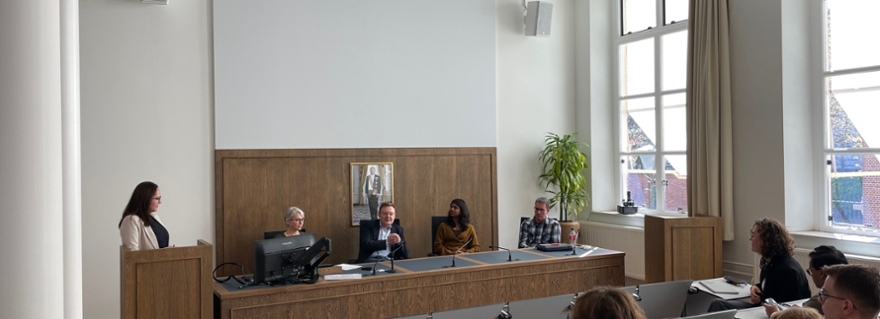
The Quantum & Law Conference 2026, organised as part of a KIEM project by Leiden Law School and the Faculty of Science, focussed on these questions. Experts from various disciplines emphasised that quantum technology is not just a technical matter, but an interdisciplinary issue that affects us all and therefore calls for an integrated approach.
Interdisciplinary issue
Vanessa Mak, Professor of Civil Law (Leiden Law School), and Julia Cramer, PI Quantum & Society (Faculty of Science), worked together to organise the conference. 'Quantum technology is no longer the exclusive domain of physicists or engineers,' Cramer says about the collaboration. 'Introducing quantum technology into society is an interdisciplinary issue that affects us all and requires close collaboration between legal experts, ethicists, technologists and policymakers. Only in this way can we encourage innovation without losing sight of the risks.'
Key insights
Important insights were shared during the conference:
- Legal challenges: ‘We need some education’, Gerrit-Jan Zwenne says. Lawyers still do not fully understand what quantum technology does or how its applications work, for example when it comes to breaking encryption. As a result, it is still not clear how the risks of quantum applications can be managed.
- Ethical considerations: ‘Quantum for Good’, meaning responsible use of quantum technology, requires collaboration between engineers and companies to jointly develop standards for the use of quantum applications.
- Collaboration: The panel discussion, with experts Clare Shelley-Egan (TUD), Gerrit-Jan Zwenne (LEI), Anuschka Mittal (UvA) and Christian Schaffner (QuSoft), moderated by Melissa Hernandez Vinhas, showed that it is only possible to create a future-proof framework through collaboration between technologists, legal experts and ethicists.
Quantum technology offers great promise, but it also entails significant risks – among other things because it can be used to break cryptography and because its high cost means it is being developed by only a small number of companies with substantial market power. Legal experts and ethicists can contribute to making quantum technology accessible for societal applications, for example by helping develop shared technical standards that apply globally.
Follow-up?
The conference was a first step within a broader discussion on how we can use quantum technology to serve society, without ignoring the legal and ethical pitfalls. To follow developments, check out the university research page on quantum and space.