

Cosmic magnifying glass reveals exceptionally heavy dormant black hole in the early universe
Astronomers have measured the mass of a dormant, supermassive black hole in the early universe for the first time. Thanks to a combination of the James Webb Space Telescope and a natural cosmic magnifying glass, researchers were able to weigh the black hole directly based on its gravity.
The black hole turns out to be about six billion times as massive as the Sun and remarkably large in proportion to the stellar mass of its host galaxy. The discovery offers new insights into the joint growth of black holes and galaxies in the first billions of years after the Big Bang. The results will appear this week in the journal Science.
Dormant black holes
Virtually every large galaxy contains a supermassive black hole at its centre. Some of these betray their presence by swallowing enormous amounts of gas. This creates a quasar: an object that can temporarily shine brighter than an entire galaxy. But most black holes are inactive. They emit hardly any radiation and are therefore much more difficult to study. This is especially true for black holes in the distant and early universe, whose light has been traveling for billions of years.
An international team led by Carnegie Science in Washington DC (USA) has now succeeded for the first time in directly weighing such a dormant black hole in the early universe. ‘This is the first time we have been able to measure the mass of a black hole at such an enormous distance in this way,’ says Mariska Kriek, professor at Leiden University and co-author of the study. ‘Normally, this is only possible in galaxies in our cosmic vicinity.’
Natural magnifying glass
‘We were able to detect this black hole at a distance of ten billion light-years by combining Webb's sharp vision with a natural magnifying glass,’ says lead researcher Andrew Newman of Carnegie Science. The black hole is located at the centre of MRG-M0138, a massive galaxy about ten billion light-years away. As a result, astronomers see the galaxy as it looked when the universe was only about three billion years old.
The fact that this particular distant black hole could be weighed was due to a rare cosmic alignment. An enormous cluster of galaxies lies between Earth and MRG-M0138. According to Einstein's theory of relativity, the gravity of such a cluster bends the light from objects behind it. As a result, the cluster acts as a natural lens that magnifies the image of the galaxy behind it. MRG-M0138 is magnified approximately thirty times by this cosmic lens.
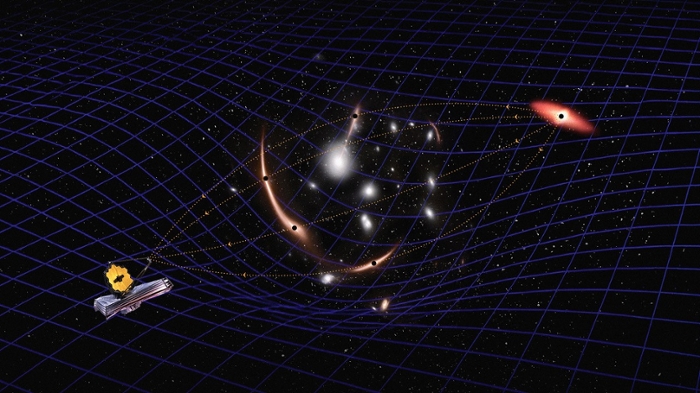
Thanks to this magnification, the researchers were able to measure the movements of stars in different parts of the galaxy. From the movements of the stars, they could deduce how much mass is located in the centre. ‘This is one of the best techniques we have for weighing a black hole,’ says Newman. ‘That is why we were excited to apply this method to a much earlier era in cosmic history.’
Grown early
The observation shows that not only galaxies, but also supermassive black holes were able to reach enormous masses early in the history of the universe. That makes MRG-M0138 an important reference point for understanding how galaxies and their central black holes grow together. ‘These kinds of observations help us better understand where that correlation comes from,’ says Kriek.
Observatories such as the European space telescope Euclid are expected to discover many more of these types of gravitational lenses. This will allow astronomers to reconstruct the joint growth of galaxies and black holes in the young universe with increasing accuracy.
Scientific article
Andrew B. Newman et al. (2026), A stellar dynamical mass measurement of an inactive black hole at redshift 2, Science.
This press release originally appeared on astronomie.nl.