
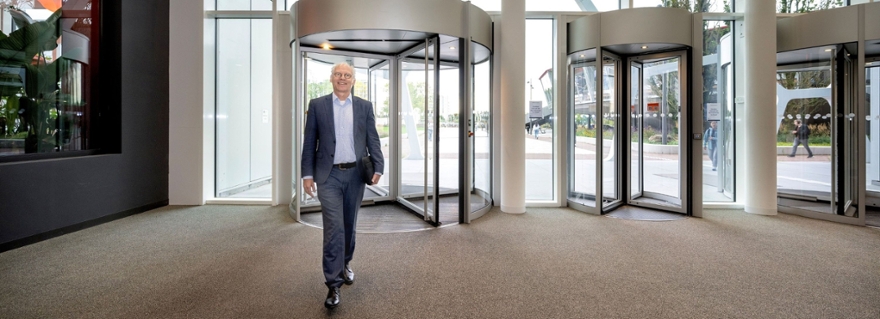
Jasper's day - A new hip, a new perspective
Within an hour, Jasper had a new hip. Recovery will take a little longer, but he hopes to be on stage at the opening of the academic year, with or without support. In this column, Jasper shares his experiences surrounding the operation.
Jasper Knoester is Dean of the Faculty of Science. How is he doing, what exactly does he do, and what does his day look like? In each newsletter, Jasper offers a glimpse into his daily life.

Tuesday 28 July
‘I wake up at a quarter to five after a night of short bursts of sleep. I’m hungry and know there is no chance of getting back to sleep. Fortunately, I have some fruit within reach for a first breakfast. I am in Amsterdam, in a clinic where my right hip joint was replaced with a prosthesis yesterday afternoon. It was a planned operation that I had been putting off for a long time, but over the past six months the pain caused by osteoarthritis had become too severe. The procedure took barely an hour. Sometimes it takes me longer to mend a bicycle tyre!
This clinic specialises in this type of surgery. They were also able to guarantee a date during the summer, making it possible to recover in relative peace and quiet. The goal is to be on stage at the opening of the academic year, perhaps with the support of a high chair. This morning, however, that still seems a very long way off. Carefully, I do simple exercises in bed that the physiotherapist taught me yesterday. They are all intended to get the muscles around the hip joint moving again as quickly as possible. The pain is quite manageable, undoubtedly helped by the painkillers.
Six weeks of rehabilitation
A nurse comes by after noticing the light in my room. Apparently, I am the first patient awake, and at 6.15 am I am served a generous breakfast. Afterwards, I carefully take a few steps on crutches. I did the same briefly last night. It is remarkable how quickly you can put weight on an artificial joint. The main problem is the muscles that were moved aside, or even cut through, during the operation. Rehabilitation over the next six weeks will focus entirely on that. First, I need to learn to walk properly again, and then spending the following months working towards being able to ski once more.

Discharged and back home
The surgeon visits before eight o'clock and confirms that the operation went well. I will see him again in mid-September for a check-up. Afterwards, the physiotherapist teaches me how to go up and down stairs using crutches. Then the nursing staff arrive with a large bag of medication, mostly painkillers, which I hope I will not need for long. The IV is removed from my hand, I receive my discharge papers, and shortly after nine o'clock Xuefei and my sister Hennie wheel me out of the clinic in a wheelchair. I have no idea how smoothly the rehabilitation will go, but I have nothing but admiration for the patient care, kindness and professionalism of the staff at this clinic. As for the rest, I face it with confidence.
Within an hour we are back home, where I awkwardly haul myself out of the car and make my way up the five steps to the living room. A high chair with armrests is waiting for me there. Everything still feels unfamiliar, and my family watch with bated breath to see whether I can manage it all without falling. We celebrate my return home with ice cream, which suits the summer weather perfectly. After about an hour, my energy quickly begins to fade. I had a spinal anaesthetic rather than a general anaesthetic, but recovering from the operation takes a great deal of energy. The morphine tablet I took this morning does the rest.
‘I'm not coming downstairs again today’
With complete concentration, I make my way up the 21 steps to the bedroom, where I carefully settle myself into bed. I spend the rest of the day sleeping, begin reading the wonderful book by Orhan Pamuk that was given to me to make this period a little more pleasant, and have brief online contact with friends, family and colleagues. I'm not coming downstairs again today and gladly rely on the excellent care of Xuefei and Kamiel. In five days, they will leave for China, so I need to rest now and make sure I am mobile enough by then to look after myself. Three days later, Jasmijn will return from her gap year, and I will be pampered once again before she begins her introduction programme in Leiden.
A new academic year is on the horizon, with a new hip, no more pain, a son preparing for his final school exams and a daughter embarking on a new chapter. Today, it all still feels a long way off, but it is a very encouraging prospect.’