
Career policy for academic staff
Leiden University wants to attract the best academics. What requirements does it set for new academic staff members? What requirements must you meet for a career in academia? Read more about our career policy for academic staff.
PhD basis for academic career
You will need a PhD if you wish to take the next step in your academic career, regardless of whether this means working as a lecturer, associate professor or professor. This principle does not apply to faculties who are hiring lecturers on a temporary basis. In any other exceptions to the rule, the approval of the Executive Board will be needed.
Experience: within or outside academia
If you are applying for a permanent position, you must have experience outside Leiden University. This can be academic experience at another university or practical experience outside academia.
GROW
Once every year you will be invited to a GROW interview. Your performance and development over the past year will be appraised, and you will make agreements for the year to come.
Permanent contracts, promotions or other awards such as an extra salary raise or a bonus are dependent on the GROW interview. Your performance must have met the requirements for your position.
Teaching qualification
All university staff with a teaching role must possess one or more teaching qualifications.
PhD candidates and academic staff who have a 0.5 fte contract of less than a year must follow a basic course in teaching skills.
All professors, senior lecturers, associate professors and lecturers with a contract of at least one year for at least 0.5 fte must possess the University Teaching Qualification (BKO).
The Senior Teaching Qualification (SKO) is a qualification for staff who wish to work at a higher level in teaching innovation and development.
Gender diversity
To attract more talent to the University, we aim for greater gender diversity right up to the highest level. We therefore pay particular attention in our recruitment process to applications from people who are underrepresented within particular roles.
More information
For more information on the recruitment and support of academic staff, see the Guidelines on the Appointment of Academic Staff.
Introduction and principles for career development and promotion of academic staff
The faculty’s promotion policy for academic staff is based on a number of clear principles:
- Academics contribute to teaching and research, including service to society, as well as management. The distribution of effort across these domains is determined by the institute board, depending on what is required for the organisation to function effectively.
- We recognise that staff members differ in their talents and skills. This diversity is highly valued. Not everyone contributes equally across all domains; this may lead to different career pathways. All contributions to the university – at every level – are therefore recognised and valued.
- Leadership forms part of every academic role. Staff are expected to develop skills such as reflection, collaboration, and organisational awareness.
- Promotion is neither an automatic entitlement nor the sole measure of success. It is the result of personal and professional growth, shaped by both the individual staff member and the organisation. With regard to horizontal career development, staff who wish to develop themselves are given the opportunity and support to do so, regardless of whether this leads to promotion.
- Promotion is based on quality and performance.
- The promotion policy should be transparent throughout the entire career journey, starting from the moment of appointment.
- Finally, the faculty applies a policy that is as consistent as possible, while allowing room for differences between disciplines and fields of research.
Career policy
The Recognition & Rewards framework emphasises that academic contributions are valued more broadly than research alone. Staff contribute in different ways across the areas of research (including service to society), teaching (including service to society), management, and personal development & leadership, while their individual talents and interests may evolve throughout their careers. At the same time, a balance must be maintained with the operational needs of the organisation. The Recognition & Rewards framework forms part of the university-wide programme Academia in Motion.
Career pathways
The Recognition & Rewards policy within the Faculty of Science emphasises that the contributions of academic staff in the domains of research, teaching, and management are all valued, with personal development & leadership serving as a common factor across all domains. Staff do not contribute equally to every domain, and individual talents and interests may change over time. Career development and promotion are aligned with these individual strengths, while also taking into account the operational needs of the institutes to ensure sufficient capacity and achieve organisational objectives.
Within the faculty, three main career pathways are distinguished:
- Research-focused pathway (U-track) – for Assistant Professors, Associate Professors and Professors with a strong focus on research and an average contribution to teaching.
- Teaching-focused pathway (U-track) – for Assistant Professors, Associate Professors, and Professors with an emphasis on teaching and a smaller contribution to research.
- Teaching pathway (D-track) – for Lecturers, focused exclusively on teaching, with exposure to research.
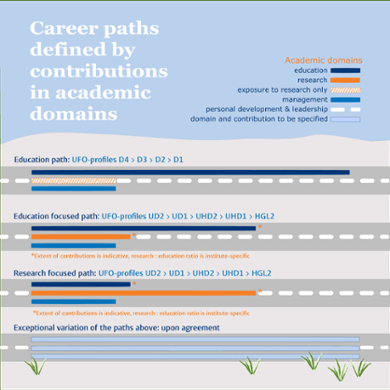
Lecturers, Assistant Professors, Associate Professors and Professors 2 are assigned to a career pathway by the institute board in consultation with the faculty board. Switching between pathways is possible where this aligns with the institute’s strategy. Lateral career development, growth without promotion, is also supported, for example through the development of new skills or the expansion of responsibilities. This requires both individual commitment and support from the institute.
Differences between the teaching-focused pathway and the teaching pathway
The difference between the two teaching-related pathways is that a staff member in the teaching-focused pathway (U-track) is involved in research and is required to hold a PhD, whereas a staff member in the D-track should have exposure to research but is exclusively engaged in teaching, with no PhD required (except in exceptional cases). D-track staff teach in Bachelor’s programmes and transferable skills courses within Master’s programmes. They may participate in programme committees and examination boards, and contribute to educational development.
Variants
Where appropriate, variants of the main career pathways may be introduced if requested by the institute board. Examples could include a pathway focused on societal impact, such as science communication or entrepreneurship. Fundraising and the supervision of PhD candidates will always remain mandatory elements, as will leadership development. Variants of the main career pathways are discussed on a case-by-case basis between the institute board and the staff member, and must be approved by the faculty board.
Discipline-specific differences
The institutes within our faculty differ, among other things, in the average amount of time devoted to teaching and research, and in the extent to which research must align with existing research lines. The career policy therefore allows room for discipline-specific interpretation. Most promotion criteria are defined at faculty level, but there are also discipline-dependent indicators, which are defined by the institute board in consultation with the faculty board.
Service to Society (Activities Beyond Academia)
Service to society (activities beyond academia) is becoming increasingly important. Staff are expected to contribute to societal activities such as outreach, collaboration with external partners, or spin-outs. Contributions to Open Science and Open Education are also recognised and taken into account in promotion decisions.
Personal development and leadership
Finally, leadership forms a common criterion across all pathways. Staff are expected to develop leadership skills, supported by the University’s professional development provision. This forms an important component of every promotion.
Recruitment and criteria
As a general principle for academic staff, the faculty applies the principle that career development is based on individual performance. Institutes may create new positions where this is strategically necessary. The standard entry levels are Assistant Professor 2 (U-track) and Lecturer 4 (D-track); appointments at higher entry levels require alignment with the faculty board. Recruitment takes place through open procedures in order to promote transparency and diversity. Vacancy texts and discussions during the recruitment process clearly communicate the intended career pathway, promotion criteria, expectations, and procedures. Candidates are assessed on both research and teaching, including service to society, as well as on personal development and leadership, depending on the relevant career pathway.
Onboarding and support
Upon appointment, the intended career pathway, career prospects, timelines, and promotion criteria are set out in the appointment letter. Career development is discussed regularly during introductory meetings and GROW discussions. New staff members are assigned at least one mentor and are informed about the institute’s strategy. Teaching skills are supported through the University Teaching Qualification (UTQ/BKO) and Senior Teaching Qualification (STQ/SKO), while further professional development is encouraged through, among other things, peer feedback.
Promotion procedure
In principle, promotion is possible at different stages throughout a career and is based on demonstrable development since the previous step. Promotion decisions take into account performance across the full portfolio of activities: research (including service to society), teaching (including service to society), management, and personal development & leadership.
Promotion procedures are established and may differ by position level and career pathway; these procedures are communicated by the institute board. Clear communication and feedback regarding promotion decisions form part of the process.
The promotion criteria (link) are standards. Assessments remain tailored to the individual, taking into account the staff member’s profile, academic discipline, and context. Achievements are evaluated in relation to one another, allowing strengths in different areas to compensate for one another.
Promotion dossier
As a general rule, candidates for promotion submit a dossier describing their achievements and development. Depending on the career pathway, the emphasis may be placed on research, teaching, or both. Additional elements, such as external references or letters of recommendation, form part of the procedure.
Promotion dossiers are assessed by a promotion advisory committee. Institute boards make decisions on promotion proposals to Lecturer 2 or Assistant Professor 1 level; promotions to higher levels are assessed by the faculty board on the recommendation of the institute board and with advice from the Committee for Academic Promotions (WeCo).
Promotion criteria
For the three main career pathways, standard criteria have been established across four domains: research (including service to society), teaching (including service to society), management, and personal development & leadership. These domains consist of several indicators through which performance may be assessed. In the case of variants of the main career pathways, the indicators are determined by the institute board in consultation with the faculty board, and in all cases include fundraising, PhD supervision, and leadership development.
The promotion criteria differ according to career pathway and position level and are set out in separate tables (see the Career Policy document on this page). These criteria are standards and serve as guidelines for development and assessment, but are not strict minimum requirements. The institute board may depart from the standard criteria where justified. In doing so, consideration is given to the staff member’s overall contribution, including leadership, collaboration, and other relevant activities. Where applicable, deviations are explained in the decision-making process.
Assessments therefore remain tailored to the individual, taking into account the individual profile, academic discipline and context. Achievements are evaluated in relation to one another, allowing different strengths to compensate for one another.