

Japanese Literature Reading List
From experimental essays to comfort reads, and from manga to court literature in verse: Japanese literature has it all.
Did you know that the Leiden University Libraries (UBL) has a wealth of Japanese literature in translation? And that the collection includes both contemporary classics and hidden gems, ranging from Haruki Murakami and Sayaka Murata to Kenji Nakagami and Fumiko Enchi? In this reading list we highlight several works of Japanese literature. All books on the list can be found in our Catalogue via the links under each title. Would you like to view these books right now? You'll find every book on this list and more in the Information Centre Huygens, in the heart of the University Library.
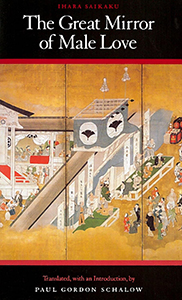
The Great Mirror of Male Love, Saikaku Ihara
2022
translated by Paul Gordon Schalow
Saikaku Ihara (1642-1693) first and foremost gained fame as a poet for his haikai no renga (linked verse) poetry, but later in life he began writing prose fiction. Much of his fiction was written for and about samurai, the merchant class, and the floating world. Ihara wrote for a wide audience and many of his stories are about love and romance.
In 1687 he published Nanshoku Ōkagami (The Great Mirror of Male Love), where homosexuality – or rather, male love – is the central theme. In forty short stories (eight sections of five chapters) he depicts relationships between men – samurai, kabuki actors and their patrons, monks, and so on, often (but not exclusively) between older and younger men.
Translator Paul Gordon Schalow introduces Saikaku Ihara, his work, and the context in which Ihara wrote, and provides ample endnotes for each story.
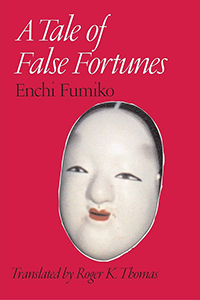
A Tale of False Fortunes, Enchi Fumiko
2000
translated by Roger K. Thomas
A Tale of False Fortunes is a retelling of events we know from, among other sources, The Diary of Murasaki Shikibu and The Pillow Book by Sei Shōnagon. The way in which the narrator interweaves quotes from historical material with her own story is challenging and keeps the reader alert, because they constantly have to gauge where the historical source ends and Enchi's narrative begins.
Through its unusual narrative structure and by telling history from the perspective of the loser, Enchi exposes patriarchal power structures and makes the reader question the relationship between fiction and history. In this way, the book closely aligns with recent feminist approaches to Greek classics, albeit almost half a century (!) later. A real must-read!
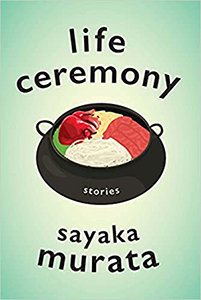
Life Ceremony – Stories, Sayaka Murata
2022
translated by Ginny Tapley
“What if it were normal to... instead of...?” With this central theme, Sayaka Murata (Convenience Store Woman, Earthlings) subtly deconstructs cultural norms. In this collection of short stories, Murata turns what we consider obvious in terms of sexuality, eating habits, death rituals, and even traditional materials on their heads. Motifs from her earlier works also reappear: asexual reproduction, unconventional families, and the willingness to break with social expectations. In essence: short stories that give you plenty of food for thought.
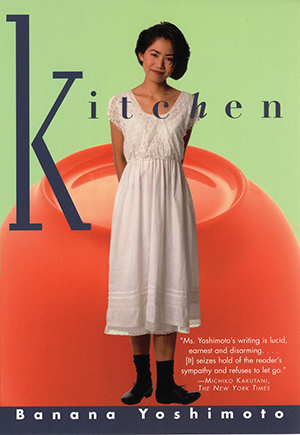
Kitchen, Banana Yoshimoto
1993
translated by Megan Backus
Kitchen is a moving story about loss and the unlikely places where we can find comfort, and how precious those moments can be. Although it is only a short story, it touches on many themes. Despite this thematic density, the story does not feel heavy or complicated because of how it beautifully follows a very limited number of characters over a relatively short period of time.
Among other things, the book is about loneliness and finding your place in one of the largest cities in the world. Given the universal themes of grief, loneliness, and uncertainty about the future, it is no wonder that this book has also reached a wide audience outside Japan.
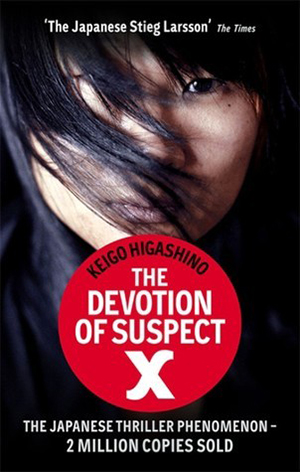
The devotion of suspect X, Keigo Higashino
2005
translated by Alexander O. Smith, & Elye J. Alexander
Math teacher Ishigami has a peculiar problem: his neighbour and her daughter have impulsively killed her dangerous ex-husband, and he has heard them do it. Ishigami is secretly in love with the abused neighbour and decides to help them. To conceal their crime perfectly, he devises an extremely careful plan. To top it off, he even claims to be the perpetrator himself. When the police investigation fails to progress, the brilliant physicist Yukawa—Detective Galileo to his friends—is called in to help. Will he unravel Ishigami's perfect solution?
Japan is known for its crime and mystery literature. In this landscape, Keigo Higashino (Salvation of a Saint, Malice) has marked an important turning point in modern mystery literature with his focus on the psychology of his characters. This book heralds the beginning of one of his best-known series, alongside which his oeuvre covers many other genres.
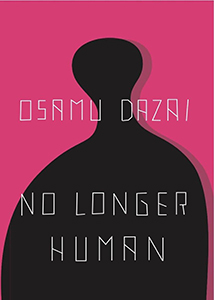
No longer human, Osamu Dazai
1958
translated by Donald Keen
Osamu Dazai's No Longer Human is as if the main character, Ōba Yōzō, left behind notebooks that were later compiled into a book by an unnamed narrator who received the books 10 years after the last word was written in them. In these three notebooks, Yōzō describes his deep struggles and feelings towards others, from his childhood until he is almost 30.
The book deals with heavy themes such as depression, suicide, drug use, and loneliness in a unique way. One of the central themes is the effort it can take to meet social expectations in order to “fit in.” For these reasons, this work is often considered Osamu Dazai's best work.
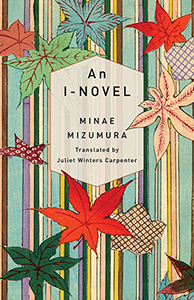
An I-Novel, Minae Mizumura
2021
translated by Juliet Winters Carpenter
There are more than four million people of Japanese descent who live outside of Japan. They are known as “Nikkei”. After Brazil, the US has the largest population of Japanese descent. A question that often arises in migrant literature is: how can someone relate to the country where they or their (grand)parents came from?
An I Novel is a semi-autobiographical work that discusses this in a unique way. The events in the book take place on a single day in the 1980s. The main character, Minae, receives a phone call from her sister reminding her that their family wants to celebrate the twentieth anniversary of their arrival in the US. But Minae has decided to return to Japan to write in Japanese, how will she break the news to her family?