Introducing: Julius van der Poel
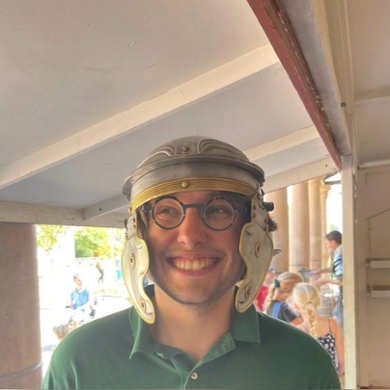
Julius van der Poel recently joined the Institute for History as a PhD candidate within Judith Pollmann’s Spinoza Project. Below he introduces himself.
I’ve been around the Huizinga Building for so long that I’m practically part of the furniture. After spending many formative years in these halls as a student, it’s a wonderful opportunity to be able to stay here and officially join the Department of History as a PhD candidate.
From the Russian Steppe to the Dutch Revolt
My path to this point hasn’t exactly been a straight one. In fact, I arrived at the history of the Dutch Revolt via a long, winding detour through Russian studies. During my bachelor’s program, I was fascinated by the tensions between a distant power and local life, in particular, how communities throughout the Russian Empire negotiated with the center in Moscow. I was interested in exploring bureaucratic power, local agency, and the art of negotiation – topics that, surprisingly, brought me back to my own "backyard" in the Netherlands.
During my MA research, I applied the same perspective to the confiscation of monastic property in Leiden after the city joined the Dutch Revolt in 1572. I examined how the city’s new Protestant administration struggled to establish a new property order while grappling with the traditional rights of old Catholic institutions. Gaining access to monastic properties and reallocating them proved to be far more difficult and contentious than the new rulers had anticipated. Outside the city walls, officials had to contend with village communities and haughty nobles, who had their own ideas about what should become of the former monastic estates.
The Long Shadow of Confiscation
I am now shifting my focus from the city to the countryside during the period between 1580 and 1750. My project, “The Long Shadow of Confiscation,” examines the chaotic and protracted aftermath of the redistribution of the former Catholic Church’s assets in the Northern Netherlands.
Historically, this story has been told primarily as a legal issue, as a top-down narrative about church councils and formal decrees. I want to shift the perspective through an investigation of how local nobles, village officials, and peasants reacted to the confiscation of church property and how they adapted to a new, often uncertain reality. Ultimately, I want to understand how these local power struggles over property shaped the religious and social identity of these communities across generations. Tracking this transformation could provide new answers to long-standing questions about the religious geography of the Netherlands and possibly explain why certain regions eventually adopted Protestantism while others remained Catholic.
Rethinking the Dutch Countryside: The Spinoza Project
My research is part of Prof. Dr. Judith Pollmann’s Spinoza Project. Together with many wonderful colleagues from Leiden and other Dutch universities, we have set out to rethink our approaches to the history of Dutch rural life. For far too long, this rural perspective has been overshadowed by the “Golden Age” of the cities; we want to bring the vibrancy and complexity of rural life to the forefront of the narrative. I hope that my research will contribute to a more multifaceted picture of rural life in the Netherlands and deepen our understanding of how local communities dealt with and experienced the religious changes triggered by the Dutch Revolt.
Uncovering this complex picture requires a specific approach. To find the sources that reveal this lived experience, we cannot remain behind our desks in Leiden. The solution lies in getting involved on the ground: long train rides to regional archives, site visits, and occasionally a bit of mud on our boots as we engage with local experts and historical societies who know their heritage best. By listening to these local voices and acknowledging their distinct stakes in the narrative, we can build a much richer, more inclusive history of the Netherlands. I look forward to meeting many of you over coffee in the Huizinga, or preferably out in the field!