
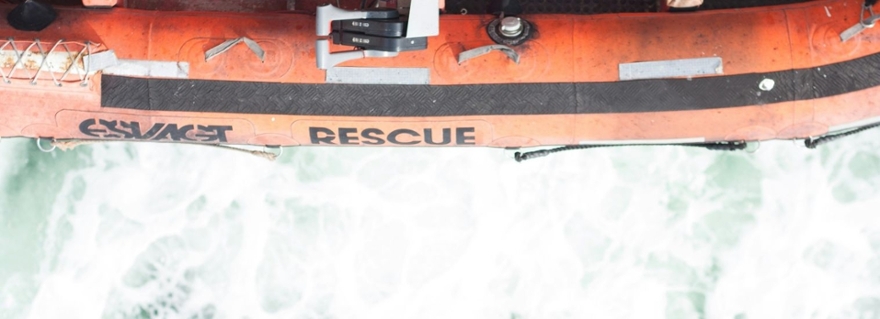
Leiden researcher Sarah Wolff advises on EU rescue missions at sea
Together with professor Violeta-Moreno Lax, Leiden researcher Sarah Wolff has advised Frontex, EU actors and other institutions on a European framework for Search and Rescue-operations. This would have high impact, for instance on rescue missions in the Mediterranean Sea.
Every day, migrants try to reach Europe by boat, mainly via the Mediterranean. The dangerous crossing claims many lives, and a great number of people need rescuing by coastal guards or navy belonging to EU member states. Yet, the EU currently does not have a clear framework on who exactly has search and rescue (SAR) responsibilities, in what situation, and what those responsibilities entail. ‘In the past few years, it's been complicated to share responsibilities between member states’, says Leiden researcher Sarah Wolff. ‘And the problem is not necessarily always search and rescue, but disembarkation. Where do you disembark people and then how do you process asylum seeking application? This is why the concept of search and rescue is so difficult to agree upon.’
Deflecting responsibility
Frontex, the EU border and coast guard agency that coordinates EU rescue missions of migrants at sea, does not consider SAR among its competencies; it is involved in operations and assets but considers it is a responsibility shared with EU Member States. Wolff: ‘The current regulation says that Frontex should provide technical and operational assistance in support of search and rescue operations for persons in distress at sea. The agency plays on the word “support” to deflect responsibility. It supports EU Member States with aerial surveillance and sending distress messages to the national Maritime Rescue Coordination Centres who are then sending SAR missions.’
Turning tide
But the tide could be turning. Several parties including member states and NGOs, have called for an EU or Common European response on SAR. Moreover, the current mandate of Frontex is being revised and will be debated in September between the European Parliament and the European Council. Looking ahead to these negotiations, Frontex, together with the Office of the High Commissioner for Human Rights, invited researchers Violeta-Moreno Lax (University of London) and Sarah Wolff (Leiden University) to present their findings on possible governance models for a EU search and rescue framework. They did so in June during a meeting at the UN House in Brussels.
Sarah, you researched several models for search and rescue. Could you elaborate on those models?
‘The models that we researched are best viewed within a spectrum of centralization versus decentralization. The most centralized model would consist of a supranational EU integrated with a clear plan and clear structures. We derived that model from an earlier naval, humanitarian mission of the Italian Marine Navy (2013-2014). It's the operation that saved the most migrants so far; 100.000 people in less than a year. The Italian Navy was coordinating the medical support, the processing of applications, with boats also functioning as medical platforms. Also, they were working hands in hands with NGOs, and the disembarkation process was also clear. The challenge would be to transpose that to an EU system where you have, of course, several states.’
How about the other models?
‘The second model consists of Frontex coordinating the work of member states who have a search and rescue responsibility. This model is possibly the easiest to implement because you can easily improve the agency and expand its competencies. But, and this is a very important point, they need to fulfill international law. At the moment, that fulfillment is under scrutiny.’
‘A third option would be to delegate responsibilities to a third country. This model however is not advisable, though due to the legal complications of extraterritoriality and possible violation of fundamental rights, it can incur. The fourth, least centralized model, would be to delegate search and rescue to a group of countries of EU member states who lead the mission. For instance, in the past, we’ve seen a coalition of the willing (Malta, Germany, Italy and the European Commission) working together in search and rescue-missions. And the last option, which was actually the model that was most preferred by attendees during the meeting, is a hybrid model. This would be a combination of earlier mentioned models in which EU institutions, Frontex and NGOs would be working together.’
Isn’t the hybrid model too complicated?
‘Well, we see it as a staggered model which allows for room to go step by step in the next three to five years and work out points of contention. In a realistic political world, it would be about taking different elements from various options. The hybrid model would, in my opinion, offer the biggest chances of producing a sustainable, permanent EU SAR mission.’
When do you expect a result of the negotiations?
‘The European Commission is due to present a revised mandate for Frontex regulation in the Fall 2026. This follows the announcement by Commission President of her intention to expand the competences of the agency notably with more surveillance technologies, to expand the number of European Border and Coast Guards. Once the Commission initiates the new draft legislation, the European Parliament and the Council of the EU will then negotiate under the ordinary legislative procedure. These negotiations will take between one year and one and a half year.’