

How does a problem like shadow banking disappear from the political agenda?
Researchers usually study what politicians say and do. But how do you investigate what they don't talk about? PhD candidate Yu-Sha Vergeer examined how Dutch media, politicians and policymakers discussed shadow banking, and why the issue repeatedly slipped from view.
During the 2008 financial crisis and later the COVID-19 pandemic, debates regularly resurfaced about the vulnerability of the Dutch financial system. Yet one issue repeatedly faded into the background, largely because it was hardly discussed: shadow banking. According to Vergeer, this was no coincidence. In her doctoral research, she investigated how shadow banking appeared in media coverage, political debates and policymaking between 2000 and 2023. In doing so, she focused on a relatively little-known phenomenon: agenda denial.
What is agenda denial?
‘Agenda denial means preventing an issue from reaching the political agenda, or ensuring that it disappears from it. In many ways, it is the opposite of agenda-setting, where media, politicians and interest groups seek to draw attention to a topic. Agenda denial has received far less scholarly attention. That is precisely why I found it interesting: we know relatively little about why some issues remain out of sight.’
How did you end up studying shadow banking?
‘That was quite the challenge, because how do you choose a relevant topic that is rarely discussed? I worked in the financial sector myself, so I started thinking about shadow banks. When these institutions run into trouble, central banks or governments may have to intervene to prevent wider damage to the financial system. That can ultimately involve taxpayers’ money. I wondered why this issue receives relatively little political attention. Are there underlying reasons for that?’

What are shadow banks?
‘Shadow banks, officially known as 'Non-Bank Financial Intermediaries (NBFIs)', are institutions that carry out financial activities similar to those of banks but are not subject to the same regulations. Examples include auction house Sotheby’s and MUNT Hypotheken, as well as investment funds, hedge funds and pension funds. They play an important role in financial markets and supply chains, but they can also pose systemic risks when they come under pressure. In Europe, the European Central Bank (ECB) spends billions to prevent problems in the shadow banking sector from destabilising the wider financial system.’
How do you research something that remains unspoken?
‘I wanted to conduct the research as objectively as possible and identify the forces at play, because there is often a deliberate strategy behind keeping issues off the agenda. I therefore looked for a way to make those processes visible without relying on speculation.
In the end, I analysed how often shadow banking appeared in parliamentary records, policy documents and media reports between 2000 and 2023. This produced a rich dataset that allowed me to identify both patterns and striking absences. I also conducted 30 in-depth interviews with people from politics, government, the financial sector and the lobbying world to better understand what lay behind those patterns.’
What surprised you most?
‘What stood out was how attention to shadow banking repeatedly waned. During the 2008 financial crisis, interest increased because shadow banks played a major role in financing mortgages in the United States, and the associated risks spread throughout the financial system.

Attention resurfaced in 2012, when research by the Financial Stability Board showed that the Netherlands had one of the largest shadow banking sectors in the world relative to the size of its economy. De Nederlandsche Bank investigated the issue and concluded that, under a narrower definition, many of these institutions were not truly shadow banks. The debate shifted towards definitions and measurement methods, while a broader discussion of the risks failed to materialise. I found that striking because the underlying risks had not disappeared.
For my research, I interviewed various stakeholders about how the shadow banking debate had evolved over time. Based on these interviews, I identified several forms of agenda-denial strategies. Some are relatively straightforward, such as simply denying that there is a problem. Others go further, for example by discrediting critics or even threatening them. Agenda denial can also operate more subtly, through delaying decision-making or introducing symbolic policies. In those cases, it appears as though a problem is being addressed, while in practice very little changes.’
So the problem of shadow banking has not become any smaller?
‘No. The sector still exists and continues to grow and has even become largr than the traditional banking sector. While some are better regulated, a significant part still remains out of sight. What I observed is that political debate was often narrowed. Rather than discussing the broader risks, attention shifted to technical details. As a result, focus moved to a small part of the problem, making it appear manageable while the underlying risks as a whole remained largely unaddressed.
The official renaming of “shadow banking” to “NBFI” did not help either. It is a vague term that is harder for the general public to understand. Sometimes the issue was still acknowledged, but attention gradually weakened as it moved from media coverage to politics and then into policymaking. Over a period of 23 years, shadow banking was discussed in a substantive way in only thirteen policy documents. That is far less than one might expect based on the level of media attention.’
What conclusions can be drawn from this?
‘My research shows that agenda denial does occur and that it can be effective. In this case, it mainly operated indirectly through subtle processes that pushed the issue into the background. The method I developed can also be used to study other societal debates, for example those surrounding agriculture, climate change or vaping. It is important that we become more aware of these kinds of processes.’
What can politicians and policymakers learn from this?
‘Agenda denial will always remain part of politics. It is no coincidence that politics is often described as an arena: interests compete with one another. The most important lesson is awareness. Not only what is discussed, but also what is not discussed, can be significant.
I have developed a toolkit that helps policymakers, lobbyists and politicians recognise agenda denial in practice. Actively countering agenda denial is difficult, but I hope this research makes these processes more visible and contributes to a more balanced playing field. Ultimately, I hope it encourages people to look more critically at what does, and does not, make it onto the agenda.’
Dual PhD
Yu-Sha Vergeer is a dual PhD candidate at the Leiden University Dual PhD Centre. ‘I had a very positive experience with the Dual PhD programme. Because I combined my doctorate with a full-time job, I was looking for both flexibility and a strong connection to the university. The Dual PhD Centre offered exactly that. I was part of a working group and had a dedicated one-to-one coach. Everyone in the programme was conducting research alongside their day job, which created a very enjoyable and supportive dynamic.’
PhD Defence
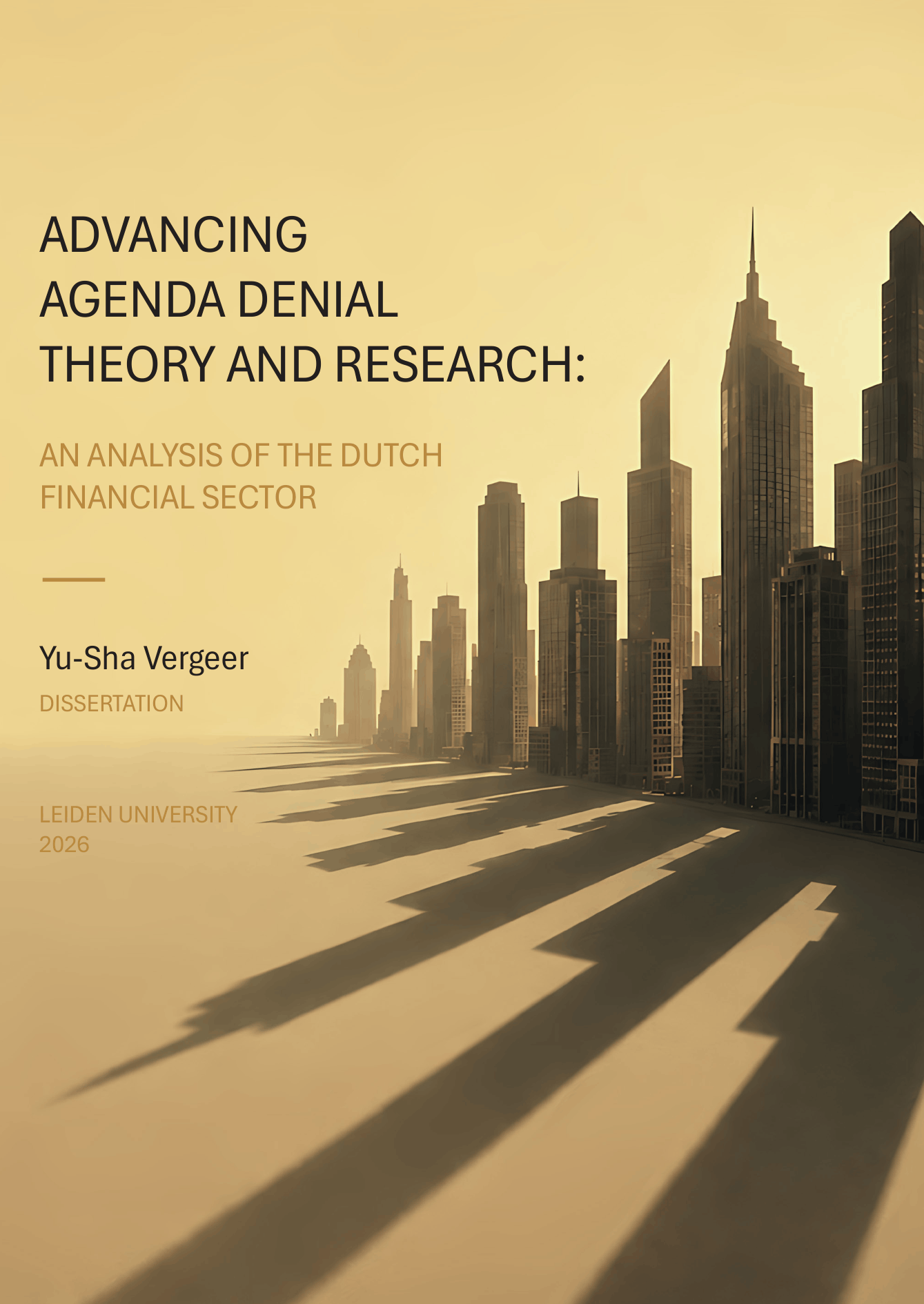
On Tuesday 20 October at 13.00 hrs., Yu-Sha Vergeer will defend her dissertation 'Advancing Agenda Denial Theory and Research: An Analysis of the Dutch Financial Sector', at the Academy Building in Leiden.
More information