

Better coffee with Gert: ‘FGGA is still continuing to grow’
Gert Renkema, Head of Finance and Economic Affairs at FGGA, has a clear message: the faculty is continuing to grow. Over a cup of coffee from the new machines, he reflects on the 2025 year-end figures, the forecasts for the coming years and the current state of play regarding BAS InSite.
Year-end figures for 2025
‘We have just completed the 2025 year-end closing, as well as the framework memorandum. This is an annual process and at the same time the starting point for the budgeting process, in which we calculate the level of the university contribution for 2027. That contribution is largely based on the number of ECTS credits obtained in the previous academic year.
We are increasing from 135,000 to 146,000 credits. That is a rise of just over 8 per cent. So FGGA is still continuing to grow. The main reason is the strong growth of the master’s programme in Crisis and Security Management. The bachelor’s programme in Cybersecurity & Cybercrime is also doing well. We will grow again next year too. This means that the contribution we receive will increase from €31.8 million to €33.7 million. So in 2027 we will receive around €2 million extra.
As for the year-end figures: in 2025 we achieved a positive financial result, and in fact it is on the high side. We closed the year with a positive result of €1.4 million after setting aside funds for loan repayment, which means we have money left over. It is also the fifth year in a row in which we have ended in the black. That presents a strong and stable picture and underlines that we are a healthy faculty.
We want to use that money to expand our staff. At the same time, vacancies are difficult to fill and that also takes time.’
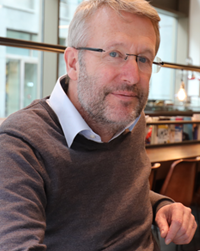
Gert on the new coffee:
‘Another important piece of news: we have new coffee machines. Great coffee with a huge range of options. My choice is the cappuccino largo puro fuerte, but only in the morning. In the afternoon, it becomes 'tea with Gert'.’
Uncertainty and forecast
‘It remains uncertain what the government’s plans will be exactly. The outline agreement looks positive in itself, but much will depend on the further elaboration of those plans and on support in the House of Representatives.
In addition, the university is working on the basis of a declining financial framework for 2027. For FGGA, this is expected to mean a reduction target of 1 per cent. In that case, we will need to cut around €300,000 in 2027. The board will then decide, in close consultation with the institutes, how we are going to do that.
We are also setting aside part of the money that remains as a buffer for possible setbacks in the future. We are also using it for the start-up of new activities. In doing so, the board is looking at the areas in which FGGA wants to continue growing.
For the years after 2027, we expect moderate further growth: a few more percentage points, including in the number of credits. If you look at student numbers, we are talking about around 3.5 per cent. That makes sense, because by then we will be building on the programmes we already have, so growth will level off somewhat.’
BAS InSite
‘The implementation of BAS InSite is proving to be a bigger task than anticipated. It is a university-wide programme over which we as a faculty have only limited influence. Since 1 January, an enormous amount has been done to correct errors.
So BAS InSite is not yet operating as it should, but people across the organisation are working hard to resolve the problems. For example, we can now see that the backlog in paying invoices, as also reported in Mare, is shrinking rapidly. We are also seeing progress in other areas. The first management reports for managers, HR and finance are now becoming available, for instance.’