
Ancient trees reveal how the climate and landscape changed
Remains of trees that grew thousands of years ago can tell us how the climate and the landscape changed in the distant past. In his inaugural lecture, archaeologist Jos Bazelmans highlights the importance of these wooden witnesses. ‘They offer insights into present-day climate change.’
Extreme drought causing the soil to crack, or excessive rainfall leading to landslides. ‘The increasingly extreme weather conditions we are experiencing today threaten the natural heritage that preserves information about the past’, warns Professor of Delta Archaeology Jos Bazelmans. ‘At the same time, climate change is prompting research into the resilience of past societies.’
If we can understand the climate of thousands of years ago, we can learn from the patterns it followed and the impact it had on the landscape and the people who lived there. According to Bazelmans, wood preserved in river sediments and peat bogs, known as subfossil wood, is particularly valuable research material.
Tree rings
The width of tree rings reflects weather conditions, says Bazelmans. Wide rings indicate that growing conditions were generally favourable, while narrow rings point to unfavourable growth in periods that were excessively wet, dry, cold or hot. ‘Combined with geological and ecological research, dated trees reveal how landscapes evolved and how precipitation patterns changed.’

From forest to tundra
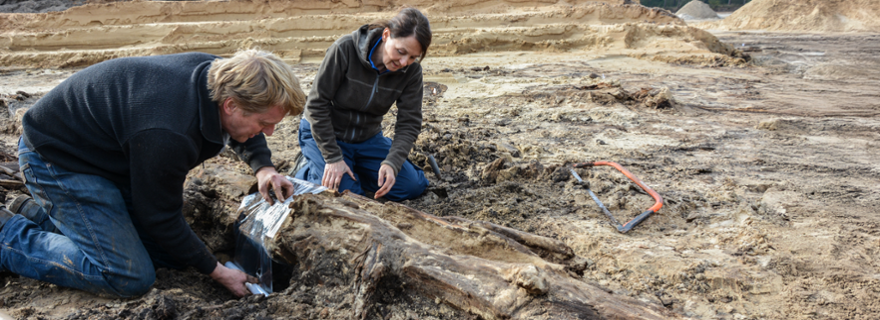
Bazelmans discusses some remarkable examples in his inaugural lecture. In the woods near Leusden, a dead pine forest almost 13,000 years old was discovered beneath the sand. Together with a team of researchers, Bazelmans studied the trees in the field, leading to an important insight: the pines showed that the climate was changing rapidly at the time.
Within a relatively short period of time, the forested landscape gave way to a tundra, a treeless landscape. Archaeological research had already shown that people had left the area during this period. The tree research in Leusden has helped improve our understanding of the changing landscape and the conditions in which people lived.
Summer in the Northern Hemisphere
Bazelmans cites another example: a study of ancient pine remains from cold regions in the Northern Hemisphere provided information about changes in summer temperatures over the past 2,000 years. ‘Long-term temperature records like these are of great value to research into recent global warming.’
Protect the climate archive
Unfortunately, this climate archive is under threat. Intensive land use and climate change are putting ancient subfossil trees preserved in environments such as river deposits and peat bogs at risk of being lost. According to Bazelmans, we should take greater care of this natural heritage. Ancient wood is not protected under the Heritage Act.
He also wants to draw attention to tree remains that have already been excavated. Better archiving of the samples could enable future researchers to answer new questions about past climate conditions. ‘Today’s climate change makes more urgent than ever to safeguard the natural archives that help us understand how climate, landscape and societies have evolved over time.’
Jos Bazelmans is a professor by special appointment and also works as a senior researcher for the Cultural Heritage Agency of the Netherlands.