

Can Europe compete? The push for technological independence
'Europe does great innovations, but the business is done outside.' With that stark warning, EU-commissioner Henna Virkkunen challenged students, researchers and policymakers to rethink how Europe turns technological excellence into global leadership.
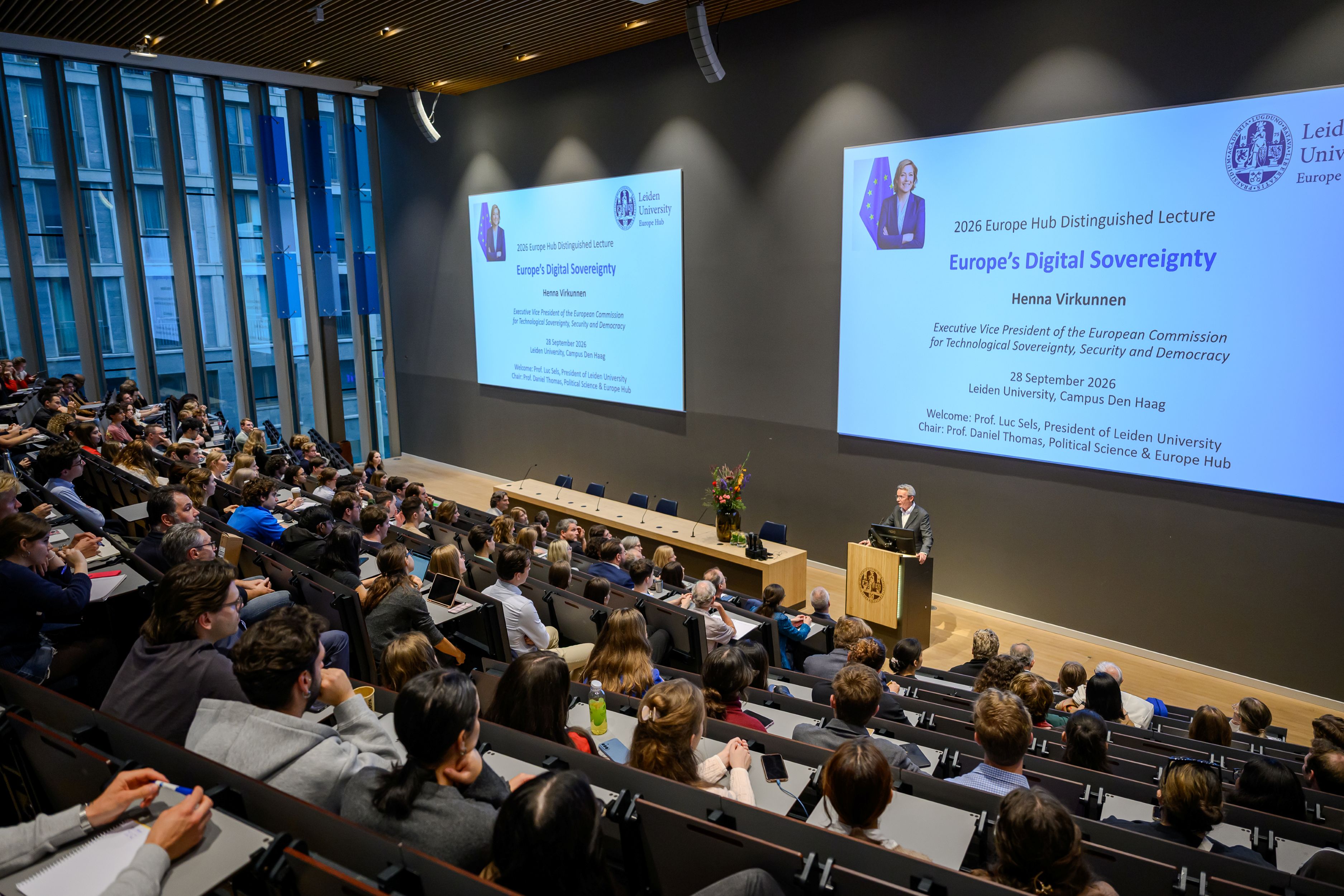
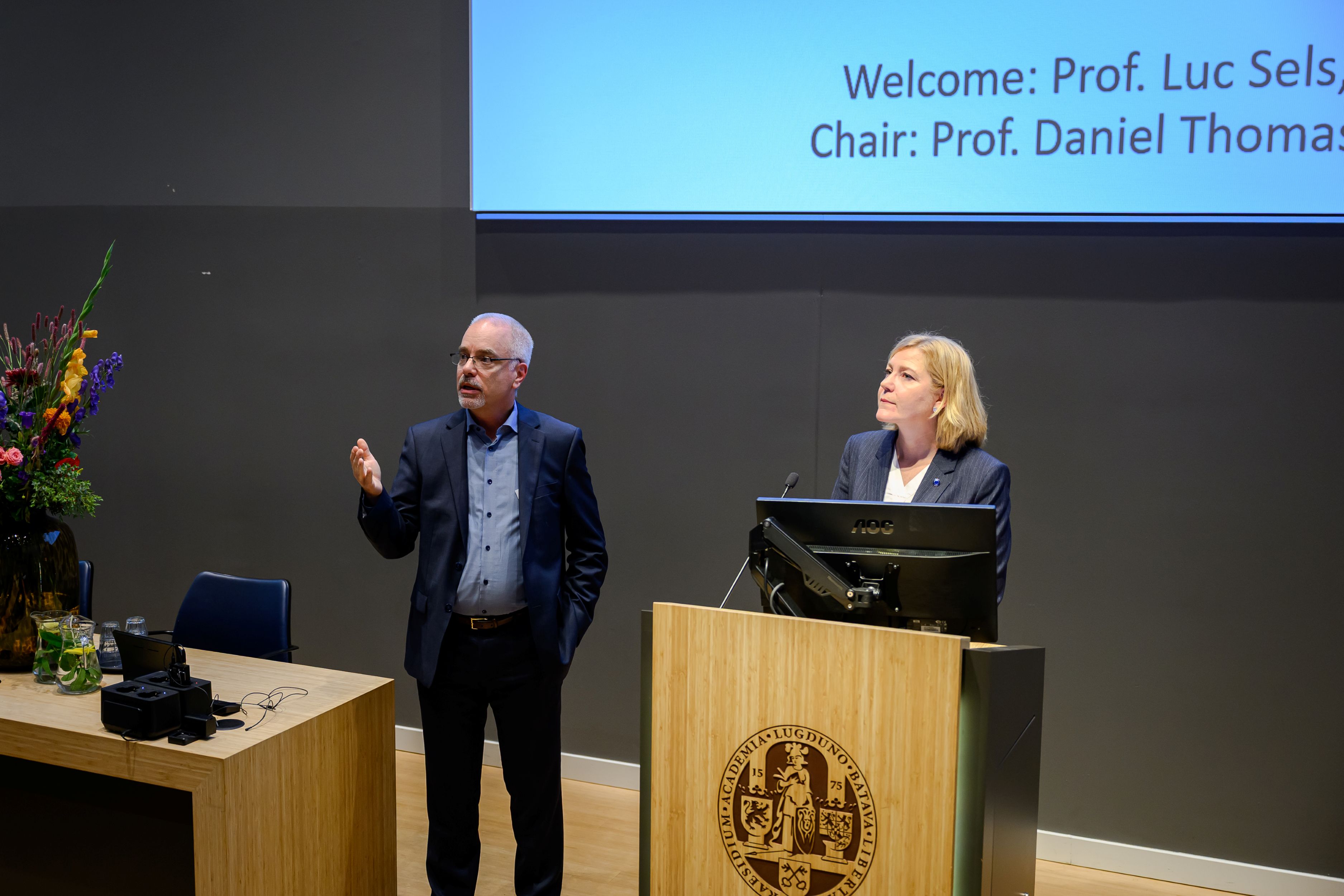
On Monday 28 September, attendees settled into the lecture hall while Prof. Daniel Thomas took to the lectern to officially open the Europe Hub Distinguished Lecture 2026. He outlined the novel mission of the Leiden Europe Hub: an interdisciplinary platform dedicated to showcasing the university’s research and teaching capacities on the critical challenges Europe faces, both at home and abroad. On behalf of the Hub, Thomas extended a warm welcome to the afternoon’s guest of honor, Henna Virkkunen, executive Vice-President of the European Commission for Tech Sovereignty, Security and Democracy.
-
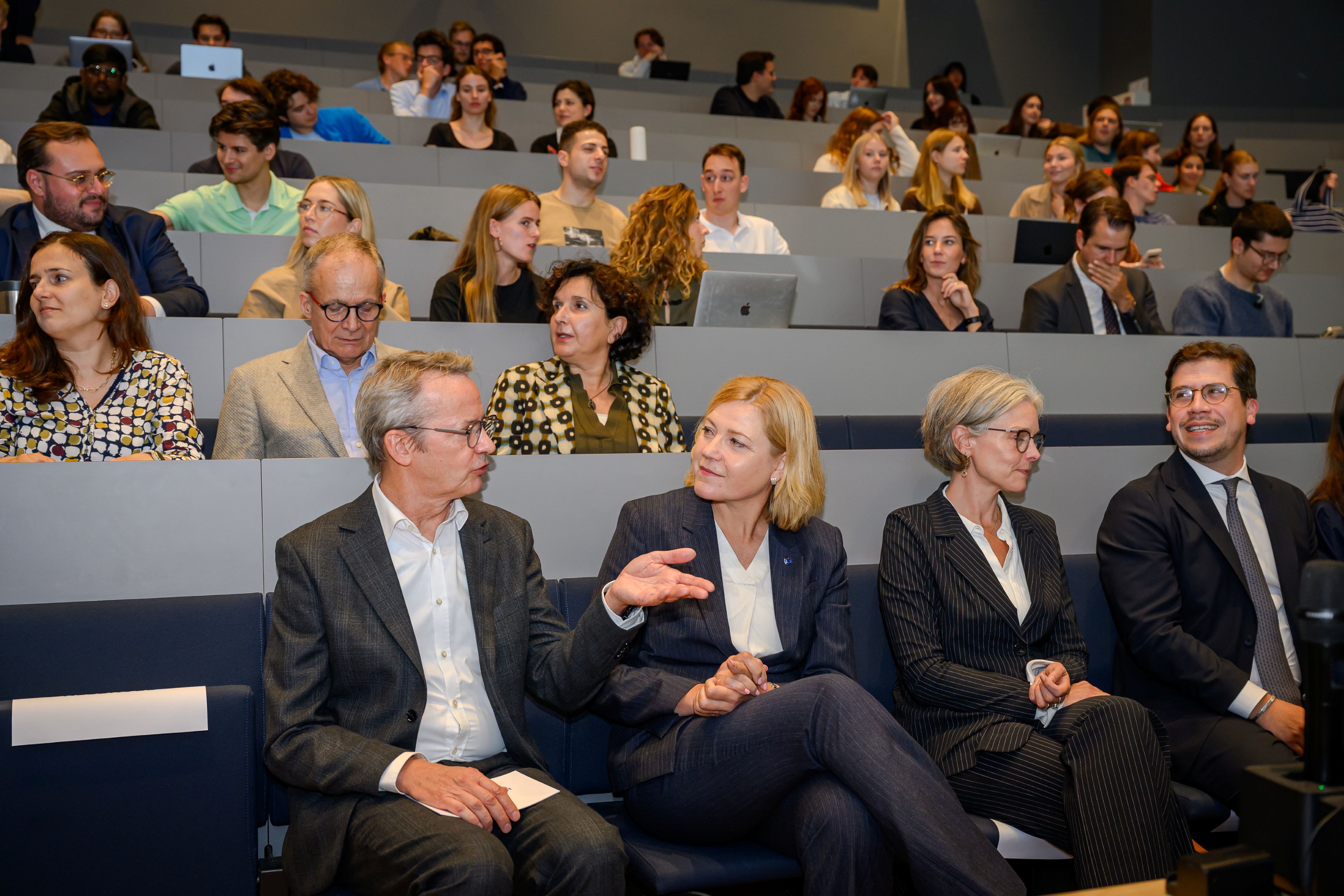
Luc Sels and Henna Virkkunen in conversation -
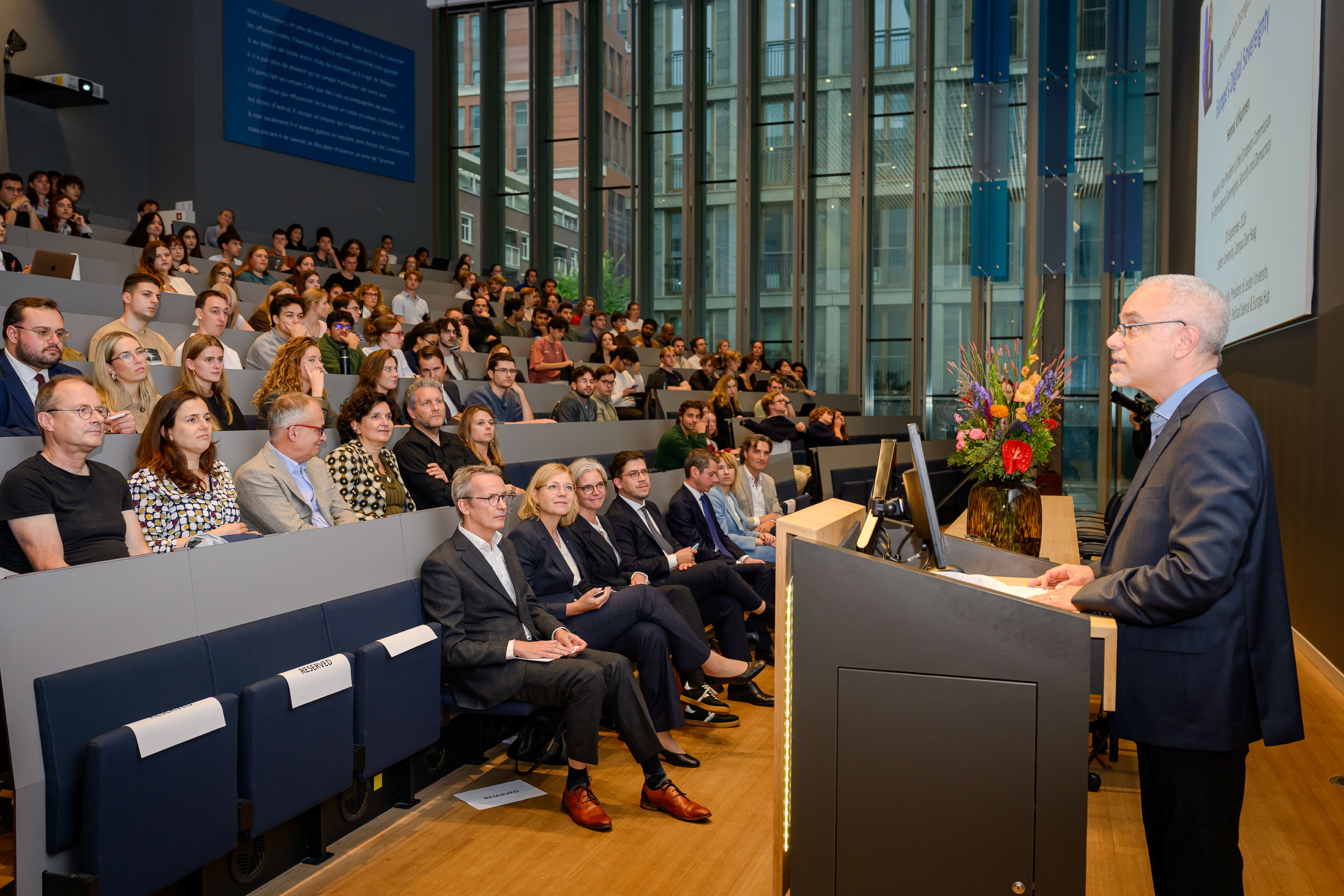
Daniel Thomas welcoming the audience -
Luc Sels talking about the AI evolution in academia
Navigating change in an age of AI
President of the Executive Board Luc Sels took the stage next, reflecting on the evolution that academia and the wider world must undertake in an era of rapid transition. In particular, Sels highlighted the necessity of a smart, deliberate adoption of artificial intelligence in higher education, balancing technological progress with the preservation of rigorous academic quality. He underscored The Hague’s standing as an international hub of peace, justice, and security, a fitting backdrop for an urgent dialogue on Europe’s future, before handing the floor to Henna Virkkunen.
Securing Europe’s technological future
Virkkunen delved immediately into Europe’s strategic imperative to remain sovereign and competitive amid an unpredictable geopolitical landscape. 'Achieving true technological autonomy', she argued, 'demands laser focus on critical sectors like artificial intelligence, quantum technology, semiconductors, the cyber domain, and space'.
Crucially, Virkkunen clarified what European sovereignty means in practice. 'Our goal is not to build walls but to build capacity. Rather than adopting isolationist protectionism, Europe must build the internal muscles required to act autonomously.' She pointed to four foundational elements guiding this push: chips, digitalisation, integrating AI into key sectors like energy, and an EU open-source strategy alongside the EU AI framework. The ambition is to triple European AI capacity in the coming years, accelerate industrial development, and mobilise roughly three million open-source developers across the European Union.
Virkkunen praised the Netherlands as an indispensable engine of European technological sovereignty. Highlighting institutions like TU Delft, TU Eindhoven, and TNO, as well as global industry leaders like ASML, she underscored the immense research and innovation power concentrated in the region. Yet, she paired this praise with an urgent call to action. Europe frequently excels at groundbreaking research and foundational concepts, but struggles with execution. 'Europe does great innovations, but the business is done outside', Virkkunen warned. 'Our goal is to show we can not only design, but also manufacture'.
Speed and unity were the afternoon’s recurring refrains. Emphasising the collective responsibility across member states, Virkkunen noted that fragmentation remains Europe’s greatest liability: 'We have huge potential, but we have to act together and act fast.'
-
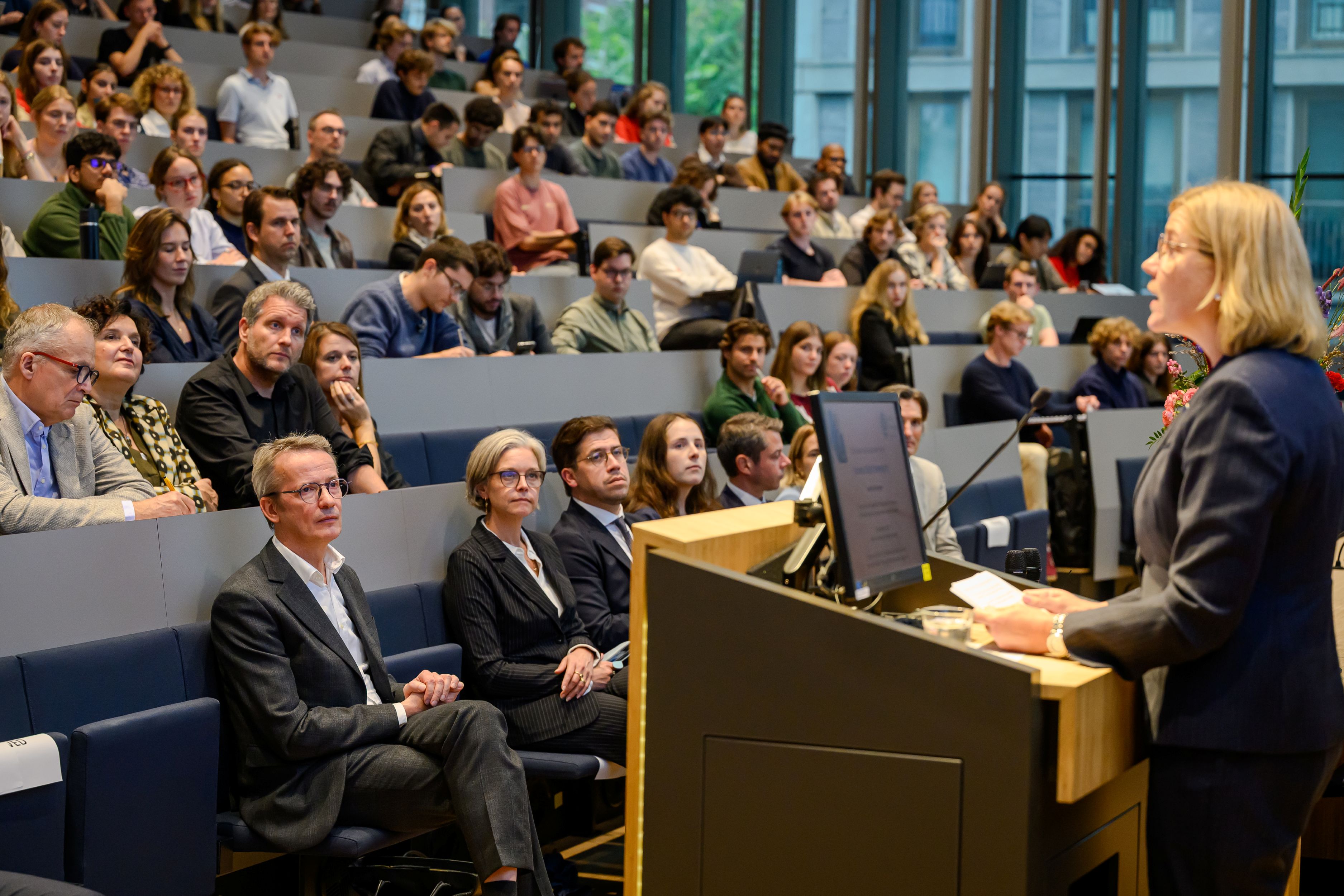
Lecture of Henna Virkkunen -
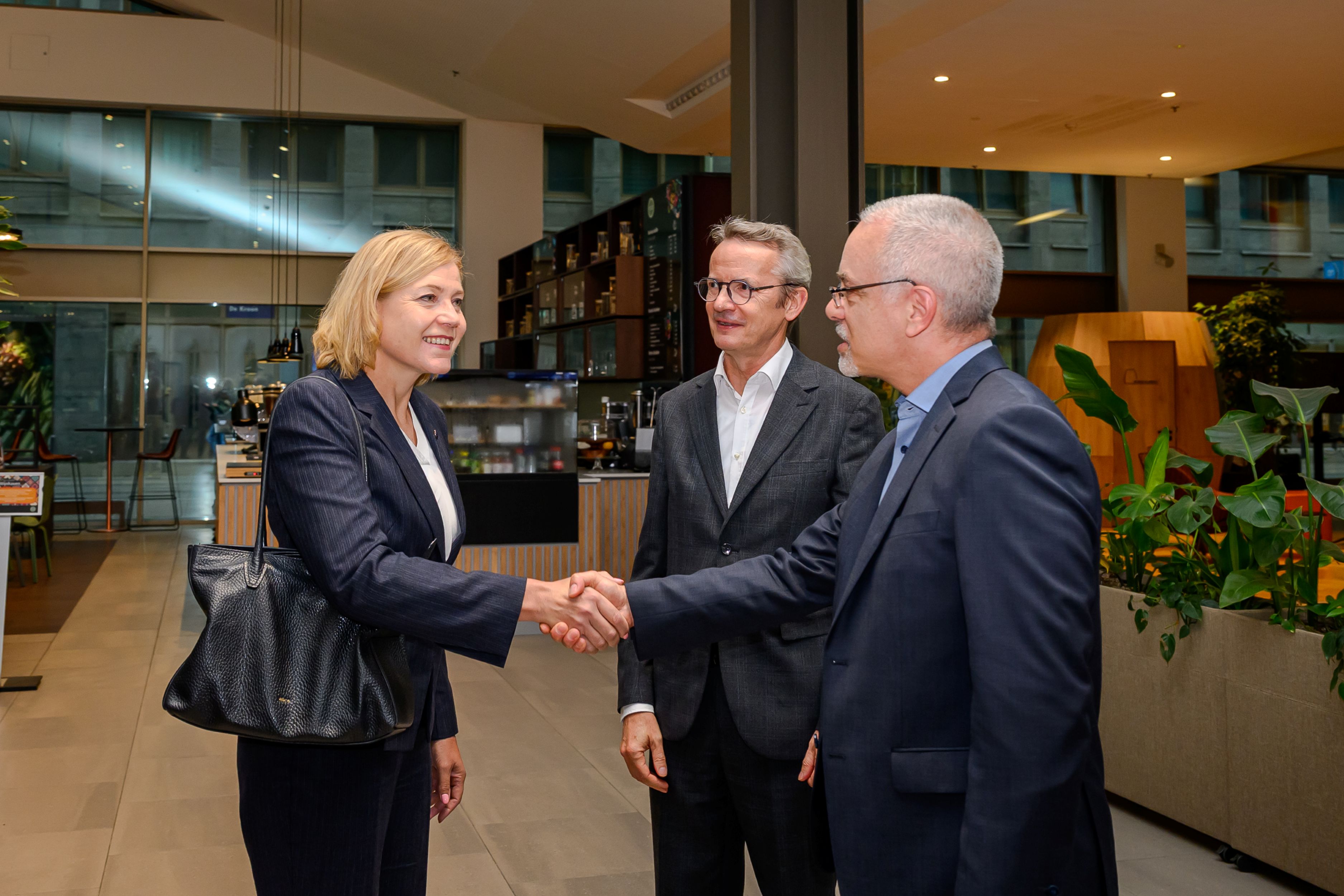
Henna Virkkunen enters Wijnhaven to meet Luc Sels and Daniel Thomas -
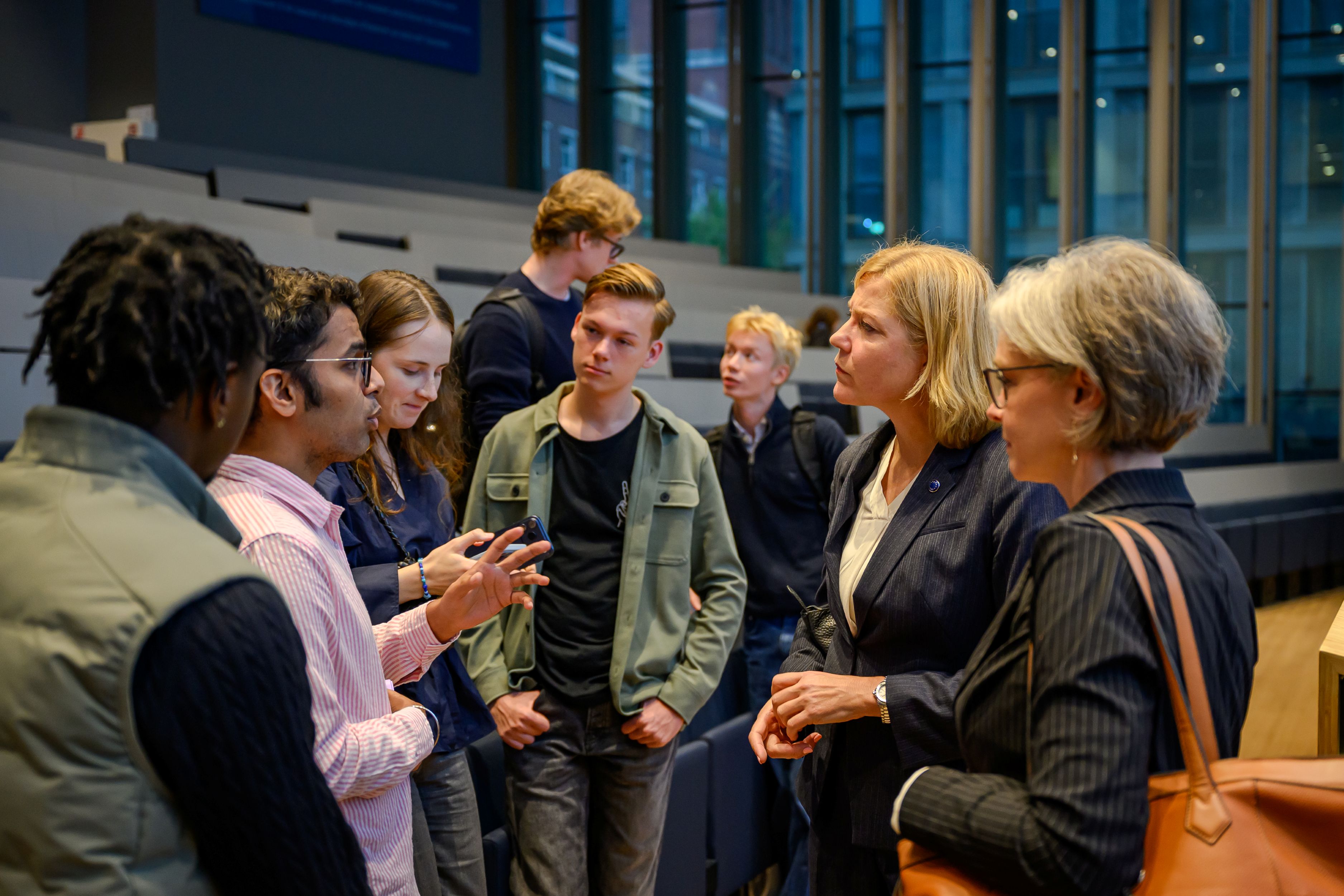
Henna Virkkunen talking with students -
Henna Virkkunen with Daniel Thomas -
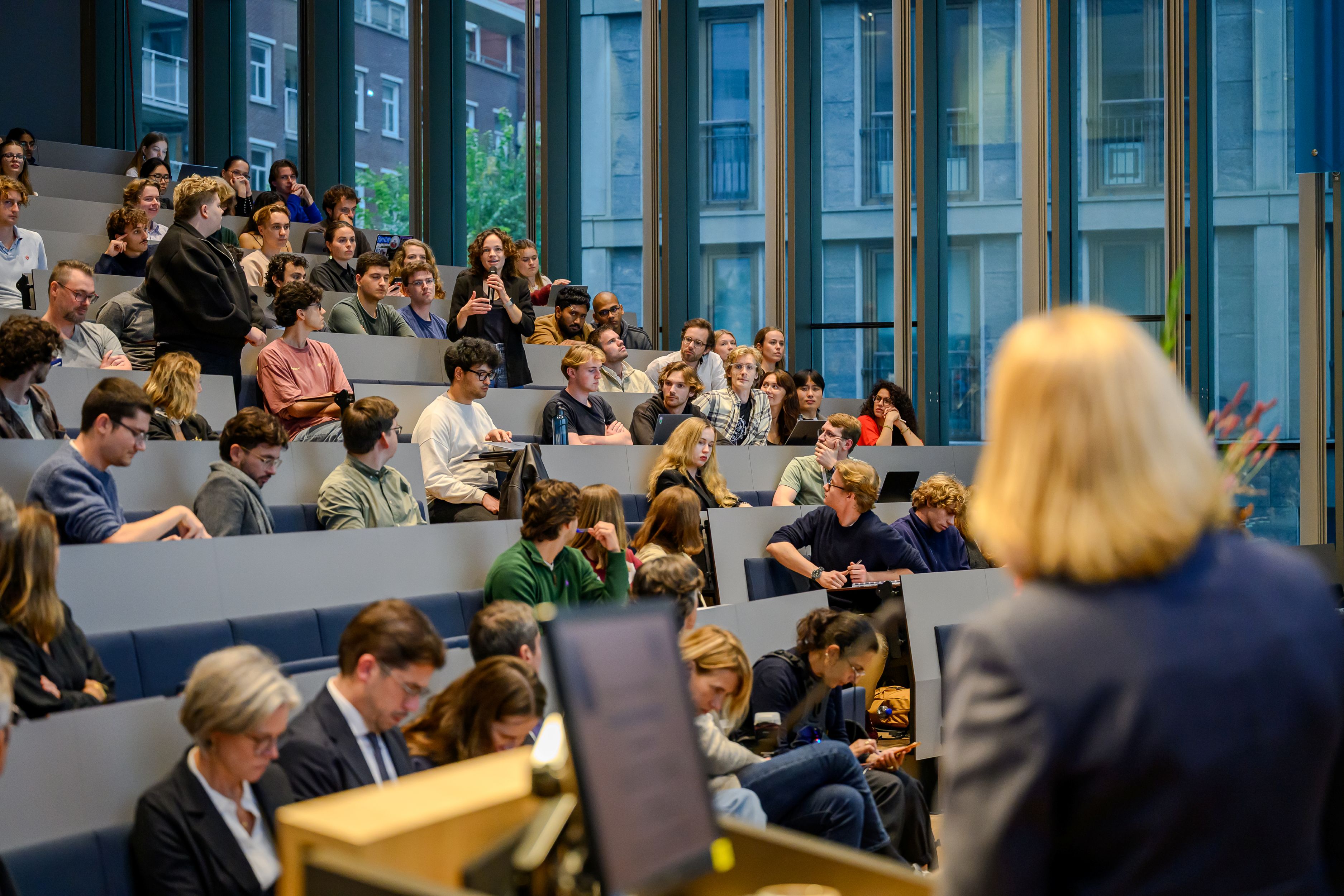
Q&A with students
What happens when a country doesn’t want a data center?
The floor was then opened for questions, prompting critical discussion from the audience. One attendee pressed Virkkunen directly on the internal friction inherent in European decision-making:
'You formulated tech sovereignty as being able to make a choice and pursue EU interests independently from others, but what happens when the EU doesn’t know or can’t agree what those interests are? Let’s say a region doesn’t want to host a data centre, what happens then?'
Acknowledging the persistent reality that consensus is often hard-won across member states, Virkkunen noted that building strategic autonomy will inevitably surface regional trade-offs. However, establishing shared European frameworks and standardising digital infrastructure targets remains the best safeguard against local gridlock paralysing the continent's collective progress. Addressing the political friction directly, Virkkunen pointed to the pragmatic beauty of European democracy. 'We vote by the majority. That means, no matter the decision, there will be one. Hopefully, we move forward.'
As the lecture concluded to warm applause, the central message resonated well beyond the hall: strategic sovereignty cannot simply be dictated from Brussels; it must be constructed collaboratively across policy rooms, industry factories, and university lecture halls. For the students and scholars leaving Wijnhaven, the takeaway was unmistakable: Europe must wake up and show the world it can drive technological change without compromising its core democratic values.
About the Europe Hub
The Leiden University Europe Hub is an interdisciplinary platform bringing together expertise on Europe from across Leiden University. It connects scholars from the Faculties of Governance and Global Affairs, Humanities, Law, and Social and Behavioural Sciences and promotes interdisciplinary research, teaching and engagement on Europe, its internal development and its role in the world.