From the defence bill to Box 3: an historic Prinsjesdag
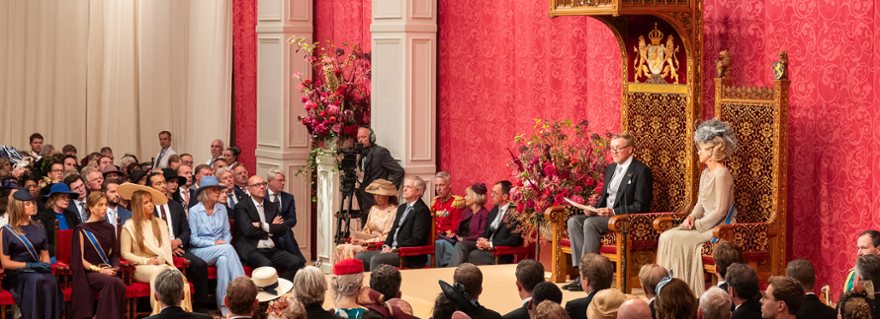
The ceremony is familiar; the political situation is anything but. On Prinsjesdag, the Netherlands’ annual budget day, the Jetten I government presents its plans, but without a stable majority, the outcome remains uncertain. Who will ultimately foot the bill for higher defence spending?
‘Prinsjesdag will be particularly interesting this year,’ says Koen Caminada, Dean of the Faculty of Governance and Global Affairs and Professor of Empirical Analysis of Social and Tax Regulations.
When a coalition has a majority in both Houses of Parliament, the governing parties have already agreed among themselves which plans they will support. According to Caminada, defending those plans is then partly ‘for show’, as the necessary support has usually already been secured. The Jetten government is a minority government: together, D66, the VVD and the CDA hold fewer than half the seats in the House of Representatives. Nor do they have a majority in the Senate.
‘The government must not only defend its plans but also win over other parties to get them through both Houses,’ Caminada explains. ‘The briefcase may be opened, but the real decisions will not be made until a majority has been secured in the Senate.’
According to Caminada, this is especially important when it comes to tax and budget legislation. The Senate cannot amend bills; it can only approve or reject them, and it also assesses the quality of legislation. The government must therefore put together a package in advance that can command sufficient support.
‘Trying to keep parties happy’
These political dynamics will also shape the Speech from the Throne, public affairs expert Arco Timmermans expects. Together with his colleague Gerard Breeman, he has been analysing the annual speech for twenty years. The Speech from the Throne is written on behalf of the government and, according to Timmermans, should explain the Netherlands’ place in the world and demonstrate that the government understands the public’s concerns. It must also balance the priorities of the various ministers.
The motto ‘Getting to work’ creates the expectation of a government ready to take decisive action. Timmermans also anticipates a new and more optimistic tone, but the government needs support from opposition parties to implement its plans. ‘I think the government will try to keep various parties happy. If it takes a very specific position on a sensitive issue, this may reduce the scope for negotiations later on. The subjects it leaves out may therefore also reveal something about the government’s choices.’
How can the government deliver on its ambitions?
This year’s Prinsjesdag therefore centres on how the government can deliver on its ambitions. Higher spending on defence and resilience, for example, requires financial choices on which the parties will have to agree. While the King presents the government’s plans, the Budget Memorandum reveals what they will cost.
Caminada is therefore particularly looking forward to the General Political Debate in the days following Prinsjesdag. He believes this will provide a clearer picture of how much support the government can secure for its plans and where it will need to negotiate. ‘With the political situation still so open, this is a genuinely historic and highly uncertain moment.’
Koen Caminada and Arco Timmermans on the Budget Memorandum and the Speech from the Throne:

Koen Caminada: ‘A major financial challenge’
‘This year, the Budget Memorandum is less of a clearly defined roadmap and more of a negotiating document, in which purchasing power, fiscal discipline and climate ambitions will immediately be tested for political support.
There is also a major financial challenge surrounding Europe’s resilience and defence, within a NATO context unlike anything we have experienced for decades. Increased defence spending enjoys broad support across Dutch politics. The question is what trade-offs this will involve: spending less on areas such as higher education or social security, or paying more tax? This also includes the debate surrounding Box 3, the Dutch tax category for income from savings and investments.
I expect to see more package deals involving vote trading, such as support for the Tax Plan in exchange for changes in another policy area.
There is still no political agreement on Box 3. If an agreement remains elusive for too long, there is a risk that the legislation will be rushed, and concerns about its quality could provide grounds for rejecting it.’

Arco Timmermans: ‘The Speech from the Throne is becoming increasingly vague’
‘The government should also use the Speech from the Throne to announce new plans, but this is happening less and less. Issues are increasingly discussed in reflective, abstract and retrospective terms. Problems and concerns are acknowledged, but we hear little about what the government will actually do. This explains the Speech from the Throne’s ever-rising “vagueness index”.
Defence will be one of the subjects discussed this year. This raises the question: at what price, both literally and figuratively? I expect the Speech from the Throne to offer few concrete answers. On innovation and the business climate, too, the government needs support from parties that want to move the Dutch economy forward, while also asking who will benefit.
Following the Dutch referendum on Europe, attention to Europe in the Speeches from the Throne declined dramatically because it had become a politically sensitive issue. This was not the case on less visible political agendas. Leaving subjects out is therefore also a way of avoiding political risk.’