

House of Orange reaped benefits of colonialism but rarely shaped it
The House of Orange-Nassau actively supported Dutch colonialism for centuries, but only rarely determined colonial policy. This is the conclusion of an independent study presented to King Willem-Alexander on 2 October. ‘The spirit of the age is no excuse,’ commented principal researcher Gert Oostindie.
Historian Gert Oostindie presented the King with five books about the colonial past of the Family of Orange. Willem-Alexander took the initiative in 2022 to commission this study on the role of his family in colonial history. The Royal House was not involved in the structure, implementation or findings of the research. Some 60 researchers worked on the study.
King: ‘A heart-rending and uncomfortable conclusion’
The King thanked the researchers for ‘their rigorous work’. ‘This research gives us clarity. The findings are unvarnished and compelling.’ They show that there was a lack of contrarian leadership, according to the King, while this could have made a difference. ‘That is a heart-rending and uncomfortable conclusion. A conclusion that really touches me.’
The King said that he fully accepts the results of the research. ‘For me, this work is not the final step; it is an impetus to do more. I can’t change the past, but I can do my best to make a positive contribution to the present day and to the future.’ He sees the findings as further encouragement to continue to pursue ‘healing, connection and reconciliation’. ‘The historical perspective offered by this study is enormously valuable.’

Centuries of support for colonialism
The researchers studied the role of the Family of Orange from 1600 to the present day. Their initial main conclusion is that the House of Orange-Nassau was involved in colonialism ‘with conviction and without any significant doubts’. All the stadtholders, kings and queens up to and including Wilhelmina regarded colonialism as legitimate and important for the Netherlands. They also considered colonial wars and the violent suppression of revolts as unavoidable and justified.
The research indicates that the stadtholders and King Willem I raised no objections to trading in the enslaved or in slavery itself. Willem II and Willem III (19th century) thought differently, but did not support abolition. Although the researchers did not find any explicitly racial statements by the House of Orange, the royal family did support policies based on European, white superiority.
‘The spirit of the time is no excuse’, said Oostindie during the presentation. ‘They knew there was opposition, and that other ideas were circulating. They could have taken a different stance. They could have set a good example.’ Until Queen Juliana, the House of Orange never used their position to change their fellow countrymen’s minds about colonialism or slavery.
Willem I alone set the course
The support from the House of Orange did not mean that they played a decisive role in setting colonial policy. In the era of the Republic (17th and 18th century), the stadtholders had limited power over colonial matters. Governors from countries such as the Dutch East India Company, the West India Company and the States-General set the course.
King Willem I was the main exception here. He had the exclusive right to appoint the colonial administration and he made full use of this. He founded the Netherlands Trading Company that introduced the profitable Cultivation System. From 1848 the power of parliament grew and the political influence of the royal house declined. Support for colonialism by the House of Orange became mainly symbolic.
‘Even without the House of Orange, the Netherlands would have become a colonial power’, was Oostindie’s summing up of the findings. ‘It didn’t need stadtholders or monarchs.’
Income and prestige
According to the researchers, colonialism was ultimately more important for the House of Orange-Nassau than the other way around. It boosted the national and international prestige of the royal family and provided income. The House of Orange benefitted from this, particularly in the nineteenth century: according to estimates, in the region of half a billion euros in today’s currency. The Dutch East India Company and later the Dutch East Indies played a crucial part here.
The stadtholders and monarchs earned little or nothing from the transatlantic slave trade and Caribbean slavery. Oostindie explains that this was not because they rejected it, but because efforts to profit from it were unsuccessful. Colonial appointments, contracts and contacts did indirectly strengthen their position in society and the administration.
Oostindie believes the research shows that their involvement went further than to oppose slavery. During the presentation, he spoke of ‘centuries of active and unscrupulous support for colonialism, including slavery as it was at the time.’ According to Oostindie, the House of Orange-Nassau was ‘strongly involved, and consequently there can be no doubt they bear some responsibility’ for Dutch colonialism.
-

Gert Oostindie is presenting the research. -

King Willem-Alexander receives the books. -
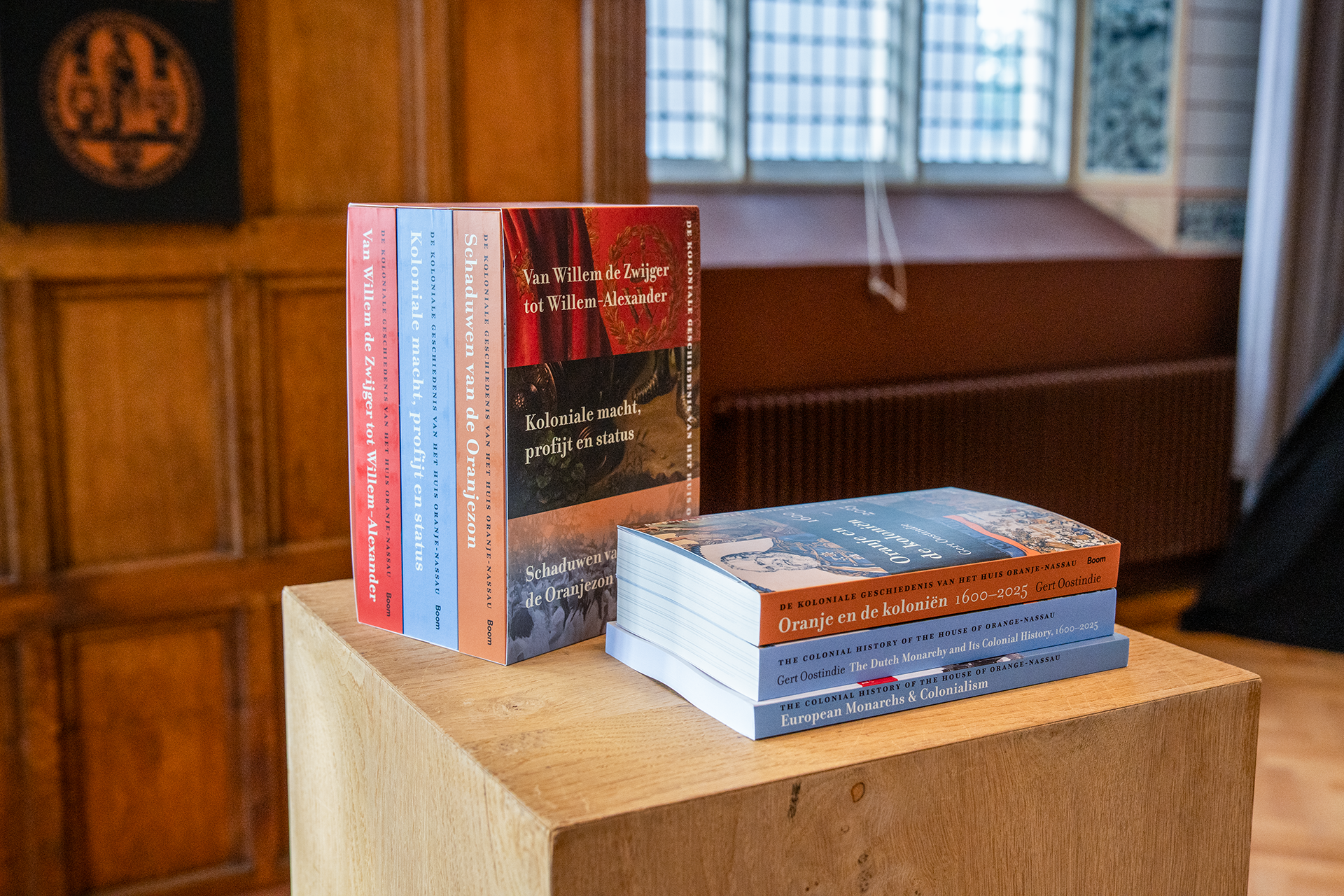
The five books on the House of Orange’s colonial past.
If you would like to know more about this research, please view the dossier 'The House of Orange-Nassau and colonial history’.