
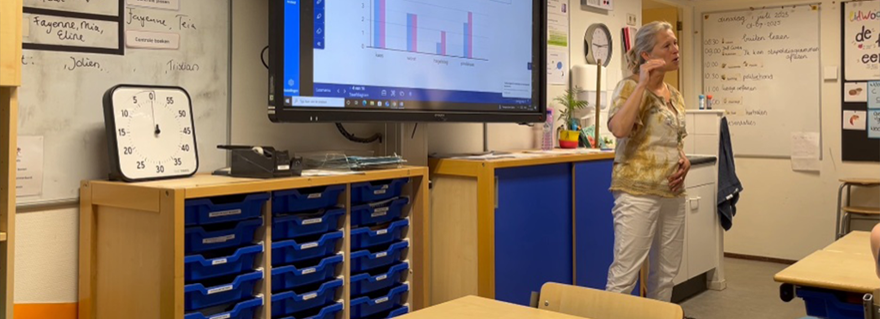
From Japan Studies to junior school: ‘I was back to square one in the classroom’
It was while wearing clogs at a Dutch theme park in Japan that Cindy Heijdra really got to know the country she was studying. Over 20 years later, she is studying again – this time to be a primary school teacher. ‘I wanted to do something with more impact.’
For 11 years, Leiden University had a small satellite in Huis ten Bosch Palace – not in The Hague, but in a replica at a Dutch theme park Japan. Japanese Studies students from the Netherlands were taught here in the 1990s and also worked at the park with its replicas of Dutch buildings and kilometres of canals. It was among the windmills there, in the second year of her studies, that alumnus Cindy Heijdra (53) really got to know Japan.
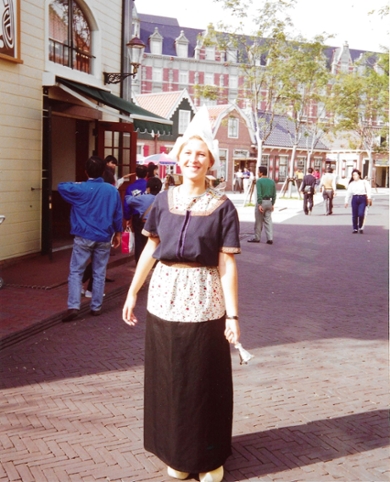
‘I’d never worn traditional costume before, but when I was there I wore clogs and handed out tulips to visitors,’ Heijdra laughs. Once outside the theme park, she was in Japan proper. She lived in a village in the countryside. ‘I discovered I still didn’t understand much Japanese. But you learn quickly when you live there. It was a real learning experience and great fun. I’m still friends with seven girls I was there with.’
Perfect combination
Heijdra decided to do Japanese Studies because it’s a broad programme. Alongside language and culture courses, she also learnt about international law and economics. She chose the degree because it seemed interesting, but that wasn’t all. ‘At the time, more and more Japanese companies were coming to the Netherlands, so I hoped to find work after graduating.’
And she succeeded. Heijdra graduated in 1997 and found a job at the Japanese Embassy in The Hague as a local staff member in the economics department. She worked for three diplomats, one of whom was responsible for agriculture, a subject that really interested Heijdra. ‘But after four years, I’d had it up to here with the embassy, to put it not so diplomatically. There was no room to grow.’
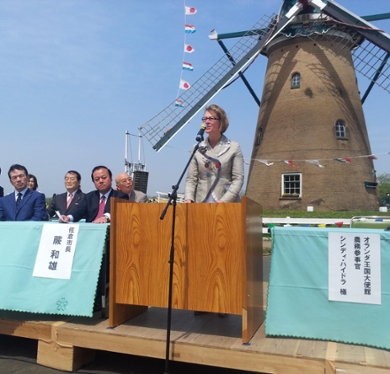
Still interested in agriculture, she found a job at the Ministry of Agriculture, Fisheries, Food Security and Nature, where she still enjoys working 24 years later. She regularly changed jobs, working as a spokesperson in the communication department and as an agriculture attaché at the Dutch embassies in Paris and Tokyo. ‘The latter was the perfect combination for me: I was working in the country I knew so well and could use my experience at the ministry.’
Retraining as a primary school teacher
At the ministry, she’s back at the communication department, where she’s working on sustainable food production and protecting nature. ‘They’re important issues and I really enjoy contributing. But these kinds of processes take time. In recent years, I began to feel I’d like to do something that has more impact and is more visible.’
Two years ago, Heijdra therefore decided to retrain as a primary school teacher. ‘The combination of work and study is tough, but it’s an interesting programme and it’s fun to learn something new.’
Back to square one
Now she’s on a placement at a school one day a week, she’s noticed how routine her work at the ministry has become. ‘I’m an experienced member of staff and know the ropes. I sometimes experience difficulties or challenges, but I know how to respond. I was back to square one in the classroom. It was quite the experience. When you start teaching at the beginning of your placement, and you notice things aren’t going well, you’re on your own. It’s hard work. When I look at what I can do compared with a year ago, I’ve learned so much.’
Common denominator
Heijdra sees similarities with her current job at the communication department. ‘We tell the rest of the Netherlands what we do at the ministry and what policy we implement.’ And thinking about how that communication comes across comes in useful in the classroom. ‘Children learn best when they’re intrinsically motivated. The challenge is to make learning materials appealing and meaningful and to connect to their everyday lives.’
Right decision
Two years after starting teacher training, Heijdra is confident she made the right decision. ‘Supporting children’s development is rewarding work. It gives me so much energy.’