
From bowing deer to spider crabs
An introduction to Japanese language and culture: pupils in the enrichment classes at De Morskring primary school in Leiden and De Vink primary school in Voorschoten get this opportunity. Pupils in years 6, 7 and 8 who could do with more of a challenge follow these classes.
The extra lessons are organised by Leiden Science Education Hub (Wetenschapsknooppunt) in collaboration with lecturers from the Japanese Studies (BA) programme. Students of Asian Studies at Leiden University teach the lessons in the presence of the qualified teacher. The lessons not only broaden the pupils' horizons, but also provide the students with an excellent opportunity to gain experience in teaching. Lecturers from the Japanese Studies (BA) programme provide feedback on the teaching materials developed in advance. The students have also received a short pedagogical-didactic training course from ICLON.
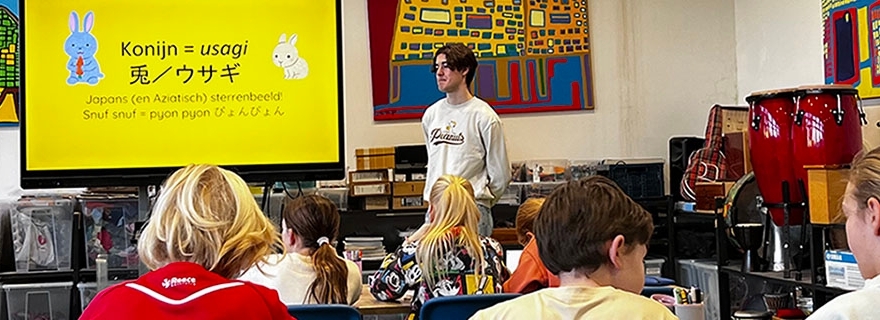
The lesson opens with a brief review of last week's material. The new theme is animals. The pupils learn how to say in Japanese whether they have a dog, a cat or even a snake as a pet. The students pronounce the words and the children repeat after them.
Cat = neko, meow = nya
Fish (also when eaten) = sakana, blub blub = buku buku
Birds (from parakeets to ostriches and chickens for eating) = tori, chirp chirp = chun chun
Snake = hebi, ssss = shu shu
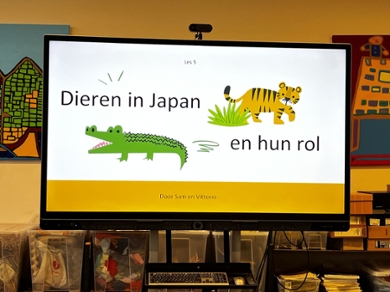
Then it moves on to special animals, such as the bowing deer in the city of Nara and the macaques (snow monkeys) that wash each other in hot springs. Finally, the students show how nature is reflected in Japanese art.
Through games and repetition, the children practise their first words of Japanese and learn about the culture. The students explain various background facts, such as the great respect for animals in Japan. Cats, for example, are very popular because of the work culture. You can leave a cat at home alone, but they also bring good luck. There are many cat cafés in Japan. The pupils also learn about Japanese eating habits, mythological creatures and how both are influenced by the country's location. By making links with internet trends, video games and cartoon characters, the lessons tie in well with the children's experiences.
Contact with a new culture visibly leads to enthusiasm and amazement among the pupils. For example, when the students tell the children that Japan is home to the largest crab species in the world, the so-called ‘Japanese spider crab’, one of the pupils asks whether it is bigger than a human being. He does not believe that this is actually possible.

Learning what you don't know yet
According to André van Haasteren, teacher at De Morskring primary school, the Talent Lessons in Japanese have another major advantage for the pupils. 'They offer the children something different from the standard curriculum. They do learn English, but that is a language you hear very often. With Japanese, there are no shortcuts; they learn something that is completely new, so even the brightest pupils realise that it doesn't come naturally. And that's a good thing to experience before you go to secondary education or university.’
In addition, Japanese lessons increase the visibility of cultural studies. 'It's good for children to realise that they can explore a culture. Because if you don't know something exists, you can't learn it,' says Sam (24), a student of Asian Studies (MA) and one of the students involved, about the value of the talent lessons. 'Science subjects, such as biology and engineering, are often given priority. But cultural studies are also important. For maintaining contacts between countries, for example.'
According to Eline Sikkema, lecturer in Japanese Studies (BA), the lessons also offer students the opportunity to discover their talents in education. 'It's great to see how creative our students are in devising the Talent Lessons and how enthusiastic they are in front of the class. These experiences are a valuable addition to their studies.'
An experience to take with you for later
It is not only the pupils in the enrichment classes who gain useful information here, but also the students. For Vittorio (20), a student of Japanese Studies (BA), this is his first experience of standing in front of a class. Yet he already notices how enjoyable it can be. 'Last week we talked about the months of the year. And just before the lesson started, two pupils came up to me and said: "Sir, we can name them all." I really enjoyed that.' He is considering teaching English in Japan later on.
Teacher André van Haasteren is very enthusiastic about the Talent Lessons. 'This is the second time we've participated. Last year we had Chinese lessons, this year Japanese. I'm very positive about it, but once a year is enough for a project like this. Who knows, maybe next year we'll do Italian.'
We are looking for schools in the Leiden region that are interested in our Talent Lessons. In March, we will start with Italian language and culture lessons. The cost is 240 euros per school for six lessons. If you are interested, please contact the ICLON Science Education Hub: wetenschapsknooppunt@iclon.leidenuniv.nl