MEPs’ visit highlights importance of knowledge about Global South
Two MEPs visited Leiden University on Friday 30 January. Their visit underscored the vital importance of the university’s expertise on Africa, Asia and Latin America in a rapidly changing geopolitical landscape.
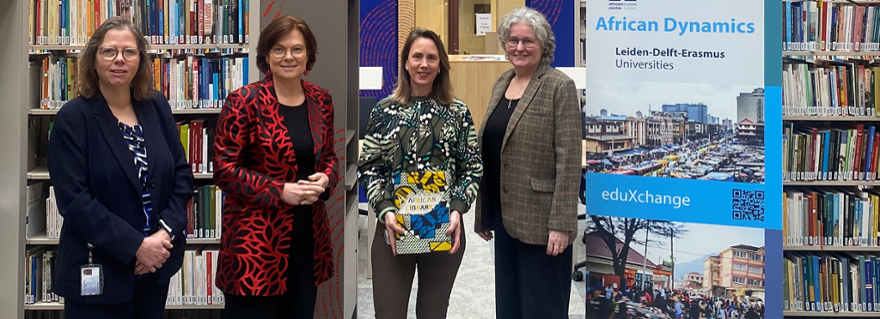
At the African Studies Centre, MEP Marit Maij (GL/PvdA), whose work focuses on EU-Africa relations, discussed knowledge collaboration with Africa and how Leiden University puts this into practice. She also addressed how European policy could be better aligned with knowledge drawn from long-standing academic networks with African partners.
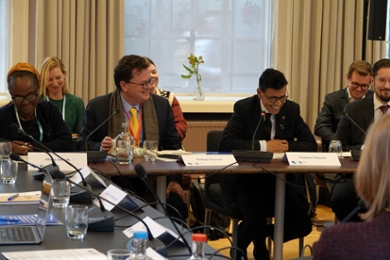
That same day, Younous Omarjee, Vice-President of the European Parliament, visited the International Institute for Asian Studies (IIAS). He attended the session Repositioning Europe’s Knowledge Collaboration with the Global South in a Fast-Changing World. The participants explored how Europe can forge new knowledge-based partnerships with countries in the Global South, highlighting the crucial role existing academic networks can play in repositioning Europe within a new global order.
Knowledge-based partnerships
The visits underline the importance of expertise on languages, cultures and international relations. As Europe increasingly seeks to strengthen its position as an autonomous geopolitical actor, the need to deepen its engagement with regions in the Global South has become more urgent. Issues such as migration, shifting patterns of trade, China’s influence in Africa and dependence on rare resources make such cooperation more essential than ever.
Recent reports from the Netherlands and Germany signal a shift in how Europe should shape its partnerships with the South. They emphasise the need for coordinated, forward-looking cooperation with Global South countries that moves beyond traditional North-South dynamics. The reports highlight the value of knowledge-based partnerships and new, inclusive networks with Global South countries.
Key role for universities and knowledge institutions
Universities and knowledge institutions have a key role to play: they equip students with an outward-looking understanding of the world and maintain long-term networks with partners in Africa, Asia and Latin America. Omarjee emphasised this in his speech: ‘Political leaders need you: scholars, researchers, universities and institutions who can work for the long term, build bridges and bring societies together. What has emerged from this discussion is genuine knowledge diplomacy: collaboration based on mutual understanding rather than dominance and on equality rather than hierarchy.’
Photo above article: Marit Maij (second from left) visiting the African Studies Centre.