Wednesday 25 March – a Wednesday in overdrive
Wednesday is usually a quiet day. Not this one. Meetings, a Chinese delegation, international science and national policy follow one another at pace. And by the end of the day, a very different kind of problem awaits at home. This is Jasper’s day.
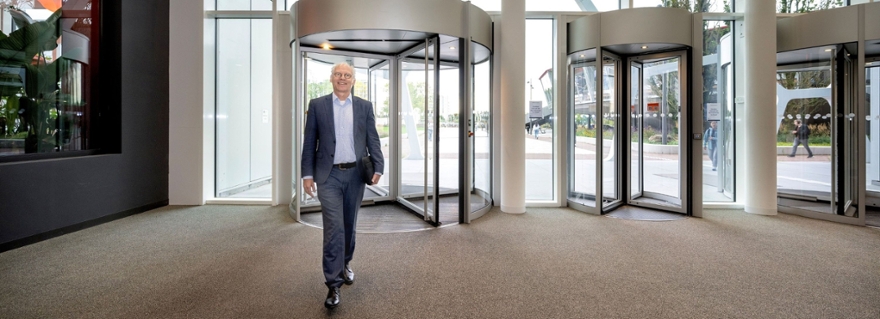
Jasper Knoester is the dean of the Faculty of Science. How is he doing, what exactly does he do and what does his day look like? In each newsletter, Jasper gives an insight into his life.
‘Wednesday, normally a somewhat quieter day. Today is different, because alongside the usual meetings, the schedule also includes welcoming a delegation from China, including dinner, an online meeting about a scientific paper, and an extra meeting with the deans of other science faculties in the Netherlands.
At nine o’clock I start with a preparatory meeting about the upcoming meetings of the science deans and the science council, the faculty-level meeting of scientific directors. After that, I head straight to the reception of the delegation from Xi’an Jiaotong University.
We have been working with this university for about ten years, including on joint PhD degree projects. We are considering expanding our existing collaboration, and the delegation is here amongst others to discuss that. Alongside two vice-presidents, there are colleagues from mathematics, computer science and AI, and chemistry. They are here for two days. Tomorrow includes a meeting with the chair of our executive board, Luc Sels. Today, everything takes place within the faculty.
We begin with a plenary introduction of the guests and the FWN colleagues present. After that, most of the delegation disperses to the various institutes, while a smaller group continues discussions about possible collaboration in education.
Research facilities – Joining forces with the LUMC
The next meeting is online with our executive board and the leadership of Leiden University Medical Center, focusing on opportunities to work more closely together on research facilities. It seems wise to align our investment agendas more closely, as resources are scarce while the importance of state-of-the-art facilities continues to grow. We already collaborate on electron microscopy and are exploring whether this can be intensified. Integration is high on the agenda. Second on the list are animal research facilities. The stakes are high for our researchers, and we will approach all of this carefully, together with the institutes.
A breakthrough on a nanometre-scale
Next up is an online meeting with colleagues in Groningen and Bayreuth in Germany about a paper currently in preparation. We quickly agree on the remaining points. What follows is more interesting: it turns out that significant progress has been made in Bayreuth in measuring circular dichroism of individual nanometre-scale objects. This is a breakthrough that allows us to obtain a much more detailed picture of molecular materials. A few years ago we showed theoretically how much this technique could teach us about photosynthetic systems, and now experimental validation is coming into view. Exciting.
Three internal meetings follow, and I finish the afternoon with the additional online meeting of the science deans. We are working on two major dossiers: new sector plans and the development of our organisation as a national platform. Sector plans allow us to invest extra in education and research, and this instrument is high on the agenda at the ministry as a way to help reverse (in part) the budget cuts of the previous cabinet. The conditions are not yet clear, but together with the national discipline councils we are preparing as thoroughly as possible for a potential call for proposals.
After that, I hurry into the city for dinner with the delegation from Xi’an. The meetings at the institutes have been positive, and the mood reflects that. Of course, plans are discussed further, but many other topics come up as well, making it a lively evening despite the guests’ jet lag.
‘No wonder I became a researcher’
After dinner I go straight home and prepare for tomorrow, with particular attention to two GROW conversations and the delegation’s visit to Luc Sels. I update him briefly on today’s discussions so he knows where we stand. I help Kamiel with a few problems on magnetic induction. It is a wonderful subject for someone who has become a professional optical physicist, but he enjoys it only moderately. With a touch of nostalgia, I think back to my own school days. I was keen enough on physics and maths to invent and solve my own exercises. No wonder I became a researcher. Around midnight I go to bed, my head full, and it takes a while before I fall asleep.’