
Import in the Stone Age? How object biographies shed new light on the Neolithic
On April 22, Lasse van den Dikkenberg defended his dissertation: Living with Flint. For this, he examined flint finds from the Rhine-Meuse Delta. These finds belong to the Vlaardingen culture, which existed here from 3400-2500 BC. His research revealed that import played a larger role in the Neolithic than previously thought. He also found traces of horn and hide processing, something for which there had been no direct evidence until now.
Let’s start at the beginning; what is your dissertation about?
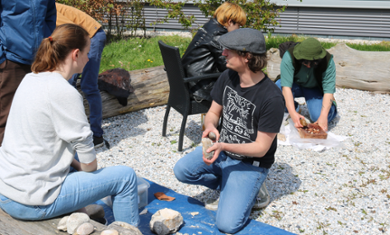
‘It is about object biographies of the Vlaardingen culture, so I look at how objects were used and where they come from, and I try to link these kinds of themes together. For example, if people brought flint from far away, how did they use it? The Vlaardingen culture is wetland archaeology in the western Netherlands, specifically the Delta region. I also look at craft specializations; that is a theme I have investigated through use-wear analysis. For example, specialized hide processing at specific sites. It is also part of a larger project, the ‘Putting life in late Neolithic houses’ project. This involved many experiments as well, for example at Masamuda with volunteers at the open-air museum in Vlaardingen.’
How does this kind of research work? Do you look through a microscope?
‘We selected 4 sites and examined them in great detail. For the biographies, I start with where does the flint come from? We have a reference collection with flint from pretty much all of Europe. And the first step is comparing it with that collection.
Next, I look at how things were made. In this period, it is actually quite simple, we call it ad hoc technology. It is mainly based on flakes, so technologically it is not very exciting, except that they imported things that are quite difficult to make ready-made.
‘And then I look at use-wear; this is the part that involves microscopic comparison with experiments and conducting new experiments because things were missing from the reference collection. For example, horn working, I conducted experiments with that as well because in the literature I couldn't actually find how to recognize those kinds of traces. As a result, I was able to find it archaeologically, and that is quite interesting because horn normally does not preserve. Previously we had no finds indicating the use of horn in the Neolithic in the Netherlands, but thanks to the use-wear analyses, we were now able to show that horn was processed.’
I had never thought about it that way; we often just assume that they used horn. Are there other materials that came to light through your research?
‘Yes, that was something I liked about the specialization aspect. For one of the sites, I was able to show that they really did an excessive amount of hide processing. That they really produced an overproduction of hides, and this is a category of material that we simply have never found before. Without use-wear, we would never have been able to say anything about that, and now we can even talk about something like craft specialization. That really shows the added value of use-wear analysis, that you can also say something about these kinds of dynamics behind materials that no longer exist.
This way, you can place quite a few materials into the story again, and I find that fascinating. That was also important for this story; there are many differences between the four sites and how the material has been preserved. And then you run the risk of bias, because, well, are those sites really that different, or are we simply not seeing the similarities because the material has been lost? With use-wear, you can show these kinds of differences. For example in the dunes, they appear to do less bone processing but based on just the amount of bone that has been preserved, you can't really tell.’
What makes the results interesting?
‘What I found interesting about it is that these people actually turn out to be very connected to other communities, especially in Belgium and Limburg, and on a much larger scale than expected. It turns out that they often also import ready-made objects and stop making axes themselves in that delta during that period. this is actually the first example I know of people becoming completely dependent on import for an everyday object. That is, of course, very interesting if you look at the modern world: we are dependent on import for almost everything we use daily. That gives a very different picture of the time than we thought.’
You defended your dissertation on April 22; what are you going to do next?
A postdoctoral position at the University of Liège in Belgium. I will continue with use-wear research there, but this time I will delve deeper into the methodology.’
How did you experience the PhD?
‘I really enjoyed the PhD; I felt completely at home in the project. The freedom you get to dive deep into the material is a special experience; I highly recommend it.’