

Centuries-old Leiden songbook republished: ‘You’re giving people their city back’
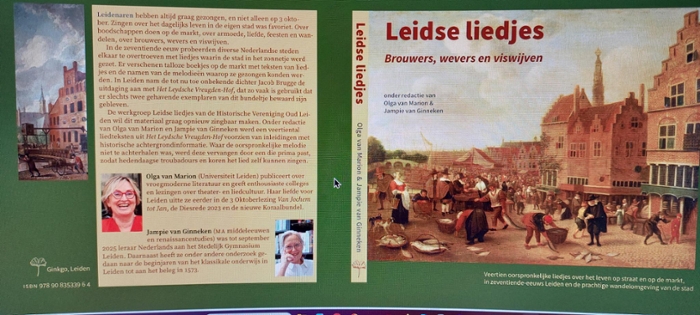
In seventeenth-century Leiden, songs were sung everywhere, from the market to the pub. Some of them were popular throughout the country, whilst others were written especially for Leiden. Together with Jampie van Ginneken, university lecturer Olga van Marion reconstructed fourteen of these local songs and compiled them in the collection 'Leidse liedjes: wevers, vrijers en viswijven' (Leiden songs: weavers, suitors and fishwives).
The Leiden songs come from a seventeenth-century songbook, *Het Leydsche vreughden-hof*. ‘Many urban songbooks were published in those days,’ explains Van Marion. ‘First came Amsterdam, then Haarlem, and in the 1660s three booklets with “Leiden” in the title followed.’ Of these, the *Vreughdenhof* is the most distinctly ‘Leiden-esque’. Van Marion: ‘In some of those collections, Leiden mainly features in the title, but this one contains fourteen genuinely Leiden songs, which are about walking in Leiden, flirting in Leiden or the hard life of the weavers in Leiden.’
The songs therefore constitute a unique historical source on life in Leiden in the seventeenth century. ‘We know all sorts of things about the university and about rich, famous people, but the people featured in this collection are neither famous nor rich,’ says Van Marion. ‘The poet, Jacob Brugge, was probably one of the many refugees who came to Leiden in the seventeenth century and who eventually made up seventy per cent of the population here. He worked as a weaver of ‘saai’, a new, more luxurious fabric. He also wrote about the life he knew. By republishing precisely that, you’re giving people their history back. Suddenly you can see how ordinary citizens experienced their city.’
Piecing together the versions
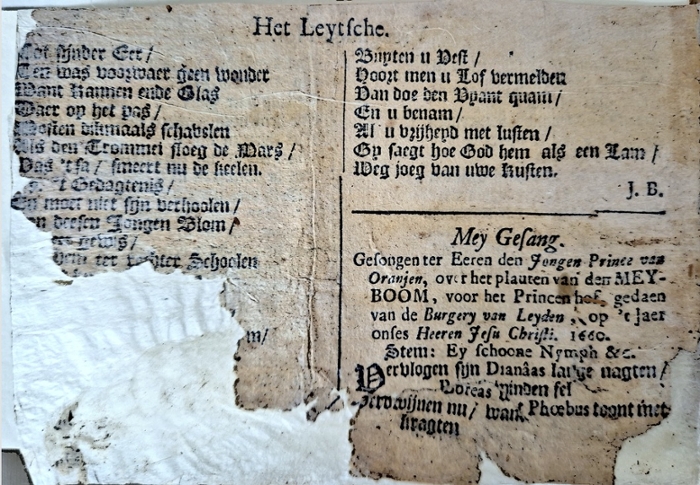
Restoring that history was no easy task. Two copies of the Leiden edition of *Vreughden-hof* still exist: a thoroughly tattered Leiden copy, from which half-pages have in places been torn out, and a slightly better-preserved version from an archive in The Hague. ‘The one from The Hague is typeset incredibly sloppily,’ says Van Marion. ‘Entire lines are missing, which means the songs no longer rhyme.’ The new collection is therefore based on the Leiden version wherever possible.
‘First, a whole working group transcribed the texts,’ explains Van Marion. ‘I then went through the whole thing again with Jampie van Ginneken, who was a teacher at the Stedelijk Gymnasium until last year.’
Adding information
Due to the rhyme and rhythm of the songs, it proved impossible to retranslate them into modern Dutch. Van Marion and Van Ginneken have provided the lyrics with footnotes and introductions. Van Marion: ‘We came across so many things we had to look up. For instance, a song mentioned someone eating a “Rustenburger koek”. Not a single dictionary mentioned what that was. In the end, we asked a historian for help, who told us it must have been a biscuit folded in half with a filling.’
Two musicologists helped with the musical notation of the songs. ‘In the seventeenth century, songbooks never contained musical notation,’ explains Van Marion. ‘The songs were sung to the tune of other, well-known songs. A line such as “Stem: Ei schone nymph” was enough to join in.’ These days, more is required, but according to Van Marion, anyone who can read music can sing along. ‘This is music for everyone.’