
Facility, Organisation
Start of TES System Installation from March 2026
Leiden University is making its buildings more sustainable, including those on the Humanities Campus. An important milestone in this process is the installation of an Thermal Energy Storage (TES) system. After phase 1, in which the Herta Mohr Building was connected to the system, phase 2 will begin in 2026: the buildings on the Doelen side.
From March onwards, work will start on installing the TES system on the Doelen side. Between March and the summer, two wells will be drilled at different locations and then connected by underground pipes. During this period, there will be periods of noise and traffic disruption.
This message provides more information about the schedule and the measures we are taking to minimise the inconvenience.
What is TES?
Thermal Energy Storage (TES) is a sustainable energy system that uses groundwater as a medium for storing thermal energy. In summer, heat is stored in underground wells and used in winter for heating, and vice versa. This results in significantly lower CO₂ emissions and reduced energy consumption, contributing to a more sustainable campus.
Work Schedule
The work will be carried out by De Ruiter Boringen and will take place in three phases:
- Early March – late March: drilling of the first well in the Paterstraatje, near the Hortus botanicus gate
- Late March – late April: drilling of the second well in the Arsenaalstraat, at the location of the parking bay
- April – June: installation of underground pipes between the two wells, via the Cleveringaplaats
Drilling the Wells
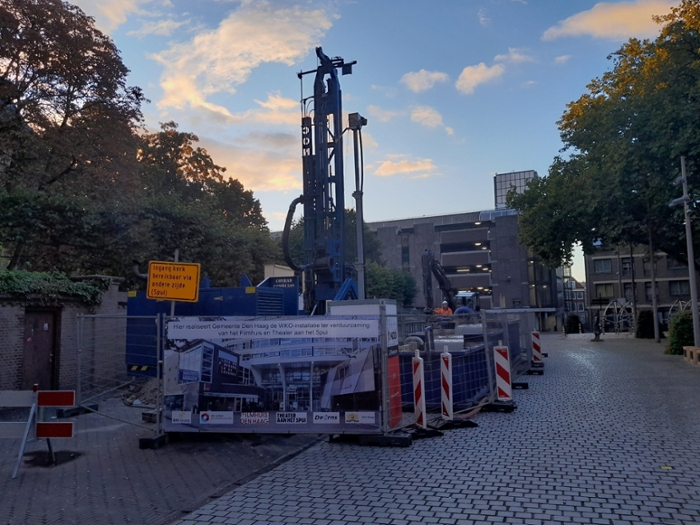
During the drilling works, heavy machinery will be present, including a drilling rig, containers for collecting groundwater and sand, and a crane. This machinery will occupy a large part of the street and involve frequent vehicle movements due to the transport of materials. This may necessitate diversions for cyclists, pedestrians and other traffic. The drilling itself may also cause noise disturbance in the surrounding area.
Installing the Pipes
Once the wells have been completed, De Ruiter will begin installing the underground pipes. The route runs from the Paterstraatje to the Arsenaalstraat, via the Cleveringaplaats (between the Huizinga and Lipsius buildings and past the Reuvens). The work will be carried out in phases to keep traffic disruption to a minimum. All faculty buildings will remain accessible on foot and by bicycle throughout the works. Diversions will be clearly signposted, and staff and students will be informed of any changes to traffic routes through faculty communication channels.
Minimising Disruption
We are taking various measures to reduce noise disturbance as much as possible—particularly during the drilling of the wells. The planning of the works takes exam periods into account. In January, the IFZ department will contact users of the buildings where the most noise is expected. Where possible, teaching and other activities will be moved to alternative buildings as a precaution. Temporary alternative workspaces will be available for staff who experience disruption.
Contact
If you have questions about the works, please contact info@humanitiescampus.nl. From the start of the works in March, the contractor will also be available to answer questions or address concerns from local residents, staff and students. Weekly drop‑in sessions will be organised in the Huizinga Building. More information will follow in due course.