Lecture | VVIK lecture
The Cosmos Malabaricus programme: researching early modern Kerala through Dutch sources
- Date
- Wednesday 17 December 2025
- Time
- Explanation
- The lecture will be followed by drinks in the LIAS common room of the Herta Mohr Building (first floor)
- Address
-
Herta Mohr
Witte Singel 27A
2311 BG Leiden - Room
- 1.80
Abstract
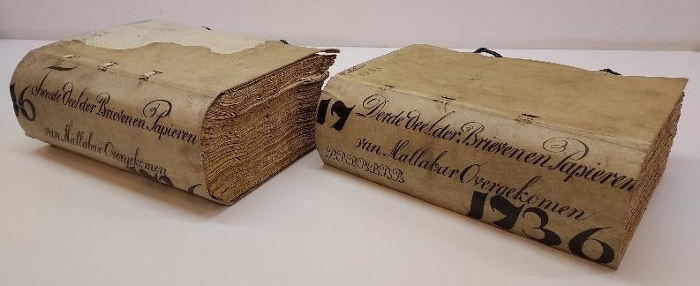
At this lecture, four history students from Kerala will speak on political culture, caste, slavery, and information gathering in eighteenth-century Kerala (or Malabar), based on their research in the archives of the Dutch East India Company (VOC). These students are presently participating in the Cosmos Malabaricus programme of Leiden University's Institute for History, which provides Indian historians with the linguistic and archival skills to use VOC documents for studying India's history. The speakers, each presenting their research for about ten minutes, and their topics are the following:
Anjana Aby examines a language translator serving the VOC in Kerala in the early eighteenth century, named Cornelis van Meeckeren. After introducing Van Meeckeren, Anjana explores his methods to gather information in Kerala and considers his significance for the Dutch presence there, zooming in on his work Korte beschrijving van de landen van Malabar (Short description of the lands of Malabar).
Based on VOC records, Lija Mary Kambakkaran Joseph investigates the Mukkuva coastal fishing community in eighteenth-century Kerala. Lija reconstructs the dual jurisdictions, internal leadership structures, and occupational roles that differentiated Christian and non-Christian Mukkuvas. She argues that VOC governance produced uneven mobility and new hierarchies within this community, revealing a dynamic interplay of caste continuity and colonial restructuring.
Drawing on a land register of the Pappinivattom area in central Kerala, compiled by the VOC between 1761 and 1769, Meenu Rabecca Mathai discusses what obstacles and opportunities historians encounter when they try to reconstruct the lives of enslaved local people listed in such documents.
Sailaja Mundakkal analyses the complex relationship between the VOC and the king of Cochin in the late eighteenth century, the penultimate days of Dutch in Kerala. Employing a case study of the murder of a VOC-allied merchant, Sailaja explains the fragility and power dynamics of both parties. Thus, she elucidates the VOC's response to the changing socio-political scenario of Kerala at this time.
The lecture and the Cosmos Malabaricus programme will be briefly introduced by Lennart Bes, who researches Indian and Dutch overseas history at Leiden's Institute for History.