
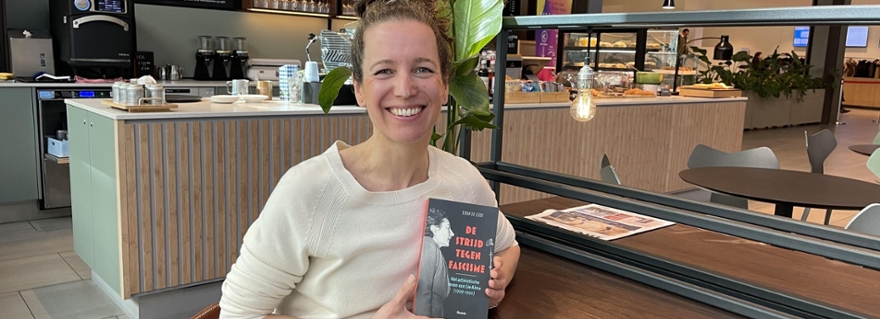
‘History has long been written mainly from a male perspective’
Historian Seran de Leede delved into the life of Lie Alma (1909–1990), the courageous woman from the Dutch province of Drenthe who spoke out against fascism in the 1930s and remains a source of inspiration to this day.
For her book on Lie Alma, The Struggle Against Fascism (De strijd tegen fascisme), researcher Seran de Leede of Leiden University delved into letters, archive boxes and histories that had scarcely been told.
Lie’s daughter, now 85, had kept an archive about her parents. Seran said: ‘For days, weeks, I sat at her kitchen table with her daughter, deciphering everything with a magnifying glass. Sometimes history is literally lying in a box in the attic, waiting for someone to look at it again.’
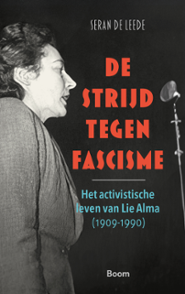
The discovering of Lie Alma
Teacher and author Seran de Leede wrote short biographical sketches years ago about Dutch people involved in the struggle against fascism during the Spanish Civil War, for the International Institute of Social History’s platform Spanjestrijders. ‘While writing Lie’s biographical profile, I discovered that her life had far more to tell than could fit into a short piece,’ Seran says.
Lie Alma was active in a range of anti-fascist committees, travelled to Spain several times during the Spanish Civil War, spoke out publicly at international women’s (peace) conferences, and was imprisoned by the Germans during the war. ‘That was when I thought: this is not only an interesting individual, but also an entry point into a part of history that many people do not know.’
Continuing her education was far from a given
Lie Alma grew up in the peat region of the Dutch province of Drenthe, in a modest family with little money. Continuing her education was far from a given, but through, among other things, schooling at a convent school, she nevertheless managed to develop into a striking voice within the left-wing and anti-fascist circles of the 1930s. ‘I find that remarkable in itself: that someone from such a background not only broke free from her circumstances, but also grew into a well-known figure in political and social circles. It speaks to enormous dedication.’
Practical courage
What made her so remarkable, according to Seran de Leede, was her combination of idealism, intelligence and courage. ‘She was highly articulate and knew how to persuade people - it was no coincidence that she played a role as a propagandist and spokesperson. What perhaps struck me most was her practical courage. At times, she had to act incredibly quickly.
During the war, for example, when there was a raid and a Jewish brother-in-law was hiding in the attic behind a hatch. She poured the men coffee and started chatting about everyday things, after which they left without searching the house. Moments like that show that courage does not always have to be grand or heroic; sometimes it lies precisely in quick thinking, reading people well, and refusing to be intimidated.’
She did the same in prison, Seran says. Lie received notes from her husband during his visits and managed to smuggle them in hidden in a handkerchief via the commandant’s room. ‘Without batting an eyelid - that really took nerve. My book is full of examples like that.’
Role of women
Lie’s life shows how active women were in the struggle against fascism. Seran says: ‘And yet this has remained underexposed in the collective memory. Of course, historical research has been done on women in the resistance and in political movements, but in the broader public imagination they still often fade into the background. The focus tends to be on male leaders, male fighters, male networks. Even though women, too, organised, travelled, wrote, mobilised and took risks.’
Not wait until it was too late
Lie Alma’s story also speaks to the present day. ‘I think her life shows how important it is not to look away when democratic values are under pressure. It troubled her that other governments remained silent. She believed you should not wait until it was too late, but speak out. That, I think, is precisely what still makes her relevant today.’
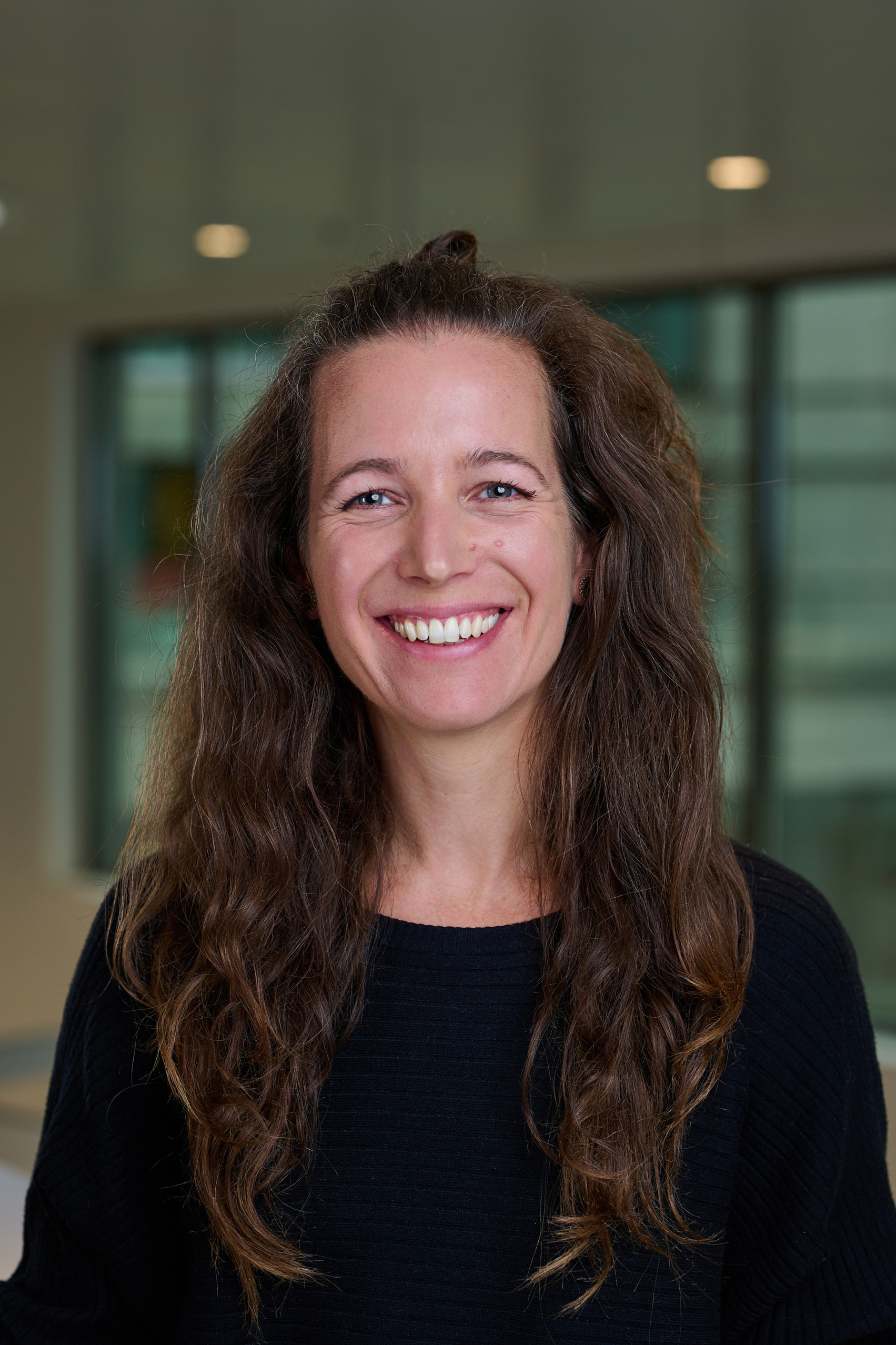
Research on gender and extremism
In her academic work, Seran de Leede also focuses on gender and extremism. For years, she has studied how women’s roles in contexts of political violence are often underestimated or misunderstood.
‘We still associate violence and extremism more readily with men. As a result, women are either overlooked or seen mainly as victims. Historically, something similar happened: women were there, but their role often received less emphasis, partly because history was long viewed through a male perspective.’