
What is the role of protest in academic debate?
Protest is a human right and an important way to hold the authorities to account. But how does the right to protest relate to academic freedom and the right to education? That’s what students and staff discussed on 22 April. ‘It’s a balancing act.’
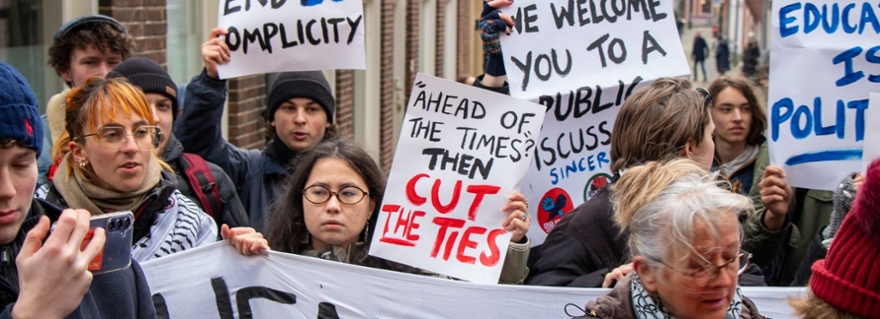
Fierce protests and even occupations of university buildings: in recent years, passions have frequently run high on campus, with demonstrations about, for example, securitisation, the fossil fuel industry or collaboration with Israeli universities. What is the role of protest, and how does this relate to academic freedom? That was the question moderator Pieter Slaman asked a small group in the Wijnhaven building in The Hague.
Occupation of Academy Building
Several participants mentioned the disruption to last year’s Cleveringa Lecture on 26 November. Pro-Palestine protestors occupied the Academy Building for hours, forcing Cleveringa Professor, Hélène Landemore, and the audience to decamp to Leiden Law School. Some participants expressed understanding for the protest, whereas others felt it went too far.
Balancing act
‘The right to protest is a balancing act’, said legal scholar Rowie Stolk during the plenary. Protest is a human right and a fundamental tool of expression in a democracy. It’s a way to call authorities to account, which is why authorities must facilitate demonstrations.
But there are limitations: demonstrations should not be violent or disruptive. Nor, for example, should they endanger public health or restrict other people’s freedom to too great a degree, said Stolk. ‘But opinions are divided on the question of what is too disruptive. It’s a grey area.’
Right to education
A biomedical sciences student said it is important to be able to demonstrate at the university, but that protests go too far if they disrupt other people’s lectures and exams, because that impacts their right to education. What if the university were to designate specific spaces for demonstrations? she asked.
Another participant felt protests go too far if students and staff feel unsafe in their building. The only thing then, a staff member noted, is whether demonstrators would be heard if they assembled ‘really politely’.
Role of silence
Assistant Professor Gerlov van Engelenhoven conducts research into the role of silence in protest, and how, for example, activists use silence as a form of protest by demonstrating in silence. In his plenary introduction, he spoke about the importance of demonstrators being heard.
‘We often forget to take the time to listen to each other and just hold our tongues. You also see the tone police making an appearance at demonstrations: critics who think demonstrators are too soon to adopt an angry tone.’ He called on university leaders to take demonstrators more seriously and to respond more specifically to their concerns and protests.
Uncomfortable discussions
An international student said they felt it was a shame that, with around a dozen students and staff, so few people had come to the meeting. ‘This is a nuanced discussion. Perhaps that’s why it hasn’t attracted a crowd.’
The format chosen was suited to people who do not agree. The participants first had the opportunity to express their opinions in groups, without interruption. Then they could ask each other questions about these viewpoints.
‘Protests can be disruptive as long as they add to the debate and aren’t violent’, said a policy adviser.
‘Good discussions don’t have to be comfortable’, a researcher responded. ‘But if you only shout and don’t engage with the other side, a protest soon loses its point. Then it’s not a dialogue. Is that what we want at a university?’
Community. Conversation. Connection.
Global tensions are also making themselves felt within our university community. We want to reverse this trend. That is why we are making room this academic year for lectures, debates and meetings about today’s hot-button issues: war and peace, intolerance, human rights, polarisation, securitisation, climate and more.
Let’s get together and listen to each other. Let’s hold an open debate. This is, after all, the beating heart of our university. It’s fine to disagree, as long as we treat others and their views or beliefs with respect.
We are inviting all members of our community to take part in Community. Conversation. Connection. You are welcome to sign up for an event – or to organise your own. Keep an eye on our events calendar for more information.