
What wild honey from the Philippine jungle reveals about biodiversity
In the Philippines, Indigenous communities have been harvesting wild honey for centuries. A new chemical analysis of this honey now provides insights into the biodiversity of the region. ‘And an additional reason to protect the national tree properly,’ says lecturer Merlijn van Weerd of the Centre for Environmental Sciences (CML).
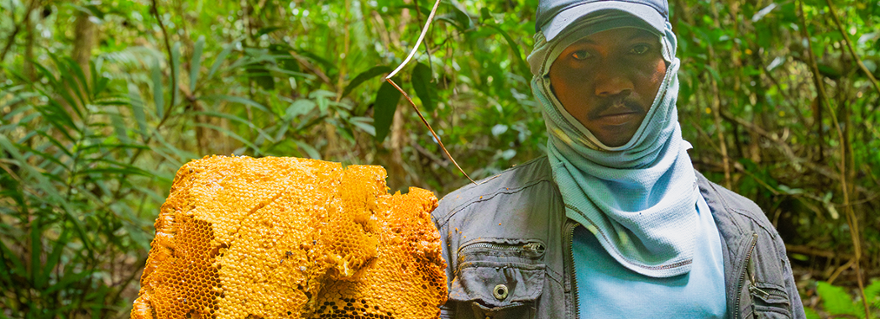
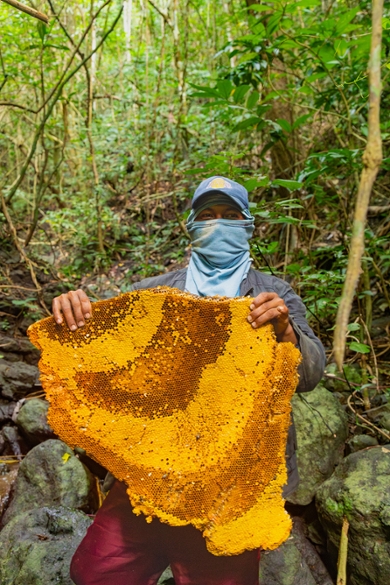
Palaui, a small Philippine island covered in tropical forest, is one of the homelands of the Indigenous Agta people. Here, they have traditionally collected wild honey in a sustainable manner as a source of both food and income. This honey is popular in the Philippines and is known for its medicinal properties. As a result, other traders also claim to sell wild honey, but in reality often adulterate the product.
To determine what qualifies as pure Philippine wild honey, Van Weerd and a group of scientists from the University of the Philippines investigated its characteristics. ‘We collected wild honey from three different islands and subjected it to chemical analysis,’ he explains.
Measuring biodiversity in honey
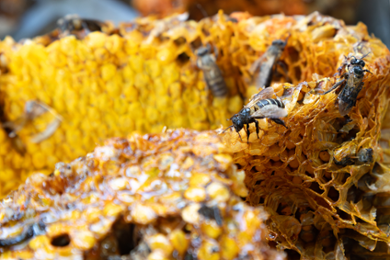
In the honey, the researchers looked for metabolites—small molecules that can be linked to the plant species from which bees collect nectar. ‘On the one hand, this allows us to identify the nectar sources used to produce the honey,’ says Van Weerd. ‘On the other, the honey reveals which plant species occur in the area: a kind of chemical fingerprint of the local flora.’
The analysis of honey from two of the three test locations in the Philippines shows that bees collect nectar from a range of plant species—so-called multifloral honey. The honey from the island of Palaui, however, consists predominantly of one unique metabolite: hypaphorine. ‘This compound appears to originate from the narra (Pterocarpus indicus), the national tree of the Philippines.’
National tree under severe threat
The finding that Palaui honey is monofloral—thus largely derived from a single tree species—came as a surprise to the researchers. ‘Apparently, the bees have a strong preference for this species. It demonstrates how important narra trees are for local biodiversity and for the Indigenous community that depends on harvesting this honey.’
Unfortunately, the species is under pressure. Its hardwood is highly sought after, particularly for furniture. ‘Although it is now illegal to fell narra trees, very few remain in the country. Only on Palaui, where little logging has taken place, are they still abundant. We are therefore keen to support the local population in protecting the species. The results of this research can contribute to that effort.’
A long-standing commitment to the Philippines
The new analytical technique for honey could also be used elsewhere in natural areas to provide insights into which (threatened) species are present. Over the coming years, Van Weerd will continue to focus primarily on the Philippines. ‘I have been conducting research here for more than twenty years. In 2003, together with Dutch and Philippine colleagues, I established a foundation to help protect local nature in various ways,’ he explains.
‘We are involved in reforestation projects, in which planting narra trees plays a central role. In addition, we assist in securing land rights for Indigenous communities, enabling them to become stewards of their land and better protect it.’
Actively making a difference as a scientist
Van Weerd’s foundation is dedicated to scientific research, nature conservation, and collaboration with Indigenous communities. ‘This has led to a great deal of interdisciplinary research, which we are now also incorporating into a new Leiden bachelor’s programme in collaboration with anthropology.’
For Van Weerd, combining his role as a lecturer with active conservation work is entirely logical. ‘In environmental science, you describe what is going wrong on the planet. That is essential, but I do not want merely to observe and then stand by powerless. By taking action yourself, you can genuinely make a difference at the local level.’
Read the scientific publication in Nature Scientific Reports.