Luris turns 20: ‘Our research drives real-world impact and innovations’
It’s been exactly 20 years since Luris first began working with Leiden’s researchers and students to create an impact on society. To celebrate this anniversary, staff look back on their most memorable projects. Spoiler: they all had difficulty choosing one single project.
There are many highlights from Luris’s first 20 years, says current director Anouschka Versleijen. ‘Luris offers expert support to researchers at the university who want to set up a research project with external partners or communicate their results to the outside world. This could mean launching a spin-off or undertaking activities that forge connections with the cities of Leiden and The Hague. That’s something we actively promote – together with the faculties and institutes. We have a great relationship with the Luris LUMC Chamber, having introduced the new Regulations on Knowledge Exploitation and Working with Third Parties together this year.’
Jessica Meijer, Head of Innovation & Business Development
‘One project that stands out for me is the #Democracyinaction Horizon 2020 consortium, which focuses on increasing political participation, particularly among the young. The good thing about this consortium is that it works with special partners: grassroots organisations that do something with theatre or virtual reality, for example. It’s a great initiative with two principal investigators from Leiden. Leading such a big consortium isn’t easy. What some researchers may not know is that you can request project management support: the Leiden Research Support Network has a pool for that. My Luris colleague Elka Smith is the #Democracyinaction project manager and does incredibly important work behind the scenes, without seeking the spotlight.
‘What some researchers may not know is that you can request project management support.’
‘I also want to mention the Resona Labs start-up for which – with Luris’s help – Faculty of Social and Behavioural Sciences researchers Diego Arize, Mariska Kret and Iza Korsmit recently received a Dutch Research Council (NWO) Take-off 1 grant. Arize and his team have created a digital environment to help regulate your emotions and an app where people can express their thoughts. The idea is based on research that helps people feel better.’
Sara Cigna, Senior Business Developer Life Sciences
‘A project that I would like to put in the spotlight is the LED3 (Leiden Early Drug Discovery and Development) hub, a joint effort of Luris supporting and coordinating the creation of this partnership between Leiden research institutes LIC, IBL and LACDR. Academics from these institutes have always collaborated, but today their collective impact within LED3 is becoming more visible and shaping a stronger future together. This network is more than a research initiative—it actively engages students, hosts an annual symposium, and sustains an ongoing lecture series, making it a vibrant platform that enhances collaborations and builds a lasting academic legacy. I’m happy and proud that LED3 now has legs and is able to expand.
I also want to mention the license with the start-up Azafaros, which is developing a drug candidate for rare and severe metabolic disorders. We recently celebrated the start of the phase 3 clinical trial. That really is a great achievement, and a demonstration of how Leiden’s research drives real-world impact and innovations.’
Alexander Mouret, Senior Innovation Manager
‘In my role, I’m proud of the wide range of outreach and public engagement activities we’ve developed as Luris over the past 20 years. I think it’s essential to make visible what the university and the LUMC are doing. That increases understanding of our mission and attracts interesting new collaborations.
‘I’m proud of the wide range of outreach and public engagement activities we’ve developed as Luris over the past 20 years.’
‘One example I’d like to highlight is the Dean’s Challenge, where we invited all the deans to formulate societal challenges that interdisciplinary student teams then worked on to develop solutions to – a fantastic collaboration with the Ministry of Foreign Affairs. Luris also helped set up the Leiden Discoveries route, which takes the general public on a tour of historical and contemporary breakthroughs in Leiden and at the Leiden Bio Science Park. Then there’s the Brave New World Conference, which Luris organised, where artists and researchers explore the future impact of new technology on society. It’s been a highly successful conference with many speakers from Leiden and abroad for ten years now.’
Marieke van Haaren, Learning with the City project manager
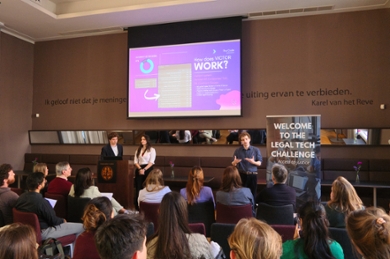
‘Nearly all my colleagues support researchers, but my role involves public engagement in our teaching, by getting students to work on societal challenges. One example is last year’s Legal Tech Challenge, where law students from our university and the University of Applied Sciences Leiden worked on real-life cases. For the Municipality of Leiden, one of the teams came up with an app that makes it easy for residents to see which benefits they’re entitled to. The municipality is now looking into whether they can actually develop the app, and the students are even in touch with the Ministry of the Interior and Kingdom Relations to explore the options for a nationwide app.
‘Another great example is a new LDE minor that started last year: Co-creating a Healthy Society. Students from the universities of Leiden, Delft and Erasmus worked with senior secondary vocational students on an intervention that helps improve their mental health. That co-creation is really impactful: by collaborating, the students learn from and with one another.’
What former Luris directors have to say
Having already launched the Technology Transfer Office at Edinburgh University, Bob Smailes was asked in 2005 to help set up Leiden University Research & Innovation Services, now simply Luris. ‘The LUMC came on board in 2009. By the late 1990s, the university had an active task force drawing the government’s attention to the subject of knowledge transfer, and at the start of the millennium, knowledge transfer was designated as a core task for all Dutch universities and university medical centres.’
Former Luris director Ivo de Nooijer was a leading proponent for the creation of PLNT, the Leiden centre for innovation and entrepreneurship. ‘An innovation and entrepreneurship hub is essential to developing an ecosystem. PLNT provides entrepreneurship skills training and programmes for students and academics wishing to start a new venture. I’m proud of PLNT – it’s a vibrant hub in the heart of the city, where we give serendipity a nudge by creating a space where people who are passionate about entrepreneurship can meet, share ideas and develop the most ambitious of plans.’
Venture capitalist and born entrepreneur Rob Mayfield started at Luris as Head of Business Development before taking over from Ivo de Nooijer. He initiated investment activities for Libertatis Ergo Holding B.V. (LEH), the university subsidiary. ‘By creating a dedicated team at LEH, we’ve been able to actively support and fund start-ups and spin-offs in Leiden.’
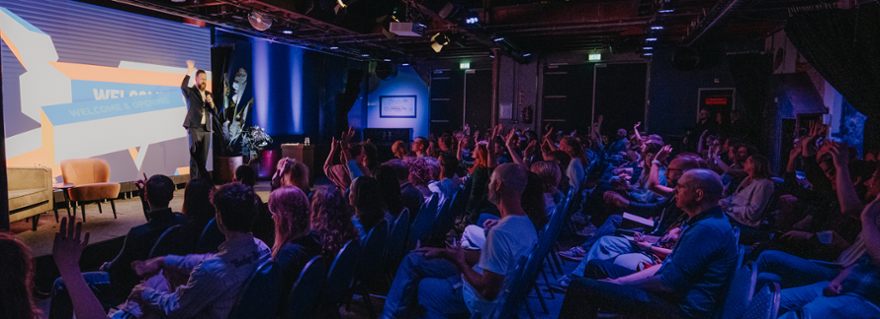
Banner: Brave New World 2025, photo by Annick Elzenga