
What does AI mean for our education? Report and follow-up on the FGW symposium on January 29, 2026
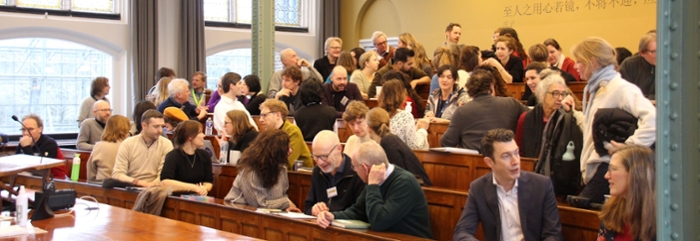
During the symposium we discussed this rapidly developments in the age of AI and their consequences for our teaching. After an interactive opening, followed by a keynote speech by Bas Haring, roundtable discussions and poster presentations, we explored how AI influences our academic values, skills, education, and testing. We shared insights, experiences and questions from both teacher and student perspectives. The symposium provided a broad and lively platform for joint reflection on the place of AI in our education system. Below you will find a detailed report of the symposium. A short report can be found here.
Interactive discussion
The symposium began with an interactive discussion focused on the following question:
What question about AI in Education would you like to explore during this symposium?
The participants’ answers to this question can be found here.
Keynote Bas Haring
After the discussion professor Bas Haring gave the keynote, which related his experience of having a Master’s thesis supervised by AI. This keynote provoked many questions and comments from the audience.
Roundtable sessions and panel discussion
After the keynote, participants attended a roundtable session or panel discussion. You can find the summary of each session here.
Panel overview
Roundtable LUCA
During this hands-on session, the history of the AI platform were discussed, after which the discussion turned to how to create AI agents on this platform. The emphasis was on having clear learning goals and whether or not using AI can be a part of obtaining those learning goals. Participants suggested several scenarios, from generating mock exam questions, a bot that activates students to create their own mock exam questions and answers, a bot that ensures students keep reading and a bot that helps students give peer feedback. This last scenario was worked out a bit further, with added emphasis on the importance of learning goals that can be fed to the bot, and the fact that with giving and receiving peer feedback, the social/interpersonal aspects are very important.
Roundtable AI and assessment
Participants voiced worries about the overuse of AI in take‑home assessments, noting that even ‘harmless’ AI support can erode key academic skills and that current assessments may focus too heavily on products only rather than on the learning process. They suggested solutions such as combining written work with oral components, using more group and reflective tasks, experimenting with creative assessment formats, and making take‑home work preparatory rather than graded. Overall, the need was stressed for diverse assessment methods, meaningful incentives for student engagement, and programme‑level dialogue. Discussions should focus primarily on constructive pedagogy, not fuelled by mistrust. AI mainly exposes existing challenges.
Mare also wrote about this roundtable session. You can read their report here (in Dutch).
Here you can find the notes of this session.
ECOLe’s website section on Measures against misuse of AI in assessment
Roundtable Futures Thinking
During the Futures Thinking session, participants explored the “cone of possibilities”: a method of exploring diverging futures, from the most likely to the most desired. Using a scenario for a campus in 2036 participants explored not only what can happen, but more importantly what emotions these imagined futures invoked. This exercise made visible how technology, AI and changing educational practices can influence daily reality.
Further, the participants discussed a “preferred future” for the Faculty of Humanities. Lecturers and students need to have the possibility to choose whether or not they use AI, while a continuous dialogue between technical and educational experts and teachers is essential. Participants also noted the importance of European AI alternatives and developing our own tools. Above all the question remains: what are our values as faculty of Humanities and how do we maintain these in a future with AI?
Panel discussion Student perspectives on AI in education
Three students with different perspectives on AI responded to three statements. The perspectives ranged from progressive to critical about the use of GenAI in education. The students agreed that it is not possible to imagine AI to not exist anymore: “it won't go back into the black box”, but we need to remain skeptical about whether it has added value in education.
Statement 1: Is it clear which rules regarding the usage of AI exist about what you can and can’t do during your studies?
The first statement related to faculty rules for students. The students agree that the rules and regulations are unclear to students for several reasons. Some students are not familiar with the rules or regulations. Other students are afraid to be accused of using AI even when they write their own texts. Are you allowed to use Grammarly? Unclear regulations lead to insecurity for students. One panel member sees the possibilities of AI, particularly for removing language barriers from sources written in a language that you don't speak for your research or to improve your writing. All students agree that the emphasis should be on the question why you would or wouldn't use AI in your studies.
Statement 2: Teachers should not be allowed to use AI to generate exam questions or to check exam questions while supervising students
The students agree that the teacher as the human in the loop has to design the course and teach it. This is also the case for creating and assessing exams. The progressive student panel member sees possibilities for both students and lecturers to profit from using AI in education. For example, if the lecturer's time and attention can go to discussing the contents of an essay rather than giving feedback on grammar and spelling.
I am confident that the current state of AI in education, and the trajectory in which it is going, will have a positive impact on the quality of education
The students warn for the harmful effects of using GenAI. As a student, letting GenAI do your assignments does not teach you anything. Right now, they agree GenAI does not have a positive impact on the quality of education. The faculty community has to keep to its assignment to educate critical students who can think, analyse and argue without the use of AI. They do agree that we cannot stay behind and that the use of GenAI has to be studied reflectively.
Statement 3: What would be your advice to the university regarding its future and AI?
The students advise sustainable use of GenAI by the faculty. The students want skills like writing to be tested on location. An oral defense of an essay is also an option, according to one of the panelists. The most important message is that degree programmes give enough attention to why or why not use AI and that pedagogy and didactics are at the forefront.
Lunch and poster presentation
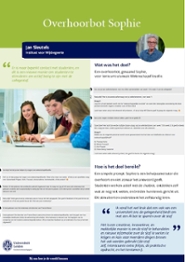
During lunch there was a poster presentation about all AI pilot project within the faculty. Most pilots use the university platform LUCA, which allows lecturers to experiment with conditioning chatbots specifically for their students and their courses in a safe environment.
Have a look at the posters to learn more about the AI pilots at the Faculty of Humanities:
- Door studenten gemaakte Stoïcijnse bots
- Ethics Exam Preparation Assistant
- Chatbot Domenico
- LULA Leiden University Language Assistant
- History Research Guide
- Lela Groen
- Pylinguist
- Overhoorbot Sophie
- AI and the Humanities
- Mylingua
- Greek and Roman Philosophy Exam Prep Bot
You can find more information about LUCA under Tools and facilities: AI platform LUCA. Are you interested in doing a pilot or do you want more information? Let us know via ecole@hum.leidenuniv.nl.
Closing discussion
The symposium ended on a plenary discussion, where lecturers were invited to share their message on AI and education with the faculty, by completing the following sentence:
The key message I want to share with the faculty about AI in education is…
An overview of all responses can be found here.
Follow-up
The faculty wants to keep pay continuous attention to AI in education in the ensuing period. It is clear that Humanities lecturers are deeply engaged with this topic. The following topics have been put on the agenda:
- The faculty is working on guidelines/frameworks for lecturers.
- We will organise more workshops where lecturers can learn about (using) AI in education. The roundtable session AI and assessment will be organised again.
- Lecturers, degree programmes and exam committees can contact ECOLe about AI advice and support when designing and organising assessments and teaching.
- ECOLe will share examples of AI-resistant assessment with the faculty.
- ECOLe will further analyse the attendees’ input during the symposium and will follow-up where necessary.