In memoriam: Takamitsu Muraoka (1938-2026)
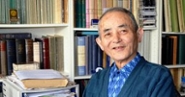
On February 10, 2026, emeritus Professor Dr. Takamitsu Muraoka (1938–2026) passed away, one day after celebrating his 88th birthday. From 1991 until his retirement in 2003, he held the chair of Hebrew Language and Culture, Israelite Antiquities, and Ugaritic at Leiden University.
Early December 2025, Keiko, his wife of sixty years, died, which came as a terrible blow, and on Christmas Day 2025 Muraoka himself suffered a stroke, from which he never fully recovered.
The Muraoka family lived in a rural village in the Kagoshima Prefecture, in the far South of Japan. Muraoka’s father was a high-ranking officer in the Japanese military and envisioned a career for his son as a diplomat. The young man, however, much preferred the humanities and chose to read English philology and subsequently Biblical languages and literature (Hebrew, Aramaic, and Greek) under Professor Masao Sekine at the Tōkyō Kyōiku University (nowadays University of Tsukuba). As a student he would occasionally visit his parental home; traveling by train from Tokyo at the time took about thirteen hours – a trip that he found pleasant and interesting, even more so than when later on the trains gradually became faster. In 1964 he went to study at the Hebrew University of Jerusalem (Israel) under various renowned Hebraists and Semitists such as E.Y. Kutscher, C. Rabin, S. Talmon and M. Goshen-Gottstein; that is where he acquired complete fluency in Modern Hebrew.
In 1970 Muraoka defended his Ph.D. dissertation, which was eventually published in a revised expanded version as Emphatic Words and Structures in Biblical Hebrew (Jerusalem/Leiden 1985). His dissertation would mark the beginning of a long and remarkable career in Semitic and Biblical philology, lexicography, and linguistics (Biblical and Qumran Hebrew, various types of Aramaic, and Septuagint Greek), with a special focus on syntax. The impressive depth and variety of his knowledge, combined with an indomitable working ethic, would earn Muraoka international fame and recognition as one of the world’s greatest scholars in the field.
Immediately after defending his dissertation in 1970, he was appointed as a Lecturer for Semitic Languages at Manchester University (UK). From 1980 to 1991 Muraoka was a full professor of Middle Eastern Studies at Melbourne University (Australia). In 1991 he came to Leiden University (The Netherlands) to take the chair of Hebrew Language and Literature, Israelite Antiquities, and Ugaritic, a post he would hold until his retirement in 2003. Upon arrival in Leiden, he amazed his students by teaching in Dutch from the very start. The present writer remembers a scene during one the first classes on Hebrew epigraphy. As we were reading the Shiloam inscription, Muraoka asked us about the meaning in Dutch of the word garzen. Convinced of his ignorance, we informed the professor that it meant bijl (‘axe’). The professor hesitated for a moment and said: ‘Een bijl? Hm, weet u zeker dat het geen pikhouweel is?’ (‘An axe? Hm, are you quite sure it isn’t a pick-axe?’) Of course the professor was right and the students were amazed at the level of preparation of their newly-arrived teacher.
Muraoka was the editor of the journal Abr-Nahrain (1980–1992) and co-edited several volumes on various aspects of Hebrew, Aramaic, and Greek. In 2017, he was awarded the Burkitt medal by the British Academy for his “outstanding contribution to the study of Hebrew grammar and syntax, and the Septuagint”. His academic publications are far too numerous to be listed here in full. A complete bibliography for the period 1964–2001 was published in the Festschrift for his sixty-fifth birthday, Hamlet on a Hill (2003:631–44). The otium he enjoyed after his retirement as a Leiden Professor in 2003 enabled him to keep working with unremitting zeal on further major publications. Among his more recent works should be mentioned A Greek-English Lexicon of the Septuagint (2009), A Grammar of Qumran Aramaic (2011), An Introduction to Egyptian Aramaic (2012), Classical Syriac for Hebraists (2nd ed., 2015), A Biblical Aramaic Reader with an Outline Grammar (2015), A Biblical Hebrew Reader with an Outline Grammar (2017), Jacob of Serugh’s Hexaemeron (2018), A Syntax of Qumran Hebrew (2020), Wisdom of Ben Sira (2023), The Book of Judith (2025). It is worth pointing out that several other bulky works are still under way and will hopefully be published posthumously.
In Muraoka’s private life, there was another major project to which he devoted much of his time and energy. His viewing of the famous 1957 film The Bridge over the River Kwai in 1970 for the first time opened his eyes to the dark pages of his own national history and the atrocities committed by the Japanese military forces. The film tells the story of the Thai-Burma railway, when many prisoners of war were forced to do hard labour, which led to the loss of tens of thousands of lives. The experience had a profound influence on his view of Japanese militarism and led to a fateful decision. After his retirement from Leiden University in 2003 he made a point of giving yearly lecture series on biblical languages and the Septuagint for at least a month at Christian seminaries – Muraoka himself was a devout Christian – in various Asian countries that had suffered under the Japanese occupation, including South Korea, Indonesia, Singapore, Hong Kong, Shanghai, and the Philippines. (As of 2021 he did the same online.) He also edited and translated into Japanese the personal memoirs of Evert Willem Lindeijer (1908–1981), a Dutch science teacher and medical orderly from the Dutch East Indies, who was held as a prisoner of war in camp Hakodate Ohashi, near Kamaishi (Iwate, Japan), during World War II and was forced to work in the iron mines there. This ego document deeply impressed Muraoka, since despite the hardships described it contained not a single reproach towards the Japanese. The book was published in Japan as ネルと子供たちにキスを―日本の捕虜収容所から(Kisses to Nel and children. From a Japanese Prison Camp; Tōkyō: Misuzu Shobō, 2000). It was subsequently used as the basis for a musical staged by pupils of a high school in Kamaishi in 2004. In 2015, Muraoka attended a Wednesday Demonstration for Japanese military comfort women victims held in Korea, on which occasion he spoke the following words:
The history of the Japanese military inflicting wounds on you and trampling your dignity as human beings is the history of my homeland, and I bear responsibility as a Japanese citizen. (…) As a Japanese citizen, I feel nothing but shame and intense anger at the current government's actions that worsen the wounds of the victims.”[1]
In 2000 Muraoka was also co-founder of the “Dialogue Netherlands-Japan-Indonesia Foundation”. On his long-term endeavour towards international reconciliation Muraoka published a personal testimony, entitled My Via Dolorosa. Along the Trails of the Japanese Imperialism in Asia (AuthorHouse, UK, 2016).
Takamitsu Muraoka will be remembered by his former colleagues and grateful students as a devoted teacher, a faithful mentor, a scholar of well-nigh unfathomable learning, and a remarkable human being.[2]
Martin F.J. Baasten
Leiden University, 17 February 2026
[1] Seoul Economic Daily, February 14, 2026 (https://en.sedaily.com/politics/2026/02/14/japanese-scholar-who-apologized-to-comfort-women-victims).